
The NC City That Stopped Sending Police to Minor Car Crashes
Clip: 10/27/2026 | 7m 28sVideo has Closed Captions
Wilmington, NC, has sent civilians instead of officers to minor crashes since 2007.
Nearly half of North Carolina law enforcement agencies surveyed in 2024 reported vacancy rates above 10%. A property damage crash can tie up a patrol officer who has somewhere else to be. Wilmington handed those calls to civilian investigators back in 2007, and since a 2023 state law, other departments have started doing the same.
Problems playing video? | Closed Captioning Feedback
Problems playing video? | Closed Captioning Feedback
ncIMPACT is a local public television program presented by PBS NC
The NC City That Stopped Sending Police to Minor Car Crashes
Clip: 10/27/2026 | 7m 28sVideo has Closed Captions
Nearly half of North Carolina law enforcement agencies surveyed in 2024 reported vacancy rates above 10%. A property damage crash can tie up a patrol officer who has somewhere else to be. Wilmington handed those calls to civilian investigators back in 2007, and since a 2023 state law, other departments have started doing the same.
Problems playing video? | Closed Captioning Feedback
Where to Watch ncIMPACT
ncIMPACT is available to stream on pbs.org and the PBS app.
Providing Support for PBS.org
Learn Moreabout PBS online sponsorship- If you get into a car crash in this city and call 911, there's a good chance police won't show up.
Instead, it'll be someone like Stanley Pollock, a civilian who's been doing this for nearly 20 years.
- Come and talk to me, yeah.
- Wilmington's had this program since 2007, so why haven't more places tried it?
We ride along with Stanley to see what's working and why more agencies aren't doing the same.
I'm David Hurst.
This is "ncIMPACT."
[light music] - Go ahead.
[driver speaks faintly] - Yeah, this is Queen Street up here.
- [Driver] The cars, these cars down here- - [David] After nearly 20 years in this role, Stanley Pollock has pulled up to thousands of crashes just like this one.
- All right, what I need, I need your driver's license, your registration, and proof of insurance.
- [David] At first glance, Pollock may look like he's a police officer, but he's not.
He can't make an arrest or write you a citation.
But if you've been in a fender bender in Wilmington sometime in the past two decades, there's a good chance he's shown up.
- My first wreck yesterday morning was right at this intersection, six o'clock in the morning.
- [David] Pollock used to work in law enforcement back in his home country.
When he moved to North Carolina, Wilmington was starting something new, something called the Civilian Crash Investigator Program.
Pollock was the first person hired.
- After doing it for some time, I think I'm at the point where I can close my eyes and press those keys, you know?
- [David] The paperwork may come second nature, but Pollock will tell you that the job is about more than just filing reports.
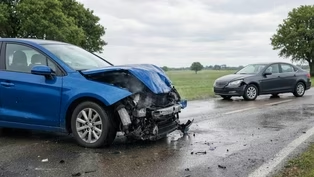
Civilian crash investigators respond to minor crashes, the ones without injuries where nobody's getting arrested or cited.
They check the scene, take statements, write the report, but most importantly, they deal with people in what can be a high-stress situation.
- You don't always want to see a man with a badge and a gun coming out to talk to you, you know?
They feel better to see a man just in a plain uniform, clearly marked with your name and your little tag saying who you are.
And you can come and talk to them, sympathize with them, and they understand who we are.
"This is somebody that I can talk to."
[vehicle humming] - [David] Not everyone standing on the side of the road expects a civilian to show up.
Pollock says he's found his own way to put people at ease.
- That sweet accent and that lovely smile, it works all the time.
[laughs] - [David] Some days are nonstop.
Others are slow.
Pollock says he never knows which one he's gonna get until the radio goes off.
- Hello, guys.
Looks like we're gonna get something to do.
- [David] The call is for a car crash about 10 minutes away.
[vehicle door clicks and taps] [radio beeping] - [Stanley] Howdy, ma'am, how are you doing today?
- I'm doing good.
- Are you still doing good?
Are you hurting at all?
- No, I'm not hurting.
- All right, let me check on the other driver, okay?
In the meantime, have your driver's license, registration, and insurance.
- [David] When Pollock gets to the scene, he checks on everyone.
- Are you okay?
- [David] Then he tries to figure out what happened.
- So what side were you coming from?
- Right there.
- So you were coming from the side up there, and you were turning left to come on this street?
- Yeah.
- And tell me what happened.
- [David] Once he gets a handle on the situation, he collects insurance information and starts on his report.
- So that's a case where the young man in the Jaguar is making a left turn from Queen Street onto South 17th Street, and South 17th Street is a one-way street.
So he says he was making a left turn coming slowly, and as he was coming out, he hit the car that was going northbound on 17th Street.
- [David] Stanley clears the scene in under 20 minutes, but a sworn officer could do the same thing, so why doesn't one?
Wilmington started this program in 2007 because officers were drowning in calls like this one.
[traffic humming] - Wilmington does have its share of motor vehicle collisions, so we can be busy out there, and it can be one after the other.
So the calls could be stacking up on you.
All right, and this is the extent of your damage, just a quarter panel, a little bit on the door?
- Yeah.
- Frank Fortunato is another civilian crash investigator.
He came to Wilmington after 28 years in law enforcement in New Jersey.
That's long enough to know exactly what a minor crash costs a police officer who has somewhere else to be.
- That could be time-consuming for patrol officers when maybe they could be dealing with something of a more serious nature.
- [David] And it's a challenge playing out across the state.
A 2024 survey found nearly half of agencies that responded to the survey were more than 10% short-staffed.
- I know anytime there's less paperwork in police work, less report writing, it's generally appreciated.
Do you have your license with you and your registration?
Thank you.
All right.
- For about 15 years, Wilmington was one of only two police departments in North Carolina doing this.
So why didn't anyone else follow?
Well, cities tried, but they had to go to state lawmakers to get approval, and only Wilmington and Fayetteville succeeded.
That's until lawmakers passed a bill in 2023 that allowed any city to do it.
So I asked Fred Baggett why.
Hey, Fred, how's it going?
- Well, okay.
I know my background- - Baggett is the legislative counsel for the North Carolina Association of Chiefs of Police.
He's been following this issue from the very start.
Do you know why it took so long for legislation to pass around this?
- I think the staff shortages made it critical to find some solutions.
And also there was some resistance or at least questions about the desirability of having civilian traffic investigators.
It wasn't any sort of policy objection.
It was more concern at the newness of it to allow civilians to go to the scene of an accident, even if it's just property damage, and interact with individuals, civilians.
- [David] There's no public database tracking which agencies have adopted this model, but my research found roughly 15 to 20 departments that have started this program since the 2023 law passed.
But Baggett says this model isn't the right fit for every department.
- It depends on the size of the jurisdiction, how many accidents do you have that this would apply to.
It doesn't make sense to hire an employee to be a civilian traffic investigator if you don't have enough property-damage-only accidents to handle in a week or a year.
- [David] The law also set a training standard for civilian crash investigators.
Before anyone works a scene alone, they have to go through training with the North Carolina Justice Academy, then at least four weeks in the field with an experienced officer.
- Oh, I just saw it now.
I'm sorry, ma'am.
- I just got it.
- I just... [laughs] - When lawmakers debated that bill in 2023, they pointed to Wilmington and to Stanley Pollock.
He's now approaching retirement.
What kind of legacy do you hope you leave behind after nearly 20 years in this role?
- Man, that somebody can come in and continue what I started.
As being here on day one in 2007, yeah, I think I've done well.
If somebody can just mimic a few pointers as to what I've left behind and continue doing what is best for themselves and the department, I have no problem with that.
- [David] It's unclear how much further programs like this will spread in North Carolina, but more agencies are rethinking who responds when the call comes in.
For "ncIMPACT," I'm David Hurst.

How Guilford County Cut Repeat 911 Calls by 99%
Video has Closed Captions
A Guilford County pilot program cut 911 calls from its most frequent callers by 99%. (7m 23s)

This NC County Started Testing the Drugs—Deaths Fell by Half
Video has Closed Captions
Testing the drug supply changed how one NC county responds to overdose calls. (7m 23s)
Video has Closed Captions
Not every 911 call needs a badge or a siren. Three NC counties are changing who shows up. (20s)
Providing Support for PBS.org
Learn Moreabout PBS online sponsorship New Episode
- News and Public Affairs

Top journalists deliver compelling original analysis of the hour's headlines.
 New Episode
- News and Public Affairs

Today's top journalists discuss Washington's current political events and public affairs.
 New Episode
 New Episode


 New Episode
 New Episode



 New Episode

 New Episode
Support for PBS provided by:
ncIMPACT is a local public television program presented by PBS NC