
Inside the NC County That Replaced Tobacco with Vineyards
Clip: 11/14/2026 | 7m 15sVideo has Closed Captions
When the tobacco industry collapsed, a community college decided the land could grow wine grapes.
Tobacco and wine grapes are farmed almost nothing alike. The one thing they share, however, is that both do well in NC’s Yadkin Valley. When families got out of tobacco, they had land already cleared and paid for, and a crop nobody knew how to grow. A community college in Dobson set out to teach them.
Problems playing video? | Closed Captioning Feedback
Problems playing video? | Closed Captioning Feedback
ncIMPACT is a local public television program presented by PBS NC
Inside the NC County That Replaced Tobacco with Vineyards
Clip: 11/14/2026 | 7m 15sVideo has Closed Captions
Tobacco and wine grapes are farmed almost nothing alike. The one thing they share, however, is that both do well in NC’s Yadkin Valley. When families got out of tobacco, they had land already cleared and paid for, and a crop nobody knew how to grow. A community college in Dobson set out to teach them.
Problems playing video? | Closed Captioning Feedback
Where to Watch ncIMPACT
ncIMPACT is available to stream on pbs.org and the PBS app.
Providing Support for PBS.org
Learn Moreabout PBS online sponsorship- This dirt used to be tobacco country.
When that economy collapsed, a community college decided the same land could grow wine grapes.
Nobody knew if wine could replace what tobacco built.
20 years later, the region has over a hundred wineries.
It's a federally recognized wine region, and it has the only college in the Southeast with its own bonded and licensed winery.
We're here to find out if that's enough.
I'm David Hurst.
This is ncIMPACT.
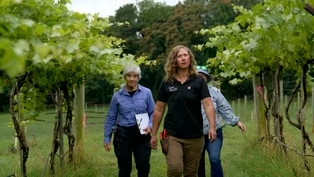
[gentle music] Sarah Bowman teaches people how to grow grapes.
- At lag phase, what we're looking for is a little bit of resistance when I cut through the berry.
- [David] Her classroom is a four-acre vineyard in Dobson, North Carolina.
Before it was a classroom, this field was somebody's livelihood.
- This land that the college foundation purchased used to be in tobacco production.
More than likely, it was a family-owned operation for a number of years.
And then at some point, that family decided to get out of tobacco farming and the land became available.
- [David] Tobacco and grapes are farmed completely differently.
The one thing they share is that both of them do well here.
- They're quite different as cropping systems.
So tobacco is an annual crop and grapes are a perennial crop.
But there are some things about the Yadkin Valley that make the location suitable for grape growing.
- [David] Farms across the Yadkin Valley made the same swap.
In 1998, tobacco companies settled to states across the country.
North Carolina put part of its share into a foundation.
The Golden LEAF Foundation helps farmers move to something else.
For families that had already decided to stop growing tobacco, the switch was easier than starting from nothing.
- Some of the benefits of that are that the land is already owned, it's already cleared, and, you know, that really is a big part of the risk of getting into grape growing, is finding the property.
- [David] But every one of these families now had a crop they didn't know how to grow.
So Surry Community College built a program around it, how to grow the grapes, how to turn them into wine, and how to market and sell it.
Charlie and Ed Shelton had just opened Shelton Vineyards down the road, and they put up the seed money for the program.
- They were our visionaries, and I would say they recognized from other regions that there was necessity for an educational facility to support the growth, economic development, right, of a region and to provide staff, people who are interested in doing these types of jobs to grow the region.
- [David] The Sheltons also led the push for federal recognition.
In 2003, the federal government made the Yadkin Valley an official American wine region, the first one in North Carolina.
- Getting the AVA in 2003 is a very early milestone for us that I think raised our reputation, raised the legitimacy of this area as a wine growing region that somebody could depend on when they were looking for quality.
- [David] Eventually, the college built its own winery, a licensed, bonded operation, and the only one at a college in the Southeast.
- At the college, we do make wine, of course, and we sell it all as well under our label called Surry Sellers.
So students are involved in that whole process of selling the wine as well.
[bottle rattles] - [David] People come to the program for all kinds of reasons.
- We have second career folks who have come in who actually want to start a business, some folks that want to go into the wine-making business or want to just work for a winery, and then others that are just here because they've retired and they're looking to have a hobby.
- [David] More than two decades later, the program is still running, but the people in it are not the people it was built for.
- When I started, I had a lot of folks that had tobacco land that had transitioned to grapes.
So they transitioned to grapes, they had tobacco land, maybe they had tobacco land in the family, and then they were transitioning over to grapes.
They planted grapes, they heard that it was a good thing to do, and they were like, "Okay, now I have the grapes planted.
"What do I do?"
- Grab a berry.
You don't really need a knife, but just.
- [David] The original students [Sarah talks indistinctly] were farmers who already had the land learning a crop they'd never grown, [Sarah talks indistinctly] but that's not who fills the classroom now.
- We still get folks from family farms, but we're getting, I think, a wider swath of folks now who just have interest in wine and farming.
[vehicle rumbles] - They've noticed the vineyards and wineries developing over the years and they want to know more.
So they come here to learn, they come here to decide if that's the career path that they want to go in.
- [David] Christopher Habershaw came to the program on his way out of the military.
- I was getting ready to retire.
I was looking for something to keep me occupied during the daytime.
- Growing up, did you ever envision you'd be working in this field?
- I grew up on a family farm, so we had cows and chickens and pigs, things like that.
So didn't think I'd be on a tractor, riding a tractor, spraying vineyards.
But yeah, I knew I'd like to work with my hands, so I would do something like this.
- [David] He graduated in 2021.
He's worked at three vineyards since.
- Everybody has different techniques and it's great because I can take a piece of every one of their ways to create my own way.
- [David] Amanda Greiner is taking classes here now.
She and her husband moved up from the triangle in 2025 and bought a vineyard in Elkin.
- Just getting into the whole wine making has kind of been a dream of mine for a long time.
So when we saw the opportunity, we jumped on it and having the support of something like Surry Community College in the area has been really, really helpful.
- [David] So the wine is here and people keep coming to learn it, but how much is it actually worth?
Well, wine is still a small piece of what Surry County grows.
The last farm census put fruit, grapes included, at about three and a half million dollars.
Tobacco is still bringing in about nine.
What actually took tobacco's place here wasn't wine.
Chicken and eggs alone brought in $271 million, but there's also money in wine that never shows up on a farm report.
- Tourists are usually dollars from elsewhere getting spent here, and so that's great.
Using other people's money is always a preference when it comes to local income.
A lot of folks went from Charlotte, who were from Raleigh, spend the weekend up here, do a lot to add to our economy, stay in a hotel, buy food at restaurants, and just partake in our local economy.
And so that's a very key extension of this part of our agricultural system is the tourism economy based off of it.
- [David] Statewide, the wine and grape industry says it generates more than $6 billion a year and supports close to 45,000 jobs.
[gentle music] - You work really hard, you put a lot of effort into the product, and there's nothing more rewarding than getting to share that with people and really tell the story about how that wine came to be.
- [David] Wine and grapes may never be able to replace what tobacco built, but it has put the land back to work and it gives people a reason to visit.
For ncIMPACT, I'm David Hurst.

How a Dead Railroad Became This Small Town’s Best Asset
Video has Closed Captions
A closed paper mill left 19 miles of railroad behind. It is now a trail. (8m 15s)

What Happened After the Largest Layoff in NC History
Video has Closed Captions
Kannapolis lost 4,000 jobs in a day. 20 years later, is the comeback real? (8m 16s)
Preview | When the Economy Changes
Video has Closed Captions
Dozens of NC towns lost their biggest employer. These three did something with what was left. (20s)
Providing Support for PBS.org
Learn Moreabout PBS online sponsorship New Episode
- News and Public Affairs

Top journalists deliver compelling original analysis of the hour's headlines.
 New Episode
- News and Public Affairs

Today's top journalists discuss Washington's current political events and public affairs.
 New Episode

 New Episode
 New Episode
 New Episode
 New Episode

 New Episode



 New Episode
Support for PBS provided by:
ncIMPACT is a local public television program presented by PBS NC