
Here and Now
Bryna Godar on Wisconsin's Proposed State Amendments in 2026
Clip: Season 2500 Episode 2516 | 6m 41sVideo has Closed Captions
Bryna Godar on three proposed state constitutional amendments that voters will decide on.
University of Wisconsin Law School State Democracy Research Initiative attorney Bryna Godar details three proposed state constitutional amendments that voters will decide on the November 2026 ballot.
Problems playing video? | Closed Captioning Feedback
Problems playing video? | Closed Captioning Feedback
Here and Now is a local public television program presented by PBS Wisconsin
Here and Now
Bryna Godar on Wisconsin's Proposed State Amendments in 2026
Clip: Season 2500 Episode 2516 | 6m 41sVideo has Closed Captions
University of Wisconsin Law School State Democracy Research Initiative attorney Bryna Godar details three proposed state constitutional amendments that voters will decide on the November 2026 ballot.
Problems playing video? | Closed Captioning Feedback
Where to Watch Here and Now
Here and Now is available to stream on pbs.org and the PBS app.
Providing Support for PBS.org
Learn Moreabout PBS online sponsorship>> In addition to the candidates for office, you'll vote for next month.
You'll see three proposed constitutional amendments on the ballot.
The questions are about a governor's veto authority, the closure of places of worship during an emergency, and government giving preferential treatment on the basis of race, sex or ethnicity.
Republicans in the legislature backed the amendment.
Questions.
Tom Tiffany supports them.
David Crowley opposes.
Is it as straightforward as that?
Partisan yay or nay?
The state Democracy Research initiative at the UW Law School did a deep dive on the ballot.
Questions.
Bryna Godar joins us with more.
Thanks for being here.
>> Thanks for having me.
>> So it seems like a lot of people might reflexively know how they think they're going to vote on these questions, but is it important to consider these kinds of proposed amendments?
>> Yes.
These amendments have implications that can cut across partizan lines.
And so while it might be helpful to look to party leaders to have some indication of how you might want to vote, it's useful to actually look at what the constitutional text itself says.
The first one asks, shall the Constitution be amended to prohibit the governor in exercising his or her partial veto authority from creating or increasing or authorizing the creation or increase of any tax or fee?
Now, it's true.
We know that Wisconsin's governor enjoys kind of the the strongest, most powerful partial veto power in the country and has historically.
Now, this is about Evers 400 year school funding veto.
But are there other examples?
>> Yes.
So Wisconsin governors have taken this broad view of the partial veto power and have used it to strike individual words or letters from budget bills to essentially rewrite provisions.
And we've seen this happen across parties.
Governor Tommy Thompson used this, the so-called Vanna White veto, to strike individual letters to make entirely new words.
Governor Doyle used this, the Frankenstein veto to cut different sentences together and completely rewrite provisions.
And then Governor Scott Walker used it, something similar to what Governor Evers used for the 400 year veto to implement a thousand year moratorium by changing the date from December 31st, 2018 to December 30th, 2018.
>> So what are the implications of this ballot question?
If voters approve it?
>> So this constitutional amendment, if approved, would not actually change that editing power.
It would just mean that the governor cannot use that power to increase a fee or a tax, or authorize the increase of a fee or a tax.
So it'd be more aimed at the purposes for which it's used, rather than the form that the veto takes.
>> All right, let's take a look at the second question.
The second proposes to change the Constitution to prohibit the state or a political subdivision of the state from ordering the closure of or forbidding gatherings in places of worship in response to a state of emergency, including a public health emergency.
This, of course, emanates out of the Covid pandemic, but goes further.
I understand from your research than other states to protect places of worship.
How so?
>> Yeah.
So a number of states have enacted laws in the wake of the Covid pandemic to make sure that places of worship and religious gatherings are not subject to more stringent standards than other locations like restaurants or bars.
But those are typically enacted via statute, which means that they are easier to change in the event of an emergency than a constitutional amendment.
Additionally, they tend to try to put places of worship on the same footing as other institutions, or require the state to have a particularly good reason for imposing the requirements.
And it's not clear if Wisconsin's proposed amendment would go sort of further in protecting places of worship compared to other locations.
>> Because aren't there already protections in for places of worship during emergencies in Wisconsin?
>> Yes.
And the Wisconsin Constitution does already have a religious freedom provision.
And there are also protections under the federal Constitution in the First Amendment for places of worship.
>> So the third question would create a section to prohibit governmental entities in the state from discriminating against or granting preferential treatment to any individual or group on the basis of race, sex, color, ethnicity or national origin.
In public employment.
And now this is about restricting DEI programs.
What are the two sides of this?
>> So proponents of this amendment are critical of affirmative action programs and DEI programs that go beyond affirmative action and argue really for sort of fairness and merit grounds for treating people under without taking into account past discrimination.
There are also arguments that the current DEI programs are themselves discriminatory.
Opponents, however, point to the fact that these programs are typically aimed at remedying past or ongoing discrimination and also how broadly this amendment might sweep in terms of what programs it would invalidate.
>> Because this movement against DEI is part of a national push with real consequences, like what we saw at the UW system.
Is it your belief that this amendment would result in more sweeping changes?
>> It potentially.
It seems like it would.
It depends on how a number of the terms are construed.
It might be something where we see organizations or the university try to comply in advance of a court ruling, but there is a lot that would remain to be fleshed out in court, and also to flush out the nondiscrimination provisions, because this would include an explicit prohibition on discrimination for things like race and sex, and that would also remain to be seen.
What the implications of that would be.
>> So overall, why enshrine such matters in the Constitution rather than in statute?
>> One reason can be because the Republican legislature and the Democratic governor might not agree on how to do things via statute.
And so sending it to the voters is a way for the Republican legislature to get bills through without having to go or get changes through, without having to go through the governor.
Other times, you know, something like equality or other issues are things that voters might want to have in the constitutional amendment, in the Constitution in a way future administrations.
>> How hard is it to change?
>> It takes a legislature passing a constitutional amendment in two successive sessions, and then the amendment needs to go to the voters for approval.
So it is a rather lengthy process to change the Constitution.
And that makes deciding on whether to implement these amendments important to think about what it would take to unwind them if voters disagreed with them in the future.
>> All right.
Bryna Godar, thank you very much.
>> Thank you.
>> This week on Inside >> This week on Inside
 New
NewElection Denial and Wisconsin's 2026 Races for Governor, AG
Video has Closed Captions
Clip: S2500 Ep2516 | 6m 15s | Candidates speak to a push by President Donald Trump in administering the midterms. (6m 15s)
 New
NewHere & Now opening for October 16, 2026
Video has Closed Captions
Clip: S2500 Ep2516 | 1m 12s | The introduction to the October 16, 2026 episode of Here & Now. (1m 12s)
 New
NewInside Wisconsin Politics: Crowley's and Tiffany's Records
Video has Closed Captions
Clip: S2500 Ep2516 | 5m 23s | Inside Wisconsin Politics on the political records of the candidates for governor. (5m 23s)
 New
NewJustin Sydnor on Prediction Markets, Politics and Elections
Video has Closed Captions
Clip: S2500 Ep2516 | 5m 50s | Justin Sydnor on the growth of prediction markets to place bets on elections and politics. (5m 50s)
 New
NewMcCoshen & Ross on Wisconsin's 2026 Midterm Election Outlook
Video has Closed Captions
Clip: S2500 Ep2516 | 8m 10s | Bill McCoshen and Scot Ross on races for governor, the state Legislature and Congress. (8m 10s)
 New
NewTony Lo Sasso on Healthcare Costs as a Top Issue for Voters
Video has Closed Captions
Clip: S2500 Ep2516 | 5m 45s | Tony Lo Sasso on how the issue of healthcare is shaped by mergers and rising premiums. (5m 45s)
 New
NewWisconsin Clerk Asks Absentee Voters to Hand-Deliver Ballot
Video has Closed Captions
Clip: S2500 Ep2516 | 1m 45s | Scott McDonell urges voters to take their absentee ballot to a drop box or clerk's office. (1m 45s)
 New
NewWisconsin Elections Officials Invest in Safety and Security
Video has Closed Captions
Clip: S2500 Ep2516 | 1m 38s | Meagan Wolfe outlined the state's election security preparations in 2026. (1m 38s)
 New
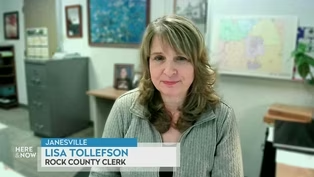
NewLisa Tollefson on Oversight of Wisconsin's 2026 Elections
Video has Closed Captions
Clip: S2500 Ep2516 | 5m 31s | Lisa Tollefson on local administration of the November 2026 election in Wisconsin. (5m 31s)
 New
NewWhat Are the Top Issues in Wisconsin's 2026 Election for AG?
Video has Closed Captions
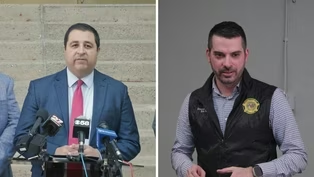
Clip: S2500 Ep2516 | 7m 28s | Josh Kaul and Eric Toney speak to state crime labs, abortion law and federal lawsuits. (7m 28s)
Providing Support for PBS.org
Learn Moreabout PBS online sponsorship New Episode
- News and Public Affairs

Top journalists deliver compelling original analysis of the hour's headlines.
 New Episode
- News and Public Affairs

Today's top journalists discuss Washington's current political events and public affairs.
 New Episode
 New Episode
 New Episode
 New Episode
 New Episode


 New Episode


Support for PBS provided by:
Here and Now is a local public television program presented by PBS Wisconsin