
Watermark
9/24/2026 | 26m 46sVideo has Closed Captions
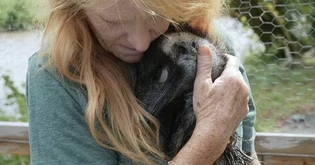
Three stories of resilience in western North Carolina after Hurricane Helene.
Explore life in western North Carolina two years after Hurricane Helene in three short documentaries by students at the UNC Hussman School of Journalism and Media. Through stories of recovery, forgiveness and resilience, the films follow individuals rebuilding their homes, livelihoods and connections to the communities they call home.
Problems playing video? | Closed Captioning Feedback
Problems playing video? | Closed Captioning Feedback
PBS North Carolina Presents is a local public television program presented by PBS NC
Watermark
9/24/2026 | 26m 46sVideo has Closed Captions
Explore life in western North Carolina two years after Hurricane Helene in three short documentaries by students at the UNC Hussman School of Journalism and Media. Through stories of recovery, forgiveness and resilience, the films follow individuals rebuilding their homes, livelihoods and connections to the communities they call home.
Problems playing video? | Closed Captioning Feedback
Where to Watch PBS North Carolina Presents
PBS North Carolina Presents is available to stream on pbs.org and the PBS app.
Providing Support for PBS.org
Learn Moreabout PBS online sponsorship[piano intro] [water trickling] [wind whooshing] [wind whooshing continues] [lighter clicking] - [Jess] I've always struggled with expressing anger.
A long time ago, my friend told me that the purpose of anger is to set a boundary and hold it.
That's what the river was saying.
You can't keep pretending like this isn't happening.
[gentle music] [gentle music continues] [gentle music continues] [gentle music continues] [soft music] - [Shelby] That first week for me, I was overwhelmed in grief and also figuring out, what do I do?
What do I do?
[broom brushing] There was this feeling of heaviness and unease that was so deep.
[soft music] [wind whooshing] - We begin tonight with the spiraling emergency after Hurricane Helene.
- Hurricane Helene.
- Hurricane Helene.
- [Reporter] There's some massive flooding going on.
- The center of circulation going right over our mountains.
- For the folks who call Ashe County Home, well, they're left completely devastated.
- I mean, you have to start over?
- Mm-hm.
- Having put all this extra money into it?
- Yeah.
Thankfully, my fundraising has been pretty good so far.
So I'm kind of relying on that because I don't have insurance to fall back on.
[sheet crinkling] Here's my store.
[laughs] You can kind of look in all of this wood right now and it's already growing mold.
So a lot of this stuff can't even be salvaged.
I didn't think that it was gonna be like how it got.
And I think there was a specific moment where that started to shift.
I started to look around at the creek across the street from us and then the creek that runs alongside the building, and I started to see them rise.
Every single minute it was an inch higher.
I was, you know, chest deep about in water.
That's when I was like, "This is absolutely beyond my control.
You have to surrender to what is happening right now and you have to get the hell out of here."
I remember just kind of like stripping everything off and just like kind of falling to my knees and just hysterically crying.
Because it was just like a very... Yeah, it was just like very surreal, like, seeing something unfold that you were certain that there was no way that it was gonna happen.
And then just like having absolutely no control over it.
[people chattering] - I think the big piece to our long-term recovery is what organizations will be able to sustain themselves.
- [Volunteer] Right.
- And so, until we have answers or a structure for that, I don't know what recovery looks like.
So each organization or each sector needs to figure out what they can do long-term if there is funding for that.
And if not, where does this move to?
- We're talking about putting together a list of materials that the businesses actually need so that we're not just receiving random things that aren't needed.
- [Business Owner] I drew up a small estimate for my building just to get an idea what it would take to put it back the way it was.
- The way it was.
- You know, just the materials and me doing the work, and you're close to 100 grand right there.
- Oh yeah.
- Yep.
- [Business Owner] That's what stresses me out.
- [Business Owner] If I hired contractors, then, you know, obviously that's gonna go up, so.
[gentle music] - This is a very rural area.
Every single business has an outsized impact because there is only one of each thing.
When you lose any one of the places in a place like Lansing, it has a much larger impact.
The general store just kind of has always been this place that's very welcome to all people.
This place is a hub for Lansing.
It draws in people from all different backgrounds and everyone finds some way to relate to this place.
It was a no-brainer, like, let's do this, let's start rebuilding.
[bright music] We're pretty much doing insulation today.
[bright music continues] [Shelby groans] It's like you have two choices in life.
You can either do something and be miserable or you can do something and make the most of it and try to enjoy yourself.
We're locked and loaded.
[staple gun clicking] [tools whirring] [bright music continues] [saw buzzing] - Watch the corners, those corners are keepers.
- [Shelby] Part of why I'm so far along is because I had Ezra next to me this whole time.
- You were never allowed to say.
- [Shelby] Pushing just as hard as what I was pushing.
- For the rest of his life.
[both laughing] [tool whirring] - It has been an overwhelming sensation of knowing that someone is next to you driving so much of what you see.
- So I was shooting for like 5/8 to 3/4.
- 3/4, that's about right.
- Yeah.
[wood banging] - [Shelby] All that barn poop.
- No, that's paint.
Barns don't poop.
- I am straight up like out in traffic right now.
3/4?
Check.
All right, we got a winner.
I am tracking all my purchases today, all my projected purchases, and then, all my potential purchases to try and understand, like, what my max possible amount spent is.
But, yeah, like the financial side of this is definitely like the most stressful because it's expensive to rebuild a store.
Crazy expensive.
So far to date, I've spent about $15,000, and that's just material pretty much.
I have a responsibility as a business owner to come back as quickly as I can.
I don't wanna be unique in being one of the only small businesses that comes back from something like this.
I want to be one of many.
And, I mean, I think Lansing's gonna come back stronger from this.
I think there's way too many people that care about this place to let it die out.
[peaceful music] [peaceful music continues] [crickets chirping] - You want some worms?
[chicken squawking] Yeah, I'm talking about you, watch her.
Come here.
Okay, all right.
I see how you are.
And they're squawking and carrying on and she looks like a... I don't even know what.
She gets real tall and she'll try to chase after them.
And you know she's having fun.
[gentle music] I love my birds.
[birds chirping] They're therapy for sure.
And Bobo has definitely been therapy.
[gentle music continues] [chicken squawking] What are you doing?
What you doing, bitty Bo?
[gentle music continues] Where's the good one at?
Let's see.
[items rustling] You know, there's like a sequence of events that you have in your mind that needs to take place or should take place.
[water rushing] We get floods like all the time.
We really wasn't anticipating a flood.
I remember the Saturday morning that we come down here to check on everything and we walked across the mountain.
When I topped the hill and I looked down where my house was, I thought, "It's gone."
[wind whooshing] [wind whooshing continues] [uneasy music] [uneasy music continues] You're happy because you're alive and then you're guilty because you know less than a mile away, somebody was in their home when it went down the river.
It's so hard battling your emotions, that has probably been the hardest thing for me.
Right up there with losing all my animals.
The colder the air gets, the, like, clearer that river gets.
And you could come up here and look off into the river and see people's stuff.
What the hell?
[footsteps tapping] Wow, crazy, crazy.
That's insane.
In my mind, I was their protector.
I did all I could do.
But my heart says, "Man, you should have went with 'em, you should have been right there with 'em."
Yeah, I guess there's a reason why I wasn't witness to it, I guess.
Maybe God knew I couldn't handle it or something.
Or maybe it's just something I don't want to, I don't know, see.
Just imagine it, I guess.
[wind whooshing] I miss my house, I miss like the smell of my house when I walked in or my blanket in the winter, you know, or summer just sitting on the porch or, you know, whatever, you miss those things.
But... It's just tough.
- Because I just popped the top on.
- [Lalena] I wouldn't change the flood because it made me a better person.
A different person.
Find his key.
[both laughing] - And the whole time he was gone.
- We have gained a lot, a lot more than we lost.
I stayed at my dad's for a couple days after the flood and on our way home, I said, "God, if you will just give me my emu, I will not gripe and complain about anything behind that island."
And it wasn't 15 minutes, literally 15 minutes, and my phone rang and it was our neighbor telling us that they found Bobo.
You're okay.
She's saved me.
[soft music] Come on.
Don't do it.
[water splashing] I love it.
I think you're doing it on purpose though.
When I get like in a place where it's like bad and I just wanna scream and cry and carry on, [soft music continues] I just think, no, I made a promise to God, I cannot do that.
[soft music continues] And I have an emu.
[soft music continues] [no audio] - [Jess] We live in a paradise.
[birds chirping] All this beauty in one place and it just feels like every piece of it is infinite.
- This is a headwaters rivers.
There's 43 square miles of watershed above us.
The vast, vast majority of that is just wild forest.
Yeah, after the flood, for the first few days, I was working my neighbor's house who flooded, we were like pulling out, oh look.
A youngster.
Looks barely big enough to be on its own.
We're just so fortunate here to live above 99% of the world's population as far as the water cycle goes.
This privilege is very poignant to me because I know what it's like to live elsewhere and not to feel that trust for what's in the water.
[water trickling] - [Jess] A couple years ago, I had surgery, Then I had to go through chemotherapy.
[water trickling] Being at the river just sort of felt comforting, like someone was there to help me, but it was the river.
[water trickling] - [Tal] Helene was definitely really discombobulating.
- [Reporter] Been a year since Hurricane Helene tore through western North Carolina.
- [Reporter] The worst flooding ever on record.
- [Reporter] Devastation and destruction stretching as far as the eye can see.
[reporter chattering] - [Reporter] Not so easy, even after they rebuilt.
[water rushing] - [Jess] 26 feet, you can't imagine it until it happens.
[water bubbling] I don't think I realized how special this place was until it got severely damaged by humans trying to fix things after the flood.
[water trickling] So I collected seeds from around the neighborhood to distribute here.
When the water rises, I would like for there to be plants growing.
The debris removal had started.
I was like calling all these biologists trying to understand what is at stake if they take the wood out of the river.
What is needed in the river to provide food and habitat for the insects that support the bats, the birds, the fish, salamanders, frogs, turtles.
Drive a track hoe into the river, it just crushes everything in its path.
[vehicle beeping] They did take equipment into the two other main rivers in our county and they're full of sediment, the banks have been stripped.
The habitat has been altered for the foreseeable future.
[sad music] [sad music continues] [wood banging] [lighter clicking] [doors creaking] As a trauma therapist, a lot of my work is helping people bring it out of their bodies.
You know, and my hope is that people can, when they're ready, process what happened and be able to recognize that the river was just doing what rivers do, like, it wasn't trying to hurt them.
[fire crackling] [water rushing] - [Tal] It seems very natural to have been concerned about the river.
Not being underwater, to our eyes, it looks so different.
[gentle music] [gentle music continues] There's like this urge that people have when they see something that's undergone change.
They feel like it needs to be fixed.
[gentle music continues] [gentle music continues] The river is healthy and alive.
It didn't really need us to like fix it in any way.
It needs us to like not continue to mess it up.
[gentle music continues] Let the forest grow along its banks, let the trees that are in it lay in it.
[gentle music continues] - [Jess] The shape of this valley was formed by floods like this.
[gentle music continues] All the animals know what to do, all the trees know what to do.
[gentle music continues] It just all seems more precious when it seems like you might not get to keep it.
[gentle music continues] [gentle music continues] [gentle music continues] [gentle music continues] [water trickling] [water trickling continues] [water trickling continues] [water trickling continues] [water trickling continues] [water trickling continues] [birds chirping] [water trickling continues]
Video has Closed Captions
Three stories of resilience in western North Carolina after Hurricane Helene. (30s)
Providing Support for PBS.org
Learn Moreabout PBS online sponsorship









Support for PBS provided by:
PBS North Carolina Presents is a local public television program presented by PBS NC