
Washington Week with The Atlantic full episode, 12/19/25
12/19/2025 | 26m 45sVideo has Closed Captions
Washington Week with The Atlantic full episode, 12/19/25
Washington Week with The Atlantic full episode, 12/19/25
Problems playing video? | Closed Captioning Feedback
Problems playing video? | Closed Captioning Feedback
Major funding for “Washington Week with The Atlantic” is provided by Consumer Cellular, Otsuka, Kaiser Permanente, the Yuen Foundation, and the Corporation for Public Broadcasting.
Washington Week with The Atlantic full episode, 12/19/25
12/19/2025 | 26m 45sVideo has Closed Captions
Washington Week with The Atlantic full episode, 12/19/25
Problems playing video? | Closed Captioning Feedback
How to Watch Washington Week with The Atlantic
Washington Week with The Atlantic is available to stream on pbs.org and the free PBS App, available on iPhone, Apple TV, Android TV, Android smartphones, Amazon Fire TV, Amazon Fire Tablet, Roku, Samsung Smart TV, and Vizio.
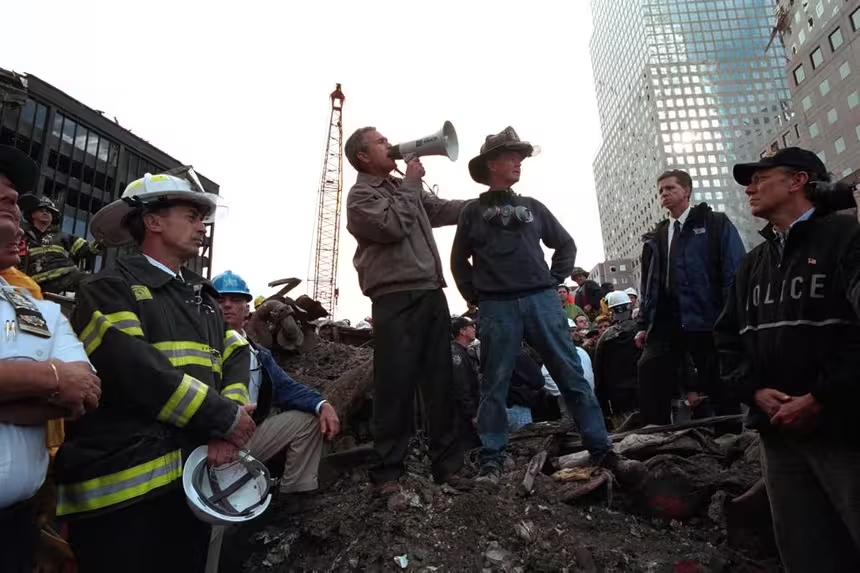
10 big stories Washington Week covered
Washington Week came on the air February 23, 1967. In the 50 years that followed, we covered a lot of history-making events. Read up on 10 of the biggest stories Washington Week covered in its first 50 years.Providing Support for PBS.org
Learn Moreabout PBS online sponsorshipJEFFREY GOLDBERG: President Trump had a lot of thoughts this week about affordability, about Rob Reiner, the Middle East, about all of his White House predecessors, and he seems very angry these days.
Tonight, a close look at the president's fast and furious primetime address to the nation, next.
Good evening and welcome to Washington Week.
This week started off terribly, the anti-Jewish massacre in Australia, the deadly shootings at Brown University and MIT, the murders of Rob and Michelle Reiner.
Weeks like this should cause us and our leaders to do some hard thinking about violence, hatred, mental health, guns, spiritual malaise, and the warping effects of technology and social media on our thinking and on our behavior.
Alternatively, if you're the president, you could just not have helpful thoughts at all, such as what happened this week.
One prime example, while the nation from left to right mourned the loss of one of our country's most beloved filmmakers, the president decided it was a good moment to make the murders of the Reiners about his own grievances.
DONALD TRUMP, U.S.
President: Well, I wasn't a fan of his at all.
He was a deranged person, as far as Trump is concerned.
You know, it was the Russia hoax.
He was one of the people behind it.
I think he hurt himself, career-wise.
He became like a deranged person, Trump derangement syndrome.
So, I was not a fan of Rob Reiner at all, in any way, shape or form.
I thought he was very bad for our country.
JEFFREY GOLDBERG: I'll talk about all of this with our panel, Franklin Foer, a staff writer at The Atlantic.
Zolan-Kanno Youngs is a White House correspondent for The New York Times, Jonathan Karl is the chief Washington correspondent for ABC News and the author of Retribution, Donald Trump, and the Campaign That Changed America, and Ashley Parker is a staff writer at The Atlantic.
So, let's talk first about the actual, parable events of the last week.
The suspect in the Brown University and now MIT shootings has killed himself apparently after several days of intense anxiety during a manhunt.
Jon, what broader lessons should we derive about from this incident, particularly as it relates to the law enforcement and social media components?
JONATHAN KARL, Chief Washington Correspondent, ABC News: Well, look, this was not a shining moment, to say the least, for law enforcement.
Let's remember that the case was cracked on Reddit, not by any investigators, local or federal.
But I'd focus on the FBI here.
Kash Patel went out and said that they had caught the shooter.
And he went out and posted it on social media, on X. They had not caught the shooter yet.
That was not true.
Who knows if that affect the course of the investigation, did that cause anybody to, you know, stop the search.
But this was not the first time he had done exactly that.
He did this with the killer of Charlie Kirk.
He went out in that case, and before Tyler Robinson was apprehended, said that they got the guy, and they didn't have the guy.
So, what is the director of the FBI doing?
Is he using this as an opportunity, tragedies like this, serious cases like this, to boost his Twitter followers to get more likes on social media?
What's he trying to do?
And, look -- JEFFREY GOLDBERG: Are you asking that rhetorically?
JONATHAN KARL: I'm -- rhetorically.
But, I mean, there's a serious broader point, which is, what is the leadership of the FBI doing right now?
I mean, we have -- JEFFREY GOLDBERG: Half of it is leaving.
JONATHAN KARL: Well, yes, a bunch of it's leaving.
The other half is working on reviewing the Epstein files.
And the FBI leadership brought largely people out of the national security division to have the task of reviewing the FBI files for release.
So, what is not being looked at, what is not being dealt with, it's a lack of seriousness at the top of the FBI that may be really dangerous.
JEFFREY GOLDBERG: Frank, same type of question to you on the Sydney massacre.
We've already had something like this in America, in Pittsburgh, the Squirrel Hill Synagogue massacre.
How exposed is the American Jewish community to the sort of Islamist terrorism that we just saw on the beach outside Sydney?
FRANKLIN FOER, Staff Writer, The Atlantic: I mean, I think of what's happened in Australia as kind of an object lesson of how things could be much worse than they are here for the American Jewish community.
I know this because I have cousins in Australia who are Jewish.
And ever since October 7th, they could feel kind of violence and terror getting ever close to them.
They would write about how there was a fire bombing at a synagogue, or how there was a kosher deli that was attacked and how there were all sorts of incidents that were happening in their neighborhoods, in their communities to their daycare centers.
And their frustration was that they felt exposed.
They felt this -- JEFFREY GOLDBERG: It's kind of a check-offs gun-type situation, that the events were all there planted, and then this was the natural culmination.
FRANKLIN FOER: It was a natural culmination.
And it was hard to know exactly where it was coming from, because it was coming from both activists who were participating in -- who were captivated by the cause of the Palestinians.
But it was also coming from these global forces.
It was coming -- there was one attack that the Australians attributed to the Iranians.
There was another -- this attack was obviously planned and implemented by members of ISIS.
And so I think that there's so much coming.
And the failure of the government to act preemptively, I think, reflects a greater pathology that we see to a much lesser extent here, which is okay.
JEFFREY GOLDBERG: No, it's fine.
But I -- you just reminded me, Jon is talking about FBI and the national security division.
There's also in the counterterrorism area.
A lot of those people in the FBI have been moved to Border Patrol, border enforcement, deportation issues.
Yes, I mean, talk about that for a minute.
It seems as if we went through a long period where counterterrorism was the dominant cause of the FBI, the dominant focus of the FBI.
Now, it seems like they've moved in a completely different direction.
ZOLAN KANNO-YOUNGS, White House Correspondent, The New York Times: Oh, you've had a trend throughout this year where FBI analysts, not just FBI, but also DEA, have been redirected to support what this administration sees as the national security priority, that being the removal of undocumented immigrants.
And I've talked to Homeland Security officials, people in the law enforcement community who say that this has created gaps in the national security apparatus.
And it's broad, right?
Yes, it's those FBI analysts, it's criminal investigators being redirected to basically stand by and support ICE agents, but it's also Homeland HSI agents that do longer term investigations right into criminality.
This is broad throughout the entire national security apparatus.
JEFFREY GOLDBERG: Right.
Ashley, let me ask you about the president's response to the killing of the Reiners.
This is a tragedy.
It's a story about a brilliant filmmaker.
Everybody loves his movies.
Left wing, right wing, it doesn't matter what you are, everybody loves his movies.
It's a story, it's a horrible story apparently about drug addiction and a family in crisis.
The president's reaction was entirely about the president.
We've seen this before, but have we seen it this floridly?
ASHLEY PARKER, Staff Writer, The Atlantic: I mean, you played a clip at the beginning of the show.
It's worth noting that those comments came after he put out a post on Truth Social that all but implied Rob Reiner by being a liberal Democratic activist, by being opposed to President Trump, sort of had it coming.
Trump's initial take was Rob Reiner has been against me.
People got angry and he and his wife were murdered.
I mean, there was no empathy.
Not just a lack of empathy.
It was such a crude, almost gleeful posting on social media that you saw cracks in Trump's coalition, which you rarely see.
You saw Republicans and not just sort of mainstream Republicans.
You saw members of MAGA who, to be fair, when Charlie Kirk had been assassinated, had said that the people celebrating this is disgusting.
It's abhorrent.
And then they see the leader of their own party doing that, and some of them had the conviction to say, you know, this isn't okay.
Now, to be clear, many of them didn't, but it was striking to see people -- JEFFREY GOLDBERG: James Wood, the actor, you know, who's a very big Trump supporter, who just loved Rob Reiner, was horrified, I think, by what the president said.
ASHLEY PARKER: And Rob Reiner, too, it's worth noting, when Charlie Kirk was assassinated, he was one of the people who came out and said, I don't care what, you know, anyone's beliefs are.
This is an abhorrent, grotesque act that should never happen to anyone.
JONATHAN KARL: It reminded me of what he did after Nancy Pelosi's husband, Paul, was attacked with a hammer, I mean, almost killed in their home in San Francisco.
And, you know, it was the same kind of thing.
It reminded me - - look back at some of the statements that Trump has made every year on Veterans Day, where he talks about the suckers and the haters and the losers and all of this and, you know, Happy Veterans Day.
So, it is consistent.
But this did feel like it went a step beyond, particularly coming in the context of coming after Charlie Kirk.
And the sense that he was justifying or saying that, explaining why, which with absolutely no factual basis whatsoever, he was dead wrong, but suggesting that Reiner's political attacks on Trump were the reason why he was murdered with a knife by his own son.
JEFFREY GOLDBERG: Right.
Zolan, I mean, one of the factors here is that his movies are very mainstream and universally beloved, and so people have positive associations, well, it doesn't matter what your politics are, with seeing those movies.
But I'm wondering if there was -- do you see -- I mean, you study the man closely -- a degree in con like a degree of anger or like kind of freneticness in his responses to the Reiner death that was unusual?
Because it did provoke this response among Republicans that you usually don't see.
ZOLAN KANNO-YOUNGS: Unusual in the sense that it was just so close to the actual tragedy, right?
It was just hours after.
But I do think this is part of a pattern?
Like in times of tragedy, whether it's natural disasters, there's usually a sense of, you know, well, that state, what are they doing for me to get this aid, this federal support, whether it's tragedy of a murder as well.
The personal grievance tends to trump empathy.
Empathy tends to get substituted for spite when it comes to this president.
JEFFREY GOLDBERG: Has he shown empathy?
JONATHAN KARL: I mean, I think there have been flashes of him showing empathy, but they're very quick and short-lived.
JEFFREY GOLDBERG: Interesting.
ASHLEY PARKER: And he'll sometimes show empathy, especially in natural disasters for red states and for his people.
He's much more able to communicate empathy if he feels like it's a Trump supporter who has lost their home in a hurricane or a tornado.
ZOLAN KANNO-YOUNGS: There was an amazing scene right on his first week in office when he went to North Carolina and showed empathy to many Trump supporters who met him at the airport there.
Later on that day, he went to California.
And he said, well, look, yes, these fires just happened.
Well, I also want these immigration policies put forward.
And he also criticized Newsom days later.
So, that difference of red to blue states, it's true.
JEFFREY GOLDBERG: Let's talk about the president's anger as events in the speech Wednesday night.
Let's watch a little bit about what he claimed he has done so far.
DONALD TRUMP: I've restored American strength, settled eight wars in ten months, destroyed the Iran nuclear threat, and ended the war in Gaza, bringing for the first time in 3,000 years peace to the Middle East.
I negotiated directly with the drug companies and foreign nations to slash prices on drugs and pharmaceuticals by as much as 400, 500 and even 600 percent.
Gasoline is now under $2.50 cents a gallon in much of the country.
In some states, it, by the way, just hit $1.99 cents a gallon.
JEFFREY GOLDBERG: Frank -- FRANKLIN FOER: Things are going so damn well, he's pissed about it.
JEFFREY GOLDBERG: Yes.
Let's look at these claims and we go through them one by one.
I was struck maybe because of my previous career as a Middle East correspondent by the claim that he has brought peace to the Middle East also for the first time in 3,000 years.
That's a long time.
That's a long time.
Yes?
FRANKLIN FOER: I'm old enough to remember the 1990s.
JEFFREY GOLDBERG: Well, you know, old enough to remember Syria, you know?
But there -- I don't even know what to ask you on that.
I mean, when people hear him say that he's brought peace to the Middle East for the first time in 3,000 years, even inside the White House, even inside the national security apparatus, what are they -- what do you think they think?
FRANKLIN FOER: That he's delusional.
JEFFREY GOLDBERG: Okay.
FRANKLIN FOER: I mean, really, there's no credible way you can an assertion like that.
And that's kind of the basis of not just his claims there, but somebody of the other claims that he was making in the speech.
And that's why it's hard to imagine that they consider this to be their most successful sales strategy, that, you know, there's only so much you can do to convince people of things where there are material realities that they're experiencing that just are at odds with what he's claiming.
JEFFREY GOLDBERG: Right, that's the affordability issues.
So, stay in the Middle East and the foreign policy issue for one second, because rather specifically, there's a very tentative ceasefire in Gaza that could break it any day.
So, at what point does the Republican Party and Republicans in Congress, let's say, say, you know what, you didn't actually bring peace to the Middle East, you didn't actually do others?
The eight wars that he's negotiated, one of them, Cambodia-Thailand war, that just got hot again last week.
ZOLAN KANNO-YOUNGS: Congo, M23, they're still fighting there as well.
JEFFREY GOLDBERG: They're still fighting.
I just -- FRANKLIN FOER: And that piece in the release, it requires him to nurture a process and to make difficult decisions where he throws the prestige and weight of the presidency behind some pretty big asks he's going to have to make on both the Israelis and of our Arab allies.
And if he's acting as if it's a foregone conclusion and everything is settled, it's evidence of a guy who's actually not really truly committed to the process.
JEFFREY GOLDBERG: I guess I'm just having a hard time this week, harder than other weeks, in using my eyeballs to look at reality and then listening to what he's claiming is reality.
The gap is pretty wide this week.
JONATHAN KARL: I mean, I think what you're seeing is the culmination of a couple of things.
One, you know, he's always had the tendency to exaggerate, extremely exaggerate, say things that aren't true, all of that.
JEFFREY GOLDBERG: And, by the way, politicians do that.
JONATHAN KARL: Politicians do that.
He's the best and the greatest at doing that.
He's the greatest exaggerator we have ever seen in all of the time.
JEFFREY GOLDBERG: He's the most humble man in history.
No one is more humble than he is, JONATHAN KARL: But the true sense that he feels entirely empowered, feels there are no limitations, there is nobody around him that will effort to try to, you know, get him to, wait a minute, maybe we should move in this direction or not say that.
I mean, the glaring example for me of that trend was right after that speech seeing Howard Lutnik, the commerce secretary, explain why he was actually accurate when he said drug prices have come down by as much as 600 percent.
JEFFREY GOLDBERG: 600 percent?
JONATHAN KARL: Yes.
This is a cabinet secretary saying, yes, no.
This is why it's, you know, why -- what he's saying -- JEFFREY GOLDBERG: A guy who's ostensibly good at math?
JONATHAN KARL: I mean, hopefully.
I mean, these people -- JEFFREY GOLDBERG: Well, he's got to be.
JONATHAN KARL: Yes.
JEFFREY GOLDBERG: Yes.
No, I'm just not - - this is a hard week to sort of track, you know, where the rhetoric is and where reality is, harder than most of these weeks.
I want to stay on this general subject, but let's go to the speech itself.
What was the rationale for doing the speech?
JONATHAN KARL: The rationale is he's taken a lot of heat for the state of the economy.
He sees it.
He reads the polls numbers.
He watches the news coverage.
He's upset about it.
So, he thought he could go out there and kind of undo it.
And he knew that -- I mean, look, he went out and gave an 18-minute speech that had no significant new announcement, whatsoever, didn't have any actual purpose, and was filled with statements that were simply not true.
And you could pick out the individual ones that you have but there was the larger point, which he says prices have come down dramatically from, you know, record high inflation when I took office to now, you know, prices are down.
I mean, it's -- that framing is entirely untrue.
I mean, the inflation rate is actually right now, almost exactly where it was in January of this year.
ASHLEY PARKER: There's also a central irony that Donald Trump is actually great at willing his own reality.
And he can be very effective if he says, you know, we've totally fixed the border.
If you're not someone -- if you're not a rancher, if you're not someone living at the border, you might plausibly believe that.
If you weren't a Middle East correspondent, you might think, okay, peace, we've got it.
But the one area where he is encountering what frankly Joe Biden encountered is that you cannot will an economic reality into existence.
Everybody gets a paycheck, or worse, doesn't get a paycheck, right, doesn't have a job.
Everybody goes grocery shopping for their family.
Everybody is approaching the holiday season and figuring out what will be in the stockings.
And it doesn't matter how much Donald Trump screams it or how much he says it.
This is one of the few areas where reality collides with that often quite effective rhetoric.
JEFFREY GOLDBERG: Does he have control at all over the economy.
What can he do?
ZOLAN KANNO-YOUNGS: To an extent, I mean, there are factors to the economy that's outside of the control of every president, right?
You would hear this from the previous Biden White House too.
But you can control your messaging.
You can control how you can connect and resonate with voters as well.
You can also control the promises you made to them.
This is an issue he ran on.
I remember when, you know, Donald Trump put on an apron and went to a McDonald's and framed his message, his economic message around a populous appeal.
Now, you tend to hear him talk about gold in the Oval Office or putting his name on the Kennedy Center.
That doesn't really match with the message that you had to the working class.
JEFFREY GOLDBERG: Well, I'm glad you mentioned the Kennedy Center.
ZOLAN KANNO-YOUNGS: There's your segue.
JEFFREY GOLDBERG: Thank you very much.
No, because, obviously, we're just learning that he's actually replacing the names or adding his name to the wall, the outside wall of the Kennedy Center.
Congress hasn't approved this, of course, so it's not actually a legal change.
But here's what Karoline Leavitt, the White House spokeswoman, had to say about all this.
She wrote, I have just been informed that they highly respected board of the Kennedy Center, some of the most successful people from all parts of the world, have just voted unanimously to rename the Kennedy Center to the Trump-Kennedy Center because of the unbelievable work President Trump has done over the last year in saving the building, not only from the standpoint of its reconstruction, but also financially and its reputation.
Then this is the big moment.
Congratulations to President Donald J. Trump, and, likewise, congratulations to President Kennedy because this will be a truly great team long into the future.
So, I don't even know what to do with that.
FRANKLIN FOER: You know, I bet J.D.
Vance is worried about his place in the second part of the ticket.
But -- JEFFREY GOLDBERG: JFK's very charismatic.
FRANKLIN FOER: He's very charismatic.
You know, Putin doesn't name buildings after himself.
Orban doesn't name buildings after himself.
This is something -- you know, the only leaders in the world who do this are in places like Turkmenistan, in Tajikistan.
There's a tin pot dictator quality to what he's doing and how he's in afflicting his insecurities on the world.
JEFFREY GOLDBERG: By the way, that's it, and that's the thing, and I don't think I'm going too far in saying this, that this is the week -- apart from the obvious tragedies, this is the week that has had it like a kind of a feeling of Boratness to it.
And the thing -- the reason that I'm bringing that up is because Trump is also this week rewritten or written captions for these portraits of presidents that are now hanging in the White House.
And under one of the captions under the Andrew Jackson portrait, he wrote, Jackson was unjustifiably treated unfairly by the press, but not as viciously and unfairly as President Abraham Lincoln and President Donald J. Trump would in the future be.
Now, the White House staff, you all cover the White House, when he suggests doing things like this that are without -- I mean, to say that it's without precedent in American history, American presidential is understating the cause, presidents have always respected their predecessors and always talked about it.
What is going on inside the White House when he does this?
ASHLEY PARKER: Well, first, there's a certain smallness to it, obviously.
But one thing I've learned, and I learned this earlier in the administration, I was told that, basically, they have an unofficial rule, which is that if the president asks for something twice, they do it.
And I said, well, why twice?
And it's worth noting also in the first term, if the president asked for something, they would first tell him, why he couldn't do it, how it was illegal, how they would resign before they would allow him to do it, how he'd get killed by the meter of the voters.
Now, I said, why twice, and they said, well.
You know, he does ask for some crazy things.
But the understanding is if he asks for it for a second time, he's serious about it and they are just going to make it happen.
They're going to get those plaques and get his text and have it carved in and put it up in the White House.
JEFFREY GOLDBERG: Well, I look forward to filming this show at the Trump-Lincoln Memorial.
It's just very, very hard to understand.
Something else that's hard to understand is Susie Wiles' loyalty to the president, or let's put it this way, the president's reciprocal loyalty to Susie Wiles.
Obviously, there was a Vanity Fair interview this week where she said some candid things about Trump having an alcoholic's personality and J.D.
Vance having a conspiracy mentality.
She is not in trouble for this.
We only have a minute on this, but talk about what's going on in terms of a White House that you used to have or a president that used to have a kind of very, very stringent standard of loyalty.
And if you didn't meet it, you were out.
FRANKLIN FOER: Right.
There is this is there's no scalps policy.
There are ways in which this White House is so much more efficient and so much more accomplished in kind of wreaking havoc in a way that doesn't feel like it's completely chaotic and completely out of control, and she's somebody who's -- and gets credit for that.
And it really is kind of astonishing to see the coordinated effort that was made by everybody in the administration to praise her in the aftermath.
JEFFREY GOLDBERG: Jon, last few seconds.
Why isn't she fired for that?
JONATHAN KARL: I mean, she's indispensable to Trump and she does not, in any way, try to steer him substantively.
She keeps the drama around him to a minimum and makes sure, to your point, that, look, he gets what he wants.
And, you know, I mean, I thought that the -- all the cascading defense from all the people in the -- senior people in the White House, the last one was Trump himself.
Even on that one line you mentioned, an alcoholic's personality, he defended that.
JEFFREY GOLDBERG: Right.
Well, we're going to have to leave it there.
I want to thank our guests for joining me.
And thank you at home for watching us.
I want to wish everyone a Happy Hanukkah and a Merry Christmas, and we'll see you all next week.
I'm Jeffrey Goldberg.
Goodnight from Washington.
The FBI's priorities under Kash Patel's leadership
Video has Closed Captions
Clip: 12/19/2025 | 11m 9s | The FBI's priorities under Kash Patel's leadership (11m 9s)
Trump rewrites history in fast and furious prime-time speech
Video has Closed Captions
Clip: 12/19/2025 | 12m 24s | Trump rewrites history in fast and furious prime-time speech (12m 24s)
Providing Support for PBS.org
Learn Moreabout PBS online sponsorship
- News and Public Affairs

Top journalists deliver compelling original analysis of the hour's headlines.

- News and Public Affairs

FRONTLINE is investigative journalism that questions, explains and changes our world.












Support for PBS provided by:
Major funding for “Washington Week with The Atlantic” is provided by Consumer Cellular, Otsuka, Kaiser Permanente, the Yuen Foundation, and the Corporation for Public Broadcasting.