
Veterans Closing the Skills Gap
4/15/2022 | 26m 46sVideo has Closed Captions
More employers say the skillsets soldiers bring back from deployment make them invaluable.
The veteran unemployment rate has steadily dropped since its all-time high of nearly 12% in April 2020, but as of March 2021, the veteran unemployment rate is still at 4.6%. Veteran advocates say it can be difficult for people to transition out of the military into the civilian job market. However, veterans often bring a unique approach and skillset to jobs.
Problems playing video? | Closed Captioning Feedback
Problems playing video? | Closed Captioning Feedback
ncIMPACT is a local public television program presented by PBS NC
Veterans Closing the Skills Gap
4/15/2022 | 26m 46sVideo has Closed Captions
The veteran unemployment rate has steadily dropped since its all-time high of nearly 12% in April 2020, but as of March 2021, the veteran unemployment rate is still at 4.6%. Veteran advocates say it can be difficult for people to transition out of the military into the civilian job market. However, veterans often bring a unique approach and skillset to jobs.
Problems playing video? | Closed Captioning Feedback
How to Watch ncIMPACT
ncIMPACT is available to stream on pbs.org and the free PBS App, available on iPhone, Apple TV, Android TV, Android smartphones, Amazon Fire TV, Amazon Fire Tablet, Roku, Samsung Smart TV, and Vizio.
Providing Support for PBS.org
Learn Moreabout PBS online sponsorship- [Anita Brown Graham] Coming up on ncIMPACT.
- I was very incredibly nervous when I got out of the military, when I was getting out.
I'm like, what am I gonna do for work?
What am I gonna do for a job?
I have no idea.
- [Anita] Some veterans struggle to find work.
Yet many say the skills they bring to the table are just what our workforce needs.
- [Male Announcer] ncIMPACT is a PBS North Carolina production in association with the University of North Carolina School of Government.
Funding for ncIMPACT is made possible by.
- [Female Announcer] Changing the course of people's lives.
That's the impact UNC Health and the UNC School of Medicine work to deliver every day.
Our 40,000 team members across the state of North Carolina are committed to caring for you, our patients, and communities, as well as educating the next generation of healthcare professionals.
Individually, we can do a little, but collectively we can do a lot to create impact.
- Welcome to ncIMPACT, I'm Anita Brown-Graham.
As veterans transition to civilian life.
One challenge they often face is finding a career they are interested in that also fits the skills they currently have.
Many say, veterans actually have the right balance of skills and leadership qualities to fill some of the skill gaps our communities face.
ncIMPACT's Evan Howell met two veterans and looks at how they each applied what they learned in the military to run a successful business in North Carolina.
- How much have we got going out.
- [Howell] As a young man, George Copeland says he had little drive to continue with school.
The year was 1969 and he was drafted to serve in Vietnam.
- Very good, nice.
- [Howell] He returned to United States in 1971 to what had become a different country.
- There was a lot of protest.
You were getting papers shoved in your face to sign.
There was protesting, the war and most of us wanted to put the war behind us.
This was the award that we did for the poster that we did for the... - [Howell] After serving as an Army Special Forces medic, he went back to college, was it teacher and even coached high school football.
And over this time he started to realize the skills he learned in war were beginning to serve him well at home.
- And I think that probably was the thing, probably the number one thing that started to develop my character and probably polished the discipline that I didn't realize that I was getting with my military experience.
But it probably gave me a continuation of the discipline that I had learned in the military.
- [Howell] Copeland says veterans fill a skills gap in civilian life because leadership and discipline form the core of military training.
He says hiring veterans can help businesses learn to develop better ideas and better direction.
- We look for the maturity these young people bring to the business.
But we also look at the dedication and devotion and the drive that these people bring.
- [Howell] Raven Coleman says that the time serving as a medic and operation enduring freedom in Afghanistan, taught her a unique form of independence.
- In theater, it's so much different and you have to rely on you don't have somebody like your field training officer, just right there with you, stepping you along.
You have to rely on all your training, all your knowledge, and make the best decision.
[cleaner buzzing] - [Howell] Coleman's business handles crime scene and biohazard cleanup along with end of life transportation services, she calls death care.
She says what she saw and experienced overseas, make it easier to help customers navigate through a crisis.
- When families are dealing on, usually their worst day of their life that something has occurred.
A lot of times they don't even our service exists until they need it and when they need it, they don't even know where to find it.
So we're just trying to help kind of fill that puzzle for them.
- [Howell] Copeland says Vietnam gave him the opportunity to grow up.
And he says, he looks for that in any new employee emphasizing that any organization will struggle if they lack that united front.
- We have a say, behind closed doors.
We can say the things that we need to say, when the door opens, we have to walk out hand in hand because our people are gonna look at us for direction and leadership.
- [Howell] He says, what any business needs is a band of employees who come to the table with a sense of duty for ncIMPACT, I'm Evan Howell.
- Joining me now is Scott Dorney.
Scott is the executive director of the North Carolina military business center.
Scott, let's start with the personal for a moment.
You served 22 years on active duty as a commissioned officer in the U.S Army.
What were some of the challenges you faced transitioning back to the civilian workforce?
- What well, great to be with you, Anita.
One thing is most people that are in the military, they've never applied for a job before.
They might have gone to a recruiting office and not too many of those folks say no.
So when I was transitioning, 43 years old, I hadn't applied for a job since I was 16 years old.
So there's definitely that challenge.
A lot of the military jobs that you have as well, don't exactly translate to civilian jobs.
So there's some challenges in being able to communicate to folks how your jobs that you had relate to the job that you happened to be applying for and putting together a good resume as a challenge.
Also, a lot of folks have misconceptions about their recruitment and selection process.
I always thought you applied for a job.
They called you.
I know with the first job I applied, as soon as I applied, I went out and bought two suits and waited for the interview call that never came.
So there is... And then one of the job that I eventually did get, it was a six-month selection process.
So a lot of folks just don't understand that.
And finally, when you do get to the new job, there's a good chance you could be the only veteran with only about 10% of our population serving in the military.
So again, communicating with your new coworkers can be a challenge.
- So let's talk a little bit about when you get to this job in North Carolina, we have any number of industries that are facing a persistent labor shortage.
What role do you see veterans playing in helping to fill this workforce gap?
- Well, a very significant role.
Here in North Carolina, we have six major military installations and every year, about sixteen to eighteen thousand soldiers transition out of the military.
I'd also mention that a lot of these folks, probably 60% or more are married.
Military spouses represent a terrific resource for our businesses to meet their workforce gaps.
So there certainly is plenty of opportunity.
These people are trained, they're disciplined, they're focused, they pass a drug test, they have background check.
So they can play a very significant role.
A lot of businesses wanna hire veterans, but there still is an education challenge to make sure employers know, first of all, the value of hiring military.
Then a lot of people don't understand the military pay rates and how much individuals make in the military and offering a wage to folks that will entice them to come to your business.
- Okay, Scott, we're gonna come back and talk some more about how veterans can help us fill these workforce issues.
Building inspectors are vital for keeping construction projects on time and on budget.
And most importantly, for ensuring that our buildings are safe.
Across the nation, the number of inspectors is decreasing.
In Mecklenburg county, community leaders recognize that this could cost a serious problem.
Melody Hunter Pillion joins us to share their solution.
Melody, what are they doing in Mecklenburg county?
- Anita, young people are not flocking to this occupation, mainly because they do not know it's an option.
Mecklenburg county wants people to know these are still good and necessary jobs.
Inspections are all about keeping people safe, who better to keep us safe than our military veterans.
- [Narrator] When U.S army veteran Toyana McKinney began to transition to civilian life, she had a tough time finding a job.
- Most jobs, they looked for the... You have to have some kind of years in, to start at a certain pay range.
So that was a difficulty.
- [Narrator] McKinney then got connected with a program called Building With Our Veterans, the program recruits and trains military veterans for jobs within the county's code enforcement office.
- I didn't really know what to the whole code enforcement and permitting was, cause I had never had a house yet and all of that, but I saw veterans apply.
So I applied.
- [Narrator] Director of Mecklenburg County's Learn to Use and Environmental Service Agency or LUESA, Ebenezer Gujjarlapudi created this program as a solution to three unrelated problems.
- One not having enough of a talented pool of applicants and available building inspectors to be able to pull from.
Two, we also had a number of veterans that came out of, whether the Iraq war or later moving into this area, like I said, being a desirable place to move into and third lack of opportunities for them.
- [Narrator] His office partnered with Central Piedmont Community College, CPCC to provide educational opportunities while county human resources and veteran services identified a pool of veterans.
Alongside classes, veterans in the program, participate in inspection ride-alongs.
For many veterans, their skills for the military translate pretty well.
- Once I found out what the actual inspection and position was, it was like, oh my gosh, this is perfect for what I see in my future.
- I don't know if they have to make... That would be a question I'd probably ask Tim.
- [Narrator] U.S Marine Corps, veteran Mitchell Bowers, is another Building With Our Veterans graduate and now works as an inspector for the county.
He says he was unsure of his career direction, when he left the Marines.
- One of my friends who I was in the Marine Corps with, he had done this program before I did and he said, man, you just need to sign up for it and try it out.
I normally do my calls in the afternoon.
- [Narrator] Bower's experience serves as one of the many success stories of the program.
- It's good to see that the county does have some of those opportunities, are reaching out there specifically to grab us and pull us and give us a different direction in life or a different career path than what we had previously been trained for or had learned on our own beforehand.
- [Narrator] For Toyana McKinney.
She is also now accounting inspector and is glad she found a career path where she can continue to grow.
- Because of this opportunity, I was able to buy my first home.
I'm able to grow, definitely grow.
There's a lot of growing capabilities within my position.
There's a lot of training that allows me go to the next level if I want to, and just to prepare me the best at what I do.
- Veterans have the right stuff for this role.
So far, the program has been successful.
Part of the success is the working relationship the veterans build with the inspections team while they're still students.
And there are other veterans on the team who serve as mentors.
However, the nation is years behind in bolstering the ranks of these important positions.
This program could be a model for others.
- Thank you, Melody.
It could be a model indeed.
Joining me now is Latonia McCoy.
Latonia is the transition manager for USO, North Carolina.
Latonia, the construction industry seems to be a natural fit for many veterans, but what are some other industries that align with the skills veterans acquire during active service?
- I would actually say all of them.
When they're in the military, there are so many different occupation codes that they can hold just like there are different jobs that are in the civilian workforce.
So the things that we have to think about is that, we have doctors in the military, we have lawyers in the military, we have the mechanics, we have human resources specialists in the military, and those are all very different jobs just to name a few of them.
But along with that, we have to think about the fact that yes, they're gaining technical skills and interpersonal skills while they're in the military, but they're also gaining skills in their private life that can be just as impactful and can help them out on that next job that they're going into.
- So let me take you up on that all of them answer.
Communities of every size in this state are facing worker shortages.
What are some of the ways communities and local companies can effectively attract and recruit these veterans with all of these skills.
- One they can tap into their veteran staff that they currently have.
They can utilize them to recruit and attract those new veterans into the organization because they understand exactly where those veterans are coming from.
They've been in their shoes before.
They also can get training for human resources and talent acquisition departments.
You wanna make sure that they have an understanding of some of the military language that may come up on resumes or even in the interview that they're doing with a veteran.
And then also that, it can be great for them also to have some knowledge of the military occupations that the service members are in when they're in the military.
- So lots of things that can be done on the employer side, let's talk about how we support the veteran or the active service person who is transitioning to becoming a veteran.
We saw in that story, a strong partnership between the county and the local community college to help train veterans for the specific skills needed in those jobs.
What are additional ways that communities that are watching this program can think about bringing people together to help veterans find meaningful work?
- Well, one, they can partner with organizations like the USO.
we have our USO transitions program that is working with service members who are transitioning out and trying to make that leap into the civilian workforce.
We can host events together like networking events or resume writing training or mentorship programs, or even doing things like having information sessions, where the companies are able to talk about the job openings that they currently have, or even talk about the culture of their organization, because those are the things that are, are gonna be great for the veteran and those are the things they're looking for, 'cause it's not only gonna make them more marketable, but it also gives them more access to those companies that have the meaningful work that's out there.
- Terrific set of to-dos.
Thank you.
We'll be back to talk some more.
Cumberland County is home to this second largest veteran population in the State.
It's also home to Transition Tech, a training program that helps veterans transition into civilian life.
ncIMPACT's David Hurst, has more on how this collaboration meets local workforce needs.
David, what is transition tech and how does it work?
- Anita Transition Tech is run by Fayetteville Technical Community College.
With its close proximity to Fort Bragg, the community college wants to serve as a helpful next step for transitioning members of the armed forces.
The program is also helping connect veterans to careers in high demand fields.
[machine roaring] - [Narrator] After seven years in the army, Anthony Ricciutti left with no idea what was next.
- I was very incredibly nervous when I got out of the military.
When I was getting out, I'm like, what am I gonna do for work?
What am I gonna do for a job?
I have no idea what is going to be happening.
I'm thinking to myself, 11 Bravo infantry.
There's not a whole lot you can do with that.
- [Narrator] He turned to a program called Transition Tech, which operates at Fayetteville Technical Community College.
He began a 15-week pipe structural welding program and earned a nationally recognized certification for welding.
- It's definitely a really incredible industry to get into just not many people do it.
[welding arc sizzling] - [Narrator] Welding is one of the many certification courses offered by Transition Tech.
[machine humming] Others include construction, truck driving and solar technology.
Veteran Jack Frakes takes one of the more popular courses.
The basic EMT program.
- The past three years been army army army and now you actually get to do civilian stuff, be around civilians and other people transitioning.
- One, two, three.
- [Narrator] After the eight week program, Frakes' plans to move back home to Chicago and become a firefighter.
He says the basic EMT program will give him a good foundation as he eventually plans to become a paramedic.
- It's awesome to have this as like which just feels kind of like work, be something that's actually like educating me and like progressing me and like preparing me for the future.
- [Narrator] The transition tech program started with 24 students in 2014 and grew from there.
They've since helped prepare hundreds of students for high demand jobs in the area and around the country.
- And just to see the soldiers when they call and it's like, I don't know what I wanna do on white will.
I've got welding, I've got EMT welding.
I like that.
I did that in high school.
I think that would be fun or I wanna drive a truck.
- Hold it to maximum.
- [Narrator] The community college has partnered with dozens of local employers and it's helping the community close some of the skills gaps.
- We're taking potential individuals who would be on unemployment and providing them with the necessary skills to be employable.
- [Narrator] For Anthony Ricciutti, he now serves as one of the welding instructors for Transition Tech and he says, he would've never discovered this passion without the program.
- I couldn't be more grateful for the school giving me a chance to thrive and to show what I'm capable of, 'cause some people aren't offering that chance.
- Veterans in Transition Tech also go through soft skills training.
They're taught how to build a resume, how to ace a job interview and how to best translate their military skills to civilian terms in order to help them find a job.
- David, thank you.
What a great program, Scott and Latonia, welcome back.
Let's bring in Elvira Johnson.
Who is the director of career development at Wayne community college?
Elvira we'll start with you.
Give us some background.
What role does Wayne Community College play in helping veterans make the transition to the civilian workforce?
- Well, as a community college in a town in Goldboro, North Carolina, where Seymour Johnson Air Force base is located, we are very much involved.
We actually have an education center on the base where soon to be veterans or people who are still active duty can go ahead and start taking some classes.
Most of the active duty people, they don't realize that they just may be a few courses away from getting an associate's degree through the CC, Community College of the Air Force.
So they don't necessarily have to just start from scratch, but providing that educational piece and also with like workforce development, there are some short-term courses that they can take, so they can go right into the workforce like we were talking about with welding and other jobs like that.
- Excellent.
So you get to waive your magic wand today and talk to higher Ed.
What are some additional ways that higher education institutions, especially those that are close to military bases can help veterans looking for work in their community?
- Well, I guess I would say to kind of reach out to where they are and get them to come in and work with them.
Resume writing.
We've started instituting mock interviews, helping the veterans when they transition into state, government or federal jobs.
Because as mentioned before, that can be a three to six month process.
So, helping the veterans to understand some of the differences between a resume that you would have getting a promotion in the military versus a civilian resume, which most employers only want to see one page.
Helping with some of those things so that veterans can kind of understand what civilian employers are looking for as they make that transition.
Also, most of the colleges and universities do have a small business center, free courses.
So not only for those veterans who want to enhance their career within education, some people may want to start their own business so they can take some free courses.
One of the ones that's very popular is boots to business for veterans who want to start their own business and then also veterans who are going straight into the workforce or will actually take a way into getting a bachelor's degree.
- Got it.
- [Elvira] A four year degree.
- So Latonia, I see you nodding very vigorously.
I love it.
I don't think we're gonna ever have another conversation.
In my lifetime that we don't talk about COVID so let's just get that on the table.
How is the pandemic induced the shift to virtual for workplaces impacted veterans who are looking for work?
So in essence, we were pretty much shut down for two years in many sectors.
What does that mean for people who got out of the service and are looking for work?
- It was very huge impact.
We had service members who were used to working in an office in-person who are now trying to navigate a virtual world, using a systems and tools that were completely foreign to them.
So the great thing about having programs like USO transitions is that we are a hybrid program.
So we do in-person events and we also do virtual events and we give our clients the opportunity to come in and familiarize themselves with the tools that we're using.
So now it's no longer, that hindrance of getting in a job, it's kind of like they have a leg up now.
So they're able to utilize the skills that they're learning from these transition programs to better help them.
And we're finding that a lot of them who in the beginning were like, oh, we don't wanna do virtual.
They were like, virtual is not all that bad, especially when it's in a hybrid workplace when I can get a little of the virtual and also a little of the in-person.
So it's all great for them.
So things are looking bright for the future of veterans going into these type of work forces.
- I want to chime in on that one too, because the training at the community College system, and like we said, we started other things going virtual helped us to really ramp up our mock interviews that we were doing along with some of the trainings that are now, most of our trainings that were in-person are now all available online on virtual impact.
The availability of training.
You don't have to wait until you get off from work, or you can take this training at any time of the day or night.
So that's something that's really been enhanced by COVID.
- Love it.
And of course, it's the work that all of you all are doing that is responsible for the unemployment rate for veterans steadily declining since the peak of the pandemic.
Scott, I wanna get to entrepreneur opportunities because I know that is where your heart is.
So talk to us a little bit about what your center does to help veterans build their own businesses.
- That's a great question.
Certainly when folks are leaving the military, they really have three choices.
Many wanna go back to school, many wanna get a JOB but do wanna start their own businesses particularly, and not limited to retirees.
But as I used to always counsel folks leaving the military, particularly if they're retiring, it's time to do something that they really wanna do, that they have a passion for.
And many of them wanna be entrepreneurs.
They certainly have a background.
They have experience.
We can train them as has already been mentioned at the small business centers at the community colleges.
Our SBTDC, where we have fortunate to have a terrific SBA district here in North Carolina.
So there's a lot of resources to help veterans and other folks start businesses.
We have the best infrastructure in the country to help small businesses get started, to grow and to leverage new markets.
And many of those veterans are interested in federal contracting and the military business center can get them in partnership with the community college, not only starting an effective business, but also being able to do successful government contract, which is the second largest sector of our state's economy.
- Wow.
Scott, Latonia, Elvira, thank you for joining us and for the important work you're doing in this state on behalf of our veterans.
And of course I wanna thank the local leaders who are all featured in this episode for generously allowing our us to share their stories.
Of course, we never end without thanking you, our amazing audience, for watching and engaging, you know solutions are out there if we work together.
Tell us what your community is doing or how we can help you.
Email us ncIMPACT@unc.edu, or message us on Twitter or Facebook, and be sure to join us every Friday night at 7:30 on PBS, North Carolina, for new episodes of ncIMPACT.
Coming up on ncIMPACT.
- Everything is expensive right now.
And with the minimum wage you just can't survive.
- [Anita] Staffing shortages are widespread as workers quit their jobs for better wages.
We'll learn how some communities are working to solve the labor shortage and provide living wages.
[upbeat music] ♪ - [Male Announcer] ncIMPACT is a PBS North Carolina production in association with the University of North Carolina, School of Government.
Funding for ncIMPACT is made possible by.
- [Female Announcer] Changing the course of people's lives.
That's the impact UNC health and the UNC School of Medicine work to deliver every day.
Our 40,000 team members across the state of North Carolina are committed to caring for you, our patients and communities, as well as educating the next generation of healthcare professionals.
Individually, we can do a little, but collectively we can do a lot to create impact.
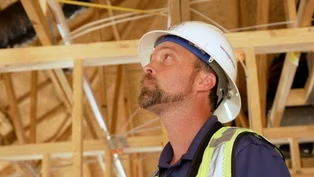
Building With Our Veterans program builds better future
Video has Closed Captions
Veterans with building safety experience have a home in this Mecklenburg County program. (3m 10s)
Preview | Veterans Closing the Skills Gap
More employers say the skillsets soldiers bring back from deployment make them invaluable. (20s)
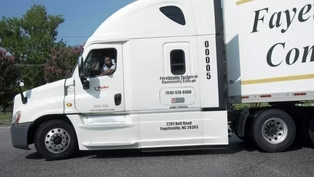
Transition Tech helps veterans find work in high demand jobs
Video has Closed Captions
A Fayetteville Tech program offers assistance to veterans entering the civilian workforce. (2m 24s)
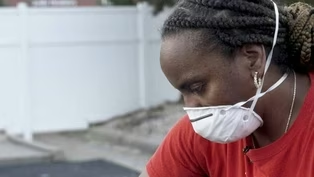
Veterans bring a sense of duty to their work
Video has Closed Captions
A Vietnam veteran says today's soldier comes back from deployment with unique job skills. (2m 53s)
Providing Support for PBS.org
Learn Moreabout PBS online sponsorship
- News and Public Affairs

Top journalists deliver compelling original analysis of the hour's headlines.

- News and Public Affairs

FRONTLINE is investigative journalism that questions, explains and changes our world.











Support for PBS provided by:
ncIMPACT is a local public television program presented by PBS NC