
The Way to Kindness
Season 17 Episode 6 | 24m 53sVideo has Audio Description
An episode devoted to Nebraskans who let their kindness shine. This time, the spotlight is on them.
A miniature car exchange allows kids to take a Hot Wheels and leave one in return. A 98-year-old, Hastings man is baking pies and giving them away to anyone in need. At Lincoln Bike Kitchen you can get a bike or fix yours for free if you volunteer. Our Place is a place for teems with disabilities to gather after school. An episode devoted to Nebraskans who let their kindness shine.
See all videos with Audio DescriptionADProblems playing video? | Closed Captioning Feedback
Problems playing video? | Closed Captioning Feedback
Nebraska Stories is a local public television program presented by Nebraska Public Media
The Way to Kindness
Season 17 Episode 6 | 24m 53sVideo has Audio Description
A miniature car exchange allows kids to take a Hot Wheels and leave one in return. A 98-year-old, Hastings man is baking pies and giving them away to anyone in need. At Lincoln Bike Kitchen you can get a bike or fix yours for free if you volunteer. Our Place is a place for teems with disabilities to gather after school. An episode devoted to Nebraskans who let their kindness shine.
See all videos with Audio DescriptionADProblems playing video? | Closed Captioning Feedback
How to Watch Nebraska Stories
Nebraska Stories is available to stream on pbs.org and the free PBS App, available on iPhone, Apple TV, Android TV, Android smartphones, Amazon Fire TV, Amazon Fire Tablet, Roku, Samsung Smart TV, and Vizio.
Do you have a Nebraska Story?
Do you have a story that you think should be told on Nebraska Stories? Send an email with your story idea, your name, your city and an email address and/or phone number to nebraskastories@nebraskapublicmedia.org. Or, click the link below and submit your information on nebraskastories.org.Providing Support for PBS.org
Learn Moreabout PBS online sponsorship(upbeat music) -[Narrator] Through the seasons of Nebraska Stories, we've collected countless moments when Nebraskans let their kindness shine.
We're spotlighting a few of them in this very special episode.
(upbeat music) Up first a Hot Wheels library that sends young imaginations racing.
(upbeat music) An elderly baker and the tender healing power of pie.
Visit a kitchen that cooks up free bikes.
(upbeat music) A place to embrace the joy of being yourself, (upbeat music) and a long ago promise kept faithfully for generations.
(upbeat music) (upbeat music) (upbeat music) -[Carson] He builds cars, Yeah.
(upbeat music) -[Scott] For me, an auto technician, we don't have enough people in our industry the same way with the old car hobby.
Hopefully we influence them to maybe one day be a technician or maybe one day have the drive to restore an old car.
(upbeat music) -[Jessalyn] He kind of refers to himself lovingly as like a big burly bear.
But he's like the softest guy ever.
I mean, he's like the nicest guy I've ever met.
- Sure.
And get me when I cuss too.
I've always been into cars.
So as we grew up, it was me and some friends that run around at the car club meetings and hung out together while our dad's had the meetings or at other places while they were working on cars.
Since day one, I just knew I was gonna work on cars.
(engine idling) Being in the car club, that was just the normal, this is my career, this is my life.
(upbeat music) -[Narrator] Working in a mechanic shop may be a career to some, it's a passion for Scott and he hopes to pass his love of cars down to the younger generation.
-[Scott] We don't really have enough people coming up through the ranks with-the younger people like we did years ago.
And that all starts with the Hot Wheels.
(engine starting) -[Narrator] The conversation between Scott and a friend inspired an idea for children to love and learn about cars.
(upbeat music) -[Scott] It's a little book library that's been repurposed to hold Hot Wheels and it's the same idea when you're tired of your book, you would go trade it at the book library.
Well, it's the same thing.
When the kids are tired of their Hot Wheels, they can come trade it in the little Hot Wheels library and get a different car.
(upbeat music) (panting out of breath) (upbeat music) It's, it's cool.
Every kid smiles when they get one.
I mean, you'd buy somebody a cup of coffee or a drink at the bar.
Why wouldn't you get a kid a Hot Wheels and make their day?
You rarely do you ever give out a Hot Wheels and the kid doesn't just smile from ear to ear.
And the parents too.
(upbeat music) -[Jessalyn] Oh gosh, every time we see 'em, it's here.
Boys, you want some hot wheels?
You want some hot wheels.
So now it's like, what is it?
What year is it?
What make is it?
And it's, it's kind of fun.
(upbeat music) -[Interviewer] Where did all these cars come from?
- Mm mm.
-[Interviewer] How'd you... --From Scott and Scott.
-[Interviewer] Who's Scott?
The Hot Wheels guy.
(upbeat music) -[Scott] Primarily when we started, we were just doing just a little library, but we wound up with so many new Hot Wheels setting around that we had to do something with them.
So we just started handing them out to people.
(upbeat music) We give well over 500 away last year, new in the package.
And that's not counting what gets exchanged to the library.
(upbeat music) -[Jessalyn] Scott is notorious for just leaving Hot Wheels and random cracks and crevices all over town.
So it's kind of like an Easter egg hunt all the time with Hot Wheels.
(upbeat music) -He does hide them Everywhere.
-[Scott] When I walk uptown for something, sometimes we'll just kind of hide cars on the window, ledges around or on the edge of the steps on the courthouse.
What what we do is if there's car seats in the back of a car and we throw hot wheels in them car seats and the vehicle leaves.
And when they go to pick up the kids at daycare or grandma and grandpa's or school and all of a sudden they find a Hot Wheels (upbeat music) -[Narrator] A toy as simple as Hot Wheels can spark the imagination and love passed down by generations.
(kids laughing) - So every Father's Day there's a huge rod run just right around the square here in Ord.
And it's always like a huge thing is bring your dad, come look at the cars and it's really fun with the Hot Wheels now my kids are starting to figure out what cars are and what this make and model is.
So they'll be like, we have that hot wheel, the Hot Wheels library, and then the car show.
(kids squealing) -[Scott] At the end of the day, what did you do to make your community better?
That's it.
If it's a Hot Wheels for a kid, then it's a Hot Wheels for a kid.
(upbeat music) NARRATOR: If you're looking for a good dessert in Hastings, you can find plenty of places to get a sweet treat.
But some of the city's tastiest pies and cakes come from the kitchen of this small home, where Leo Kellner has lived for more than six decades.
(doorbell ringing) WOMAN: Thank you, Leo.
MAN: Thank you, Leo.
WOMAN: Red Velvet's my favorite.
NARRATOR: The doorbell seems to always be ringing here, (doorbell ringing) as friends stop by to pick up one of Leo's culinary creations.
LADY: Thank you so much for making this cake.
Thank you again.
LEO: Yeah, okay.
NARRATOR: Leo spends his days in the kitchen, gladly, baking hundreds of pies and cakes every year.
LEO KELLNER: My crust is thick, flaky, tastes like, more or less like a cookie.
NARRATOR: And Leo Kellner is 98 years old.
LEO: I gotta have something to do.
I'd be dead if I wasn't doing this.
I lay at night in bed and think how I could change things, and make things better.
I've changed my pie three times, the apple pie.
NARRATOR: Leo grew up during tough times in the 1930's, watching his mom and sister bake with whatever ingredients they happened to have.
He spent a lifetime working with irrigation and grain-drying businesses.
He didn't retire until he was 92, that's when Madeleine, his wife of 72 years, got sick and passed away.
LEO: I started 12 months or so after my wife died.
I was sitting there, not knowing what to do with myself.
I was used to working and I had given up what I was doing, you know.
I was sitting here in the house, and I said to myself, I can bake.
NARRATOR: He made 144 apple pies that first year and hasn't stopped since.
You might think it provides a great retirement income for Leo, but the thing is, he doesn't charge a cent.
He gives every one of his pies and cakes away for free to friends, those who are sick, or the hospice volunteers, to those attending a funeral, to an elderly woman or a man who just can't afford a good meal.
LEO: You don't know what that means to a person unless you've been poor like I was years ago.
I would've been so tickled.
My folks couldn't even give me a pie or a cake or something.
So I've lived that life, and that's why I am happy when I can help somebody put a smile on their face.
(doorbell ringing) MADDY MUSICH: Hey, Leo.
NARRATOR: Leo is even building a pie-making legacy.
He's mentoring 12 year old, Maddy Musich, teaching her how to bake, because, as Leo puts it, girls today need to know more than just how to run a computer.
MADDY: Is that good enough?
He's like my other grandpa, kind of.
When I get older, I wanna bake for my kids, and teach them how to do it.
And even if they don't like it, just who doesn't love food anyway?
LEO: I consider her just more than a friend.
Part of me, when I go, I want her to take over where I left off.
Because I think she will.
NARRATOR: He can share his recipes with Maddy, but she'll soon learn Leo adds something to his pies and cakes that you can't buy in a grocery store.
LEO: I make it with love.
I don't make it just to be making it.
I make it with love, and it's my secret ingredient.
(slow guitar music) KYLE LUTTGEHARM: I think bikes are important for community for a variety of reasons.
A bike is more than a bike.
It's transportation and something that can completely change, change their lives.
(light guitar music) I think it can be a lot of different things to a lot of different people just depending on the situation and what you want out of the bike.
NARRATOR: Bikes have played a significant role in the life of Pepe Fiero, founder of the Lincoln Bike Kitchen.
PEPE FIERO: I was living out of my car, it was a bike that helped me get back on my feet.
And once I did get back on my feet I noticed kids walking to school, you know, to college and I thought well, if it can help an old guy like me, what would it do for them?
So I started picking up bikes at yard sales, in alley's, trash cans, and taking them over to the bike shop downtown where they would clean them up and then I would park them in front of coffee shops.
The issue still was there that I had a lot of bikes in my garage.
Carol Smith said she had a storage for me.
She gave me the address and when I got there I thought it was the garage, it turned out to be a little house.
I put up a Facebook page and I put we need volunteers.
If you have any experience bring it.
If not, that's okay, because I don't either.
And we opened at 12 and I think at 12:15 the first two volunteers actually showed up.
And the rest is history.
MALE VOLUNTEER: You want that number for Peter's bike?
JAY: Yes.
KYLE: We have a earn a bike program that takes approximately 20 to 25 hours to complete.
When you start it you have 10 hours that are required, that you volunteer to the kitchen.
We have volunteers strip the bikes, clean the shop, patch the tubes, do kind of day in and day out things that keep us going.
B.J.
GREEN: So then, they get a bike because they have worked for it.
They work with a mechanic to refurbish their bike.
You don't do any kind of going on to the grass and ride in the grass?
GIRL: Tricks and all that?
B.J.
: Yes.
GIRL: Sometimes, not really.
B.J.
No, not really?
All right, let's go upstairs.
We have a kids bike program.
They come in, they get sized, our mechanics refurbish their bike and they walk out with a safe, well-functioning bike.
(upbeat music) KYLE: It's to help kids get on bikes without any requirements.
Kids just need a good bike and I think that that's an absolute necessity in a child's life.
KYLE: Yeah, much better.
(upbeat music) B.J.
: We've got a bike repair program.
Your bike's not working, you come in, you see us, we've got really terrific, knowledgeable mechanics.
You get your bike up on the stand, get it fixed, you keep going.
NARRATOR: The Lincoln Bike Kitchen ran for three years out of the house on 15th Street.
But they soon discovered that a new location was needed.
So in 2013 the bike kitchen moved to First Street.
Although it's a better facility overall, the new location comes up a new set of challenges.
B.J.
: The number one challenge is paying rent.
The Lincoln Bike Kitchen does not charge for any of our services.
You get a repair, we don't charge you.
You need a part from our parts bin over here, we don't charge you.
We don't charge for anything.
So paying rent can be a little tricky.
We have had really a lot of support from the community.
We've held fundraisers.
We had a grand opening party.
We had a soup supper.
And that's been a good fundraiser.
JAY: That's what the shop is about.
Everybody coming together and doing what you can, and we have so many people who do so many different things and I think that's like the real heart and soul of this place.
MALE VOLUNTEER: This come off, he was on the ground, this come off.
B.J.
: Bikes are amazing.
They're amazing machines and they're amazing for what they do to ya.
PEPE: What I wanted was to see people get empowered again.
You know, it's a kitchen to feed the lack of transportation for those that need to get back on their feet.
JAY MAUK: We help people get lives.
We help people get healthy and stay healthy.
We help them get around.
We help them know their neighborhoods.
And that's what we do.
A bike is life.
- Matching.
- The yellow goes over there.
- Oh, I did need- - The back of the tile -matches.
-- Good.
-There you go.
- Good job.
-Nice one.
- We've got peak.
(gentle music) -[Adeline] To be able to have your child go to a place that you know is safe, that they love to go to, (gentle music) it's everything.
(gentle music) That's what every parent wants.
(gentle music) - [Narrator] Before 2018, there was no place for teens with special needs to go when the school day was over in Hastings.
Parents were forced to find in-home care or leave work early to ensure their kids were safe.
As Adeline was looking at these options for her own daughter, she knew there had to be a better solution.
-[Adeline] Our oldest daughter, who is six years older than Zoe, she was a junior in high school and it kind of occurred to us, oh, she's going to college.
What shall we do now?
And so I started hunting around other like Special Olympics parents and saying, "So, what do you guys do?"
"We stay home."
Well, that's not an option.
I'm a teacher.
My husband works a day job.
That's a no.
We just gotta figure this out, and so I started asking, "Well, what if we did our own?
What if we like co-opt something?
Could we do that?"
- [Narrator] They did exactly that and started their own program.
Our Place After School Care.
It began in the basement of Adeline's Church, but quickly grew into a place of its own that let them help others, like Joslynn.
-[Erin] My daughter Joslynn, she's 15.
She was born early and she has cerebral palsy.
So, she's in a wheelchair.
She's 100% physically dependent on others to care for her.
So, life before Our Place was I had in-home care providers that would come to my house and watch her until I would get home from work.
Unfortunately, recently, she started to have some pretty significant health issues.
She's been having some seizures, and so my providers in-home are not able to provide the emergency medication, and so unfortunately, they had to let us go.
I was actually looking to have to cut back my hours at work, which literally means not enough money to put food on the table, to pay my mortgage, to provide the things that my kids need.
- There ya go.
- Oh.
K. Here, Zoe.
Will you throw that away, please?
-[Joslynn] Well, that was no yolk.
(people laughing) - [Caregiver] That was was no yolk.
- That was no yolk.
Like, that was no joke.
- [Caregiver] Right.
-[Erin] She absolutely loves it here.
The caregivers that I would have in-home before would be middle-aged, maybe a little bit older women, and so she's a 15-year-old girl.
She's a teenager, and so having other teenage girls that she could be around, it just makes her thrive -in that area.
- Almost a strike!
- [Adeline] Depending on the day, if they're in the mood, they'll do games or things like that.
Otherwise, sometimes, they're just hanging out, talking.
-[Raegyn] They do a lot of fun activities, like games, baking, snacks, cupcakes, usually always cakes when we bake.
Otherwise, we also do art, crafting.
- It's just more fun than stuck in my bed.
(gentle music) -[Christie] We have families with kids with special needs that there are so many different things that they explore or need, maybe like being able to hang out with friends, but going to birthday parties or hanging out with friends after school is not something that they get a chance to do.
- [Narrator] Our Place was created to give teens with special needs opportunities they didn't have before.
In 2022, they took it one step further by opening a consignment store to give the students a new level of independence.
- [Adeline] So, the Freedom Factory happened, because we saw a program called Roots to Wings in Arlington, Nebraska, and they do that program for 21 and older, and I thought well, that's a fabulous idea that their people make things, and then they sell it in a consignment store.
I thought, well, why couldn't my teens do that?
(gentle music) They get their first paycheck and one is just staring at it, mouth agape, doing this jump up and down kind of thing.
It's just so fabulous.
- Who's ready to frost some cupcakes?
- Woo hoo!
- I am!
- [Narrator] These past six years have just been the beginning for Our Place After School Care.
Dreams and ambitions for the program are big.
No matter what growth comes in the future, their focus on caring for and celebrating teens with special needs will always remain.
-[Erin] Moms and parents, advocates are allowing those kids to be seen, and so we're not ashamed or shunning or hiding them away anymore, and so we have to give them the full realm of being able to fit into a community and having a space that's safe.
(gentle music) -[Adeline] That's why our name is Our Place, 'cause it is their place.
It's where they can go to be themselves and not have to worry about what someone else is thinking or any of those kinds of things.
(gentle music) - On your napkin.
There's your knife, honey.
(traditional Native American music) DWIGHT HOWE: We had that fire going at five o'clock this morning and we, the soup is ready.
NARRATOR: In a world of war and bad weather we don't often hear stories like this.
On a spring day the people of Neligh, Nebraska, many descended from German pioneers gathered together at the invitation of the Ponca and Omaha Tribes.
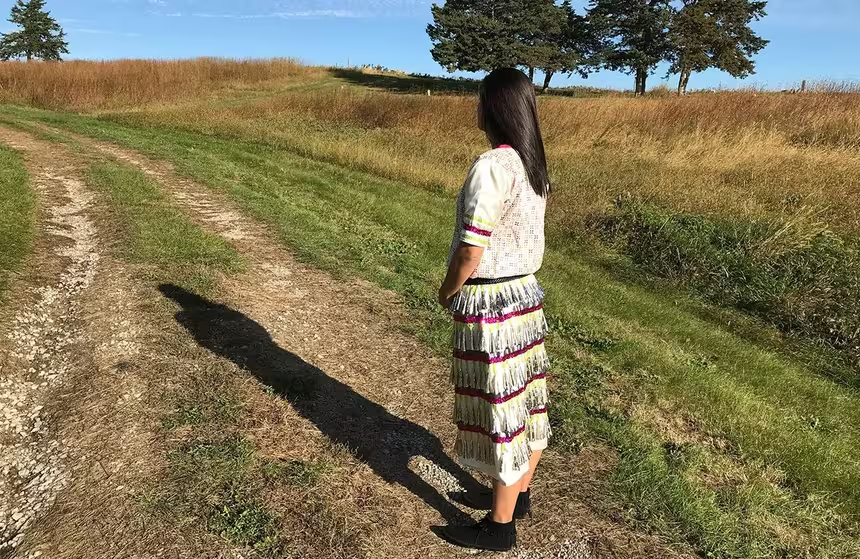
Here to be thanked for keeping a promise.
(drum beats and Native American singing) It's May 22, the anniversary of a death.
We're at Neligh's Riverside Park bounded by the Elkhorn River swollen full after hard spring rains.
In 1877, members of the Ponca Tribe were exiled from their Nebraska homeland into a place called Indian Territory.
(traditional Native American music) DAN JONES: Picture this, 600 human beings coming through here, your community, this time of the year, 134 years ago, the banks are full of water, and our people were forced through that water.
(thunder rumbles) NARRATOR: It was the spring that hundreds of Ponca people, men, women, and children, were forced to leave their Nebraska homeland and sent on a nightmare journey into Indian Territory.
(wind howling) JOE STARITA: They began in the early morning hours of May 19th to ford the Niobrara River and to begin moving the entire village, more or less on foot, from the Niobrara, Nebraska-South Dakota border to Oklahoma.
NARRATOR: Five days into the 55 day journey a baby girl died of pneumonia.
Her father begged the people of Neligh to help bury his daughter and watch over her grave.
(hammering) The town carpenter made a cross and they had a graveside ceremony.
Decades later the people of Neligh put up a granite stone and they kept their promise.
There are always flowers on the grave of White Buffalo Girl.
(melancholic music) DWIGHT: Wiblaho to all of you, thank you.
Wiblaho, thank you very, very much.
NARRATOR: Members of the community receive a blessing.
SHAMAN: The city, all that's near and dear to you.
Blessing home to them all on behalf of this little girl here I must say thank you.
NARRATOR: Now it's time for a feast, corn soup and fried bread.
(people laugh) GLORIA CHISTIANSEN: We are very honored by all of this.
This is another chapter in which the young people are going to be able to experience.
So much of this goes away with time.
LEVERN HAUPTMANN: It makes a person really feel good.
It shows the commitment of our local citizenry through all of those years.
NARRATOR: Levern Hauptmann has never forgotten the words that were spoken at the dedication of the historical marker at Neligh's Laurel Hills Cemetery.
LEVERN: "May the warm winds of heaven blow safely "on this site and may the great spirit bless "all who have joined in these services."
(upbeat music) (upbeat music) - [Narrator] Watch more Nebraska stories on our website, Facebook and YouTube.
Nebraska Stories is funded in part by the Margaret and Martha Thomas Foundation, and the Bill Harris and Mary Sue Hormel Harris Fund for the presentation of cultural programming.
(upbeat music) (upbeat music) (upbeat music) (upbeat music)
















Support for PBS provided by:
Nebraska Stories is a local public television program presented by Nebraska Public Media