
Thank Your Lucky Stars & Harley Valley
10/9/2025 | 26m 46sVideo has Closed Captions
Morehead Planetarium in Chapel Hill and Dale’s Wheels Through Time Museum in Maggie Valley.
Discover the story of how Apollo Era-astronauts trained at Morehead Planetarium in Chapel Hill. Then, visit Dale’s Wheels Through Time Museum in Maggie Valley for a motorcycle ride through our nation’s past.
Problems playing video? | Closed Captioning Feedback
Problems playing video? | Closed Captioning Feedback
Best of Our State is a local public television program presented by PBS NC
Thank Your Lucky Stars & Harley Valley
10/9/2025 | 26m 46sVideo has Closed Captions
Discover the story of how Apollo Era-astronauts trained at Morehead Planetarium in Chapel Hill. Then, visit Dale’s Wheels Through Time Museum in Maggie Valley for a motorcycle ride through our nation’s past.
Problems playing video? | Closed Captioning Feedback
Where to Watch Best of Our State
Best of Our State is available to stream on pbs.org and the PBS app.
Providing Support for PBS.org
Learn Moreabout PBS online sponsorship- Coming up on Best of Our State.
(engine starting) Before they reached for the stars, they looked to the skies right here in North Carolina.
And we're cranking it up and heading west to the Smoky Mountains where motorcycle history comes alive.
That's next on Best of Our State.
We dip into treasured stories for a look at all the beauty and character of North Carolina.
Hello, I'm Elizabeth Hudson, Editor-in-Chief of Our State Magazine and your host.
Before they walked on the moon, they walked through these doors in our state.
From 1959 to 1975, every Apollo-era astronaut, including Neil Armstrong and Buzz Aldrin, trained at the Morehead Planetarium in Chapel Hill.
Join us for the incredible story of how celestial navigation training at Morehead helped shape and even save America's greatest space missions.
- For 16 years, Chapel Hill was a secret space town.
Everybody thinks about Houston, Cape Canaveral.
Nobody thinks about Chapel Hill, North Carolina.
Yet 62 astronauts came to Chapel Hill secretly to train on celestial navigation, stellar identification at Morehead Planetarium and Science Center.
You had the first people to walk on the surface of the moon, the first people to go into outer space.
They came to Chapel Hill so that they would know how to safely return to the Earth.
For them to make it back home to their families, to their loved ones, and to more spacewalks, hopefully in their future, they had to come here, and there's no other way to do it.
Imagine how many people have come to Morehead Planetarium and sat in here and had great field trips, and they don't realize necessarily that they're sitting in the same space as a lot of moonwalkers in the 1960s and '70s.
- A lot of people are surprised when they hear about our role in the early space program.
For years, it was a matter of national security.
You have to remember the space race was a part of the Cold War, so in many ways we were the front lines of the Cold War.
I'm Todd Boyette.
I'm the director of Morehead Planetarium and Science Center.
Morehead Planetarium opened in 1949.
We were the first planetarium anywhere in the world on a university campus, the first planetarium in the South.
- John Motley Morehead was a man who really liked to have his name on things.
He really wanted to make sure that he was giving gifts back to the people of North Carolina.
My name is Michael Neece, and I have worked at Morehead Planetarium off and on since September of 1991.
It was an elegant, beautiful building with bronze railings and velvet rope and just every room with marble and wood paneling, just a gorgeous facility.
And he spared no expense when it came to the equipment in the dome.
- The spectacular production staged in the planetarium portray exact heavenly configurations from thousands of years past or hence.
It is visited annually by thousands of school children and adults alike.
- There's a kind of anecdotal story about a senator or congressperson from New Jersey saying the people of North Carolina were astronomically ignorant, and Mr.
Morehead took that personally.
My name is Nick Eakes.
I'm an astronomy educator here at Morehead Planetarium and Science Center, and I do all sorts of things, but mainly I work in our full-dome theater, teaching people all about the nighttime sky.
The space race was in full force already.
Sentiment in the United States was getting behind the fact that we wanted to send people into space and get humans on the moon.
- We choose to go to the moon in this decade and do the other things, not because they are easy, but because they are hard.
- The early days of NASA, they had their operations in Langley, Virginia.
Langley, Virginia is pretty far away from Houston and pretty far away from Kennedy Space Center.
And so for them to be flying anywhere, well, it didn't make sense for them to go any place other than flying on that flight path directly over Chapel Hill, North Carolina.
- Chapel Hill in the '60s, early '60s, was a somewhat sleepy university town, so these astronauts who were rock stars in many ways, their privacy could be protected, they could be focused, they needed no distractions, because what they were learning here was very, very important.
The idea of celestial navigation is going back to our ancient mariners who would navigate ships using the night sky.
So the idea is can you do that in space?
And you probably need to do it in space, especially in the early space program because the navigation systems were so primitive.
- Onboard the Mercury, Gemini, Apollo spacecraft, if the onboard navigation failed, they had to reference the stars out the window to be able to figure out their coordinates and plot a safe return to Earth.
Practically, the astronauts were learning guide stars.
So we were able to project specific stars with markers on the planetarium dome, and the astronauts sat inside of mockups of their actual space capsule.
- They actually took a barber's chair and mounted a seat on it that was a good replica of what the spacecraft would have, and then they would move the barber's chair around and then they would open up the night sky, show the night sky, and then the astronaut would have to determine where he was in space.
- They would say, "Okay, point out the things that you know."
They were all pilots.
They knew a lot of constellations.
They knew some bright stars.
So they were able to point out some things.
And then they would say, "Close your eyes."
They would spin the star machine so the stars would be in a whole different space.
And then they would say, "Open your eyes.
Now what do you see?
Now what can you spot?"
- You have to think about it.
It's one thing to do it when your feet are on the ground and you're looking up and you're oriented.
You know where you are.
In space, what if you're upside down?
What if you have no way to orient yourself?
There's no horizon.
You don't know exactly where you are.
- The original star machine was a Zeiss Model 2.
It was the most advanced piece of equipment anywhere in the world.
- It was definitely a big deal to have this machine here because at the time that Morehead first opened, it was only the eighth planetarium built in the United States.
I'm Richard McColman.
I am the full-dome theater manager, which basically means I run the planetarium theater.
These Zeiss projectors were sort of the Rolls Royce of simulation technology back in the day.
But what we're looking at is, you can see there's a big sphere or a big ball right there and then another one which is further up on top of it.
This larger sphere or ball is basically what we call the star ball.
So you can look at all of these lenses.
They look like a bunch of eyes on the projector.
Each one of those lenses would project several hundred stars and when you put them all together you'd have a whole dome full of stars.
- So the beautiful thing about this was that we could take you to any place, any time on Earth.
So if you wanted to go back 2,000 years or 10,000 years, you wanted to go forward 200 days, I mean, you pick it, you'd be able to do it with this.
- There were accurate star maps that have been made for thousands of years, but being able to actually manipulate it with the planetarium technology on the dome led them to practice better.
So this was a place that had a very accurate reference for what they were actually seeing in the stars.
- We live in such a digital age, it is hard to imagine in what it was like in the 60s.
Basically what we were doing was putting people in a tuna can, strapping dynamite on their backs and pointing them in the direction we wanted them to go.
It wasn't that bad, but it was, compared to what we know now, it is almost like that.
And I know we talk about how brave these men were.
I don't think we talk about how studious they were and how smart they were, because they had to know the night sky better than anybody.
Their missions depended on it.
- Apollo 12 was one of the situations where they had kind of a crisis on board.
- We had won.
We had landed on the surface of the moon with Apollo 11, but the public sentiment was still there for NASA to keep going back.
So after the historic flight in July, November 1969 is when Apollo 12 was slated to go to the moon.
- This is Apollo Saturn launch control, three hours, twelve minutes and counting, the Apollo 12 crew now departing the crew quarters, boarding their transfer van, ready for the nine-mile trip to the launch pad.
On the launch pad it was a kind of stormy, cloudy day.
- They made the mistake of assuming that during a rainstorm they could go ahead and launch, not realizing that as the rocket and spacecraft ascended through the clouds, it would actually generate an electrical discharge, in this case, of course, in the form of lightning.
- Ignition sequence start.
Six, five, four, three, two, one, zero.
All engines running.
Commence liftoff.
Pete Conrad reports the yaw program is in.
Tower clear.
- The rocket's exhaust kind of acted like a big wire, hanging down from the end of the rocket down to the ground.
And so essentially it acted like a big lightning rod, but they were on the lightning rod.
- Thirty-six seconds later, lightning struck the spacecraft.
- I don't know what happened here.
We had everything in the world drop out.
I'm not sure we can get hit by lightning.
Fuel cell lights and AC bus lights, fuel cell disconnect, AC bus overload, one and two, main bus A and B out.
- That knocked most of their spacecraft electrical systems off line, including their navigational system.
Now fortunately, the rocket had its own onboard navigational system, and it was able to carry them up into orbit.
Once they got into orbit, they had no separate navigational reference inside the spacecraft.
- In space and on Earth, they checked out the systems.
- The astronauts actually had to completely align their navigational system from scratch, citing key guide stars.
The work that the Apollo 12 astronauts did was essentially due to the training that they had received at Morehead.
So not only was the mission successful, but of course it got the astronauts home safely.
- Without using the different measurements that they were taking in here and all of that training, they would never have returned safely to the Earth.
- The astronaut training program is an incredible part of our history.
We will always want to celebrate it and talk about it.
And at the same time, we continue to serve North Carolina and beyond through our programs and activities.
- Morehead Planetarium does not formally train astronauts anymore, but we informally train tons.
Because we have school kids who come through here.
We have the general public.
Your friends come from out of town, you bring them here, you can sit in these same seats.
So we may not formally train astronauts, but who knows what little kids are going to walk into this dome, look up at the stars, and be really excited about it, and then pursue that next career and be the first person to walk on Mars.
- [Elizabeth Hudson] In the heart of our state's smoky mountains, a bike museum like no other has roared to life.
Dale's Wheels Through Time Museum boasts 400 motorcycles, one legendary family, and a legacy firing on all cylinders.
So hop on, we're going to crank it up and take a joyride up to Maggie Valley, straight into America's motorcycles past.
(motorcycle engine) - At the time, there weren't even motorcycle museums.
- Yeah!
- It wasn't even a thing.
- It wasn't even a thing.
It's overwhelming.
When you walk in the door, it's like, how could this all be here, all of this history in one place?
Collecting and preserving, it's one thing, but what this place is really about is getting the next generation inspired about where we came from.
This is actually the motorcycle that started the museum altogether.
This is my dad's first machine.
He actually bought this bike when he was 15 years old.
He was behind an old service station on his way to school, and they ended up selling him the bike for $20.
He locked himself in the garage for about a month or two and rolled this motorcycle out.
The bike's a 1957 Harley-Davidson Servi car at its inception.
As you can see, it's all stripped down and rebuilt with that late 1960s kind of chopper look, so it was really the machine that ignited his passion for Harley-Davidson and his passion for motorcycles.
My dad was Dale Walksler, lifetime motorcyclist.
He opened his own motorcycle shop when he was fresh out of high school in Glen Ellyn, Illinois.
At the age of 22, my dad became I believe the youngest Harley dealer in the history of the company.
My dad had always been passionate about motorcycle history, and as his early years as a Harley-Davidson dealer, started to develop a collection of vintage machines.
My dad started the museum as a car museum.
It was Dale's Classic Cars.
Over time, the cars became fewer, and the rare motorcycles became more and more prominent.
His appetite for early motorcycles was - fierce would be an understatement.
It had to be American-made.
He loved bikes with character, bikes with personality, bikes with great stories.
On my table to the right here is a 1903 Indian motorcycle considered by many in the transportation world to be one of the most important innovations of the 20th century.
Basically attach one of the earliest internal combustion engines to a bicycle chassis.
It's what we call a Camelback Indian, which got its name from this kind of rear gas tank and oil tank.
It was the beginning of personal motorized transportation in America, period.
- Before the motorcycle comes out, the fastest thing that the average person has ever seen is a horse at full gallop.
And so now you have these machines coming out that are running 30, 40, 50, you know, not very long, 60, 70 miles an hour.
It just had to be an incredible thing not only to see one, but even to be able to get on and ride one.
So your big companies, your Harleys, your Indians, your Excelsior motor companies were able to develop a transmission in about 1915 or debut it for 1915, the same year as this bike.
The only way to get the engine spinning is to spin the rear wheel.
Coming from bicycles, you spin the pedals to spin the wheel.
With the transmission, all of a sudden now your bike becomes capable and it becomes versatile.
You sense the beginning of motorcycling.
Those manufacturers learned that the best way to sell motorcycles or the best way to get in front of potential customers is to win through various competitions.
So as you move into the Great Depression, maintaining these big monster tracks made of wood, filling grandstands became increasingly difficult to do.
So huge growth in popularity of hill climbing in the 1920s.
It's a form of competition that really required significantly less of a financial impact.
Bikes on the hill here at the museum are some of the rarest motorcycles in the world, bar none.
Just to my left here is a one-off 1935 Harley Davidson 80 cubic inch factory hill climber.
The 80 cubic inch class definitely needed that big sturdy frame.
The gas tanks specially made for the frame.
Hill climbing, very much just like it sounds, the goal was to get to the top of the hill the fastest.
My dad found Maggie Valley by chance.
He was on his way back from a car show in Florida.
- Here's the fun part!
- Driving back to southern Illinois.
He was coming on I-40 and stopped to get fuel.
Driving in western North Carolina, the beauty attracts you.
Some of the prettiest mountains anywhere in the world.
- All right!
- He actually found this piece of property that day.
He decided to pick up and move here in 2001.
My dad extended the invitation for me to come work here at the museum.
Typical day, get the doors opened up, start to welcome visitors, spend the day sharing history, telling stories.
Museum closed at 5, 5 minute stand up dinner, head back to the shop.
The evenings in the shop, called it the 6 to midnight gig and most nights it went well past midnight.
Those moments for me were some of the most exciting periods of my life.
(engine starts) - Yeah!
Yeah!!
- Getting to revive one of those bikes and hear it run for the first time in maybe 80 or 90 years.
There was no thrill like it.
- Every day inside the museum we were firing up bikes all the time.
There are certain bikes though because of their rarity that we fire up on special occasions.
The Traub is one of those machines.
This is the only one that was ever made.
It's a one of one.
Everybody's heard of Harley, they've heard of Indian.
Nobody knows the name Traub.
In fact, nobody knew what this bike was when it was found in 1967.
So they're tearing down a building in Chicago at 1520 North Palina Street, knock through this brick wall.
As the dust clears, they see something sitting behind the wall, and here this bike is hidden.
And what we've been able to determine was this was built by a gentleman by the name of Richard Traub.
Based on the seat, the carb, and the mag, we know this bike was built about 1916.
But when you take the engine apart and you look at the bore and the stroke, it's around 78 cubic inches.
For that period of time, it was 20 years ahead of Harley and Indian and where their development was.
When most people think of a homemade motorcycle, you kind of have your mind to something that's been cobbled together.
You see all the weld marks.
There's no mistakes on this bike, but he poured his heart and soul into this.
If you build a machine that's this beautiful, this capable, why do you never do anything with it?
Unless somebody happens to come across Traub's diary at a yard sale somewhere, we're probably never going to be able to answer.
Because of its rarity, we don't run it all the time.
So we always tell people, "You never know when you're going to hear it run."
Because when I say special occasion, it doesn't mean that it's a special event at the museum.
Someday we just decide it's a special occasion.
And we're going to fire it up.
My dad passed in 2021 after a long battle with cancer.
He was sick for a long time.
You know, walking through the museum, you can still feel his presence.
He's everywhere in here.
I watched my dad over his many, many years inspire so many people.
I can only hope to do the same.
Working alongside Matt and Dale, they really are both cut from the same cloth.
I'm here because of the passion and excitement that Dale and Matt had for this stuff.
One of my favorite parts of this job is not just being able to share the history, we get to hear their stories.
You'll have a guy come in and he'll say, "Hey, my granddad rode a 1937 Knucklehead.
Do you have one?"
And so you go over there and you show it to them, and a lot of times these guys will just tear up because that was the first motorcycle they ever rode on.
- One of the earliest memories of being around motorcycles is my dad setting me on the seat of his 1948 Panhead while it was running and putting my hand on the throttle.
Seeing his excitability and seeing him be so passionate about something I think is also what really helped root this in me.
Having completed the project, I think it's a great honor to be able to be a part of this.
Having complete control over the direction you're headed.
You want to hear a run?
Yeah.
Excellent.
(engine starts) - [Elizabeth Hudson[ You know, here in North Carolina, light has always meant something to me.
I grew up in a house that had 19 windows and my mother kept every one of them spotless.
After the spring pollen, after summer storms, after a winter freeze, out came the paper towels and the windex.
My dad used to tease her, "You're going to wear a hole in those windows."
But he was just as devoted to the light.
That's why our windows didn't have curtains or blinds, just open panes letting the sunlight pour in.
Our house sat on a hill in Randolph County with the Uwharrie Mountains off in the distance and no neighbors in sight.
Just light.
Always light.
Even now, I still look for it.
Most mornings before I sip my coffee, I glance up the street to the house across from mine, my mom's house.
I look out her kitchen from my window and when her blinds are open, I know that means she's up, that she's fine, that everything is as it should be.
All across this state, that same light shows up, breaking through the fog on the Blue Ridge Parkway, sparkling down the rocks at Looking Glass Falls, glinting off the ocean at Oak Island.
Whether it's morning sun or the last bit of starlight at the end of a firefly chase.
The light always finds us.
And oh, how it shines.
(bright music) ♪ ♪ ♪ ♪ - More information about Our State Magazine is available at ourstate.com or 1-800-948-1409.
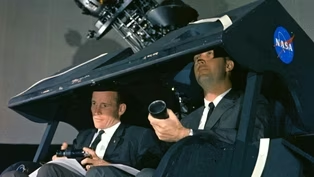
Preview | Thank Your Lucky Stars & Harley Valley
Video has Closed Captions
Morehead Planetarium in Chapel Hill and Dale’s Wheels Through Time Museum in Maggie Valley. (20s)
Providing Support for PBS.org
Learn Moreabout PBS online sponsorship











Support for PBS provided by:
Best of Our State is a local public television program presented by PBS NC