
Tan and Sober Gentlemen | Podcast Interview
Special | 47m 45sVideo has Closed Captions
The Carolina Celtic punk-bluegrass group discusses family, grit and pure communal joy.
Tan and Sober Gentlemen share how North Carolina’s deep musical traditions, Irish roots music and communal barn‑dance culture shape the band’s rowdy, high‑octane sound. From family legacies to punk‑folk energy, they reveal how community, humility and keeping “one foot in the dirt” guide their music and mission. Hosted by PBS NC’s James Mieczkowski.
Problems playing video? | Closed Captioning Feedback
Problems playing video? | Closed Captioning Feedback
Shaped by Sound is a local public television program presented by PBS NC
Made possible through support from Come Hear NC, a program of the N.C. Arts Council within the N.C. Department of Natural and Cultural Resources.
Tan and Sober Gentlemen | Podcast Interview
Special | 47m 45sVideo has Closed Captions
Tan and Sober Gentlemen share how North Carolina’s deep musical traditions, Irish roots music and communal barn‑dance culture shape the band’s rowdy, high‑octane sound. From family legacies to punk‑folk energy, they reveal how community, humility and keeping “one foot in the dirt” guide their music and mission. Hosted by PBS NC’s James Mieczkowski.
Problems playing video? | Closed Captioning Feedback
How to Watch Shaped by Sound
Shaped by Sound is available to stream on pbs.org and the free PBS App, available on iPhone, Apple TV, Android TV, Android smartphones, Amazon Fire TV, Amazon Fire Tablet, Roku, Samsung Smart TV, and Vizio.
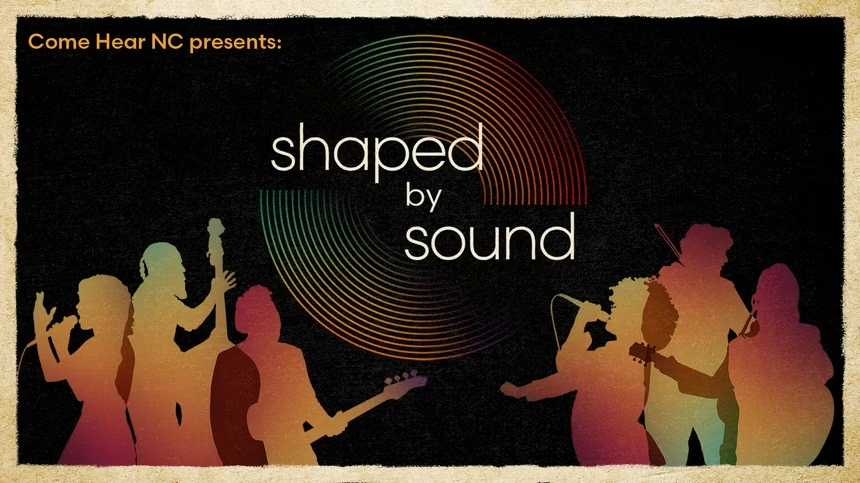
Explore Shaped by Sound
Dive deeper into Shaped by Sound. Explore the standout artists from Seasons 1 and 2, meet the show and podcast host, James Mieczkowski, and discover more ways to watch and listen.Providing Support for PBS.org
Learn Moreabout PBS online sponsorship- The Shaped by Sound podcast is made possible through support from Come Hear NC, a program of the North Carolina Arts Council within the North Carolina Department of Natural and Cultural Resources.
- All right, Ben and Tucker from the Tan and Sober Gentlemen thank you so much for being on the show today.
- Thanks for having us.
- I mean, we're really-- - A distinct pleasure.
- Yeah, we're excited to have you.
First thing I wanted to ask you, I heard you all say on a podcast, it's an interesting band name you have, what led you to the Tan and Sober Gentlemen?
You said that you are neither of those things.
- Yeah, none of the three.
- We didn't start that.
- Where did that come from?
- We got our start at a dearly departed Irish pub in Raleigh, North Carolina called the Tir-na-nog or Tir-na-nog if you pronounce correctly, which I do not 'cause I'm from here.
And got started as a pickup band, sort of going up there to figuring out how to play Irish music.
And the lady who ran it, our band's godmother, Annie Britton-Nice, put me together as fiddler and was like, "Hey, the band today didn't show up, "why don't you go play on Friday?"
And so we played and she called us the Tan and Sober Gentlemen 'cause at that point we were none of the three.
- That was great.
- And the gig went well.
She was like, "Okay, come back and do it next week."
So we came back and did it next week and then we were a band and that was our name.
- Yeah, wow.
- New name stuff.
- So shout out to her.
- Yes.
- Making that happen.
And that's a really fun name.
So I'd also kind of wanna take that and you sort of started to intro a little bit about the history of the band, but I kinda wanna take just maybe a larger step back.
Can you sort of talk to us about the, like how history influences the music that you all make?
'Cause it feels like it's so rooted in history.
- Yeah, we're all born and raised in North Carolina.
A very large portion of American music got its start in the Carolinas.
This is where-- - - By American music you mean old time?
- All American music in general.
- Yeah.
- Like the very first American music was something called old time music, which is a mix, way more complicated than this, but at its core it's a mixture between Irish fiddling and African banjo playing.
- Right, and like even the blues and everything was-- - And it all came out of that.
They first met somewhere along here in the 1700s sometime.
That tradition kept going, kept forking and sparking off different branches and whatnot, and blues and bluegrass and country music and gospel and all that's like rock and roll eventually all comes from that originally.
And I grew up playing old time music, that's what my family plays.
Courtney's from down in Johnson County and they've got that like real strong vocal tradition down there.
Her grandpa, Herman Rayner, was an old time fiddler.
Alan, our mandolin, accordion, multi-instrumentalist man comes from a very old contra dance family.
- Yeah, that's kinda-- - Contra dancing's one of the offshoots of American folk dance and it had died out in the South and it was his grandma that reestablished it in Charlotte, Nancy Howe.
So he grew up playing contra dance music, which is a specific mix of old time music and Irish music and whatnot, specifically formulated for that style of dancing.
Eli, our fiddle player is from up in Burke County and he grew up going to like the Swannanoa Gathering and Celtic Week there, learning from people like Jane McMorrin, Martin Hayes and John Doyle, learning that Irish element of North Carolina music.
Jake, our drummer, is a punk rocker and a marching band kid from UNC.
- He's very indie rock more than that, but yeah, definitely more indie than punk rock.
- He brings that, you know, the drumming aggression to it, and I'll let Tucker explain his own self.
- Yeah, I grew up, my family grew up with doing a barn dance and like both sides of my family have been in North Carolina and it's in Orange County for like 200 years.
I just kind of came up in it.
Like one of the songs we play, the Pig Song for example, like my grandmother taught me that and her mother taught her that, Mama Lou.
And that song comes from Ireland and the UK.
It's about the famine and a few other, it's just a tune we got passed down and I never knew where it came from until we went there.
It's just, it's always been around.
- You've kind of described really where you all were starting and sort of like where it came from down the line.
As the Tan and Sober Gentlemen, how would you describe the music that you all play?
- It comes from traditional music, but it ain't traditional in the presentation of it.
We got a drummer and we're trying to re-blend the North Carolinian and the Irish elements, right?
And just play it really, really hard and really, really fast and have a good time doing it.
- Yeah, yeah.
We're kind of, I mean, I like to say that, especially in the bluegrass scene, it's slowly turned into more highbrow music with the introduction of Sierra Hole and Chris Thile.
But it was a little different before with Ricky Skaggs and Tony Rice and incorporating jazz.
But eventually it just got to where it's more and more highbrow and more, but originally it was all like, it was party music.
It was meant to bring people together and so something that we are trying to blend back to bring everyone in.
It doesn't matter where you're from, who you are, it's just meant to bring people together and make people dance and have a good time because we especially need that.
- Yeah.
- Trying to bring everybody's brows back down to where they belong.
- Yeah, I was gonna say, let's get lowbrow.
Let's get lowbrow, y'all, love it.
- It's very, very true though.
This music reels our party music.
And if you've ever been to a good house party in the Western half of our state and you've got people dancing and drinking and packing together, you've got a really hot jam going on in the corner, playing like Rye Straw at 150 beats per minute, it's that energy that we're trying to capture and put on stage.
It's hard to do that with straight up acoustic instruments 'cause the stage in and of itself is a barrier between you and the crowd and we're trying to eliminate that barrier as much as possible.
So you add drums and you add the bouncing up and down element of the stage show and hopefully that brings everybody else up off their feet and giving us that energy right back and reestablishing that feedback loop.
- We want to make the crowd feel like they are being engaged with properly 'cause you know that you'll go to shows and it's entertainment.
When I go to a show, I'm a metalhead, so I love the mosh pit, I love shows that are theatrical and I love things that are in your face and you're just like, oh my gosh, right?
And then I've been to shows where I've been really disappointed because there was no audience engagement 'cause if I wanted to just go and see someone to have an intimate setting with listening to music, that's great, I'll do that.
But if it's one of those things where I want to see a band perform live and it's basically them playing exactly what's on the album to such an extent that it's like, oh, I could just listen to this at home, that doesn't really do it.
- Right, like where's that extra sauce?
- Right, it's part of that element of like, hey, we are not just musicians, we're entertainers and performers.
You know, we're just regular people.
That's what we're trying to bring back is like, hey, you're not-- - Bring the human element to it.
- Back to it, yeah.
- The songs will speed up or slow down.
Someone might hit a clam every now and again, but if you-- - I'll forget the words.
- But if you deliver it with the right energy, you'll get that right energy straight back.
- Yeah, and it's funny, I mean, gosh, as we were watching you all play, I leaned over to our producer, Matt, and I was like, I wish I was in the mosh pit right now.
- Yeah, that's exactly what we want.
- I mean, you nailed it.
You do just have this like energy, it feels contagious.
Other people have described you all as, I guess, like sort of like a hurricane.
(laughing) - Yeah, my boy, the Bristol Herald Courier.
- And I want to know, I mean, how do you continuously sort of bring that energy?
- We definitely try to stay healthier than we used to.
And I think-- - It just comes natural to it.
That's how the band does, at least for me, like the minute I step on stage, my blood gets pumping, I start getting ants in my pants.
- You get very antsy, yeah.
- Yeah, and there are enough of us on stage, too, that we can have our own little dance party, you know?
- Yeah, yeah, it's so fun to watch you all do that, to just like have fun with each other on stage, you know?
Like in jam and just like rock out.
And I feel like that does kind of feed into the audience.
And you can't stop that.
- I hope so.
We certainly have fun doing it.
- Good.
- I hope everybody else does, too.
- Can you all describe to us a little bit about your relationship with Ireland?
- My people are from there, but my mom's side is, you know, it's four generations back.
So like not enough that I got much of anything directly musically from there.
When I was like 19, 20 years old, and trying to figure out who I wanted to be, musically, so to speak, I went up to that pub, the Tir-na-nog.
It was there that Annie, the woman who ran that pub, took me under her wing and was like, "Hey, this is who you need to listen to."
Introduced me to all the local musicians there.
There was a whole crowd of expats from the north of Ireland down there.
And they would all play music, in particular a man named Jerry McCrudden would teach me songs.
And a man named James Olin Oden, he was real formative in that.
And that's where I remember just sitting in sessions there and being like, "This is the same music."
You know, it's gone, it's changed, but it's the same music.
And that's what gave me the idea of putting this band together to do that sort of thing.
- Yeah.
- You know, I grew up listening to Irish music and playing it with my family.
I didn't realize where it was from, for extent, 'cause it's been so long.
And like my family is very Scotch-Irish.
We grew up singing it like the tunes.
And you know, like it's something that I guess I never really thought too deeply on until I joined this band.
And like, but you know, we've been here from the Scotch-Irish forever.
And it's kinda, I guess it's lucky that it stuck around.
- And I know that, I mean, you all go to Ireland and like play these songs.
- Yeah.
- Yeah.
- So like, what is that like to be from the United States, North Carolina specifically, go across the ocean into like where this really came from and like play this sort of music?
- It's incredible.
- Yeah.
- Yeah.
- It was so much fun.
Remember the first time we went over there, I was pretty nervous about playing, you know, Irish music for the Irish, right?
- Right.
- And I'd been over there before, but not in performing capacity.
And I remember playing in Hackett, little tiny place about the size of this room we're in.
- Yeah.
- Yeah.
- And you know, playing our bluegrass songs and some girls like, "Do you guys know Dirty Old Town?"
- Yeah.
(laughs) - Yeah, we played, and once they figured out we knew all the old Irish songs, that's all they wanted to hear.
- Oh, you were in then.
- The whole streets singing along.
- Yeah, yeah.
- Yeah.
- Yeah, we did every, it was funny 'cause like, that was with our original lead singer, William, and we were, it was just tiny pub.
- Yeah.
- Like that pub is the size of this room.
And there's a bar in it and like 50 people and then us.
- Yeah.
- And our old lead singer, William, who's, you know, long hair, really tall, a little gangly.
And like, you know, he's got the one microphone singing into that out of a little speaker.
People are hanging through the window and he's shoving the microphone into whoever's soloing.
(laughs) - Oh, wow.
- It's just like, you know, it was very, it's one of the, it's funny 'cause like as, you know, a punk and metal head, that was the most punk thing we've done at the time.
And it was, it was hilarious, so.
- You all keep going back though, right?
It's not just like a one-off thing.
Like you all do this.
- We've been six times now.
- Yeah.
- Yeah.
- I mean, do you see yourself continuing to do this?
- Talking to people over there, now that we are established there, I think the reason why we go over well, or at least part of it, is that we're, we play Irish songs, but we do not play them in an Irish way.
- Mm.
- Yeah.
- We play them like we're from North Carolina.
- Right.
And that's what they're attracted to as well.
- Yeah.
- Yeah, yeah.
- 'Cause we're not pretending to be anything other than who we are.
- Yeah.
- Which is great, especially when we're playing some Irish song where it's a lot of like, ♪ Fiddle-dee-aye-dee-aye-dee-aye ♪ And our North Carolina house, they're, ♪ Fiddle-dee-aye-da-da-da-da ♪ (laughing) The pig song that we do is actually, the first time we went, I met this band called Alfie, that is their old-time musicians over there.
- Yeah.
- They're like competition musicians.
And we're sitting in the bar, and I all of a sudden hear that tune, and I'm like, how in the heck do you guys know this tune?
Like that my family has had, like nobody else knows it, in North Carolina at least, or like most people don't.
So we start talking, and they're like, this is an old, old-time and Irish tune.
They were like, that, you know, it was around, and I was like, let me hear your version.
And it's slightly different.
The melody is slightly changed.
Ours is definitely, it has a lot more movement in it.
- Yeah.
- And the hums are a little different.
But theirs, you know, you can look it up.
It's called the Pig Song on their album.
They have, check them out, they're amazing.
- Alfie, A-L-F-I with a theta.
- With a theta, yeah.
- Right?
- Yeah, yeah, they're really good.
And it's a banjo player, Uilleann pipes, harp, and guitar.
And they're really amazing.
Like, it was fascinating to just walk into a pub, hear that, and then all of a sudden, like, the connection immediately happens.
Like, it was wild.
- That happens every single time.
Like, just this past year, we were at the, I'm gonna try to pronounce this, yet again, the Flackiole Naharron.
- Close, close, Flackiole Naharron.
- Their National Festival of Traditional Music, in a jam at like 4 a.m.
in some pub.
And someone pulling out Whiskey Before Breakfast, except it's a jig, called Daniel O'Connell.
It was like, different time signature, and like, super Irish-y, but it definitely, the melody to Whiskey Before Breakfast.
- That's so cool.
- Every time, you know, more and more.
- It sounds like one of those things where, like, if we're gonna talk about the idealistic sides of like, America, and like, what we are, it seems like that is what it is, right?
Like, it's like, based in something from far away, but our interpretation of it, and also sort of giving this respect, and like, honor to it, right?
- Yeah, yeah.
- It's the melting pot, right?
You know, you can hear, for say, like, Miss McLeod's "Real," this is a Scottish tune, actually, but they play it in Ireland a lot.
It gets over here, and we call it "Hop High, Ladies," or this, that, and the other.
And you can hear how it's changed, by being in the South, and being exposed to African music.
It's faster, it's harder driving, it's got a rolling rhythm, rather than a straight up and down, bouncy rhythm.
- Two and fours, yeah.
- The Irish-Scottish versions have like, these triplet snaps that the melody instruments play.
The old time version, it's rolled over, like everything's on the front of the beat, it's got this (imitates drumroll) - Yeah, yeah.
- It's a little more modal, you know, there are more blue notes in it.
It's not like, straight up pentatonic scale, they'll bend the notes a little more.
- Right, yeah, that's something that, like, it's cool as a banjo player to, you know, like, I play an African instrument.
- Yeah.
- You know, it was brought over by the slave trade, and it's funny how the way that instrument traveled, versus the fiddle, was the opposite direction.
You know, banjo music, being an Irish music, happened much later.
And like with the, was it the Irish Revival of the '70s, or was it something else?
- The banjo went from the US to Ireland in the early 1900s.
- Yeah, yeah, yeah.
- During the golden age, quote unquote, before the Great Depression, when all the famine boats came over in the 1840s, right?
- Right.
- And then, once the Irish were well-established enough, and they won their independence in 1921, a whole bunch of people came back, and they brought with them the banjo, which at that point had turned from the five-string southern version into the four-string jazz banjo.
Came out in New Orleans, but was going around a lot, and that came back to Ireland, and occupies the same space as the bouzouki, or the mandolin, in Irish music.
- Yeah.
- It's a cool sound, and so what I've tried to do in our band is incorporate some of that sound, 'cause even though I play five-string, apparently the way I play is kinda weird, 'cause I do three-finger scrugs and two-finger, but the way I've just figured out how to play this is very straight melody, and incorporating the triplets where I can.
- Right.
- So I've actually, the way I switch back and forth is kinda interesting, apparently.
- You've stolen a lot from Don Reno, right?
- No, actually, I never listen to much of him at all.
I just figured it out.
My biggest influences are actually J.D.
Crowe and Jimmy Mills.
- Yeah.
- And, well, of course, Earl Scruggs, but everything I figured out on the single string, 'cause yes, Don Reno did play that way, but I'm doing kind of out of a D position, 'cause most of the tunes, it just works well, and incorporating that style to mimic the Irish trills, and also that just straight fiddle melody, and incorporating those, it's different, 'cause most banjo playing in the South with scrugs, reels, and everything is based off of arpeggios.
- Okay.
- Versus what I'm doing when we're playing certain songs is you'll hear me switch over.
I'm doing a mix of, I'm moving around the melody with the scale versus with the arpeggio in the core position.
- Yeah.
- That tends to happen with the banjo.
- So is that sort of like you introducing a jazz style?
- Jazz does do that, they have a, usually it's a four string banjo and a flat pick.
- Okay.
- I'm doing it with a five string with open tuning, open G tuning with three fingers.
- Right.
- And with the finger picks on.
- Right.
- So I have figured out a way to mimic that style with, and it's not new, I mean it's just my version of it, which is not, it's not new, it's not groundbreaking per se, but it sounds really well, and fits the role well.
- It sounds really cool.
Also you play, what is it, it's like a combination of a guitar and a banjo, is that right?
- No, no.
- It's just like an electric banjo?
- No, so I have a custom made electric banjo from Chris Capozzoli Guitars, you should check him out, he's got some incredible instruments.
- Yeah, yours looks really cool.
- Yeah, so that was a prototype he made.
- Huh.
- He's got two more, and he was gonna give one to Bella Fleck, but he chickened out.
(laughing) - Well Bella Fleck, if you're listening or watching.
- Yeah, yeah, yeah, seriously.
I am gonna go back to them, and we're gonna put my other banjo, which is an OB 250 plus, gold tone.
That neck design, it feels really comfortable as far as banjo playing goes, so I'm gonna get him to make one based off of those dimensions for this banjo.
- Yeah.
- That is the Capozzoli, and so I can swap it out, because he based the neck off of the good time dimensions for this banjo, 'cause you know, it's a prototype and we're figuring it out.
- What's the good time, you know what that means?
- So that's a D-ring banjo.
- Okay.
- I believe he based that off of the good time banjo, which is a good beginner series.
- Okay.
- And then they do-- - The D-ring banjo is the F-150 of banjos.
- Yeah, pretty much.
- Gotcha, all right.
- That's the good time banjo, so that's kind of the technicalities behind all that.
- Yeah.
- You know, Chris is a master luthier, he does amazing work.
- I like to, when we were talking to you all sort of before, you said this phrase and it really stuck with us.
It's, you said this phrase, the importance of keeping one foot in the dirt.
- Mm-hmm.
- Can you explain that to us a little bit?
- Just being-- - Got a couple-- - Grounded?
- I mean-- - Couple different-- - Yeah.
- Ways you can think about it.
One is that, you know, we're doing a punk rock version of it, but we are all rooted and trying to remain rooted in the traditional music of our state, right?
What I'm gonna do tonight is I'm gonna go get my bass out of the studio and I'm gonna play old time music with some friends in Hillsborough.
You know, Tucker's going out and playing bluegrass at the Bluegrass Jams.
Eli's got an Irish session going on at the Beltree Bar in Carrboro, he runs every Monday.
- Yeah.
- Like we all make sure to go out and play traditional music as it was intended, as social music, you know, not performance, just people gathered around playing it.
And then the second bit of that, this music comes from somewhere, right?
- Yeah.
- And, you know, a lot of the stuff we play comes from where we're from.
- Yeah.
- And I think there is value in being from and existing in the community that produces the music that you play.
My favorite thing that Hank Williams said was that authenticity don't matter a lick, it's all about sincerity.
- Yeah, sincerity.
- And, you know, I find it a lot easier to really mean a song about like a failing farm, for instance.
- Yeah.
- If I just helped the Willards patch up their shed the other week than I did if I had, you know, moved to Nashville.
- Right.
- Yeah.
- So it's that authenticity.
- Yeah, it's the sincerity behind that more.
- Yeah.
- 'Cause you can be authentic and, you know, there's something I like to say, this is specific, this is not everywhere, but like jazz musicians and bluegrass musicians sometimes have this, or where they were very dedicated to how it was on the album.
And they, we call them, my nickname for them is grassholes.
But there's this whole movement that's like, we wanna be very open and sincere about what the music is.
And, you know, 'cause there's a lot of gatekeeping in most genres.
And, you know, that's something that like, at the end of the day is not worth it.
And, you know, when you have to stay like one foot in the dirt, like grounded with what the purpose of this is.
And that is to like bring people together once again, but also like if you have someone who's trying to learn, who's also maybe not exactly perfect at what they're doing, but what they're trying to play a style and learning how to do that, the worst thing you can do is be like, oh, you're not from the scene.
'Cause I'll be honest, like we don't fit in in a lot of the scene.
Like it was really hard for us to make a presence at the IVMA for instance, or like, 'cause the IVMA is for example, they're wonderful people, bluegrass musicians are awesome usually.
And there's a very welcoming scene there.
But there's like this kind of weird competitiveness to it.
It's not bad, it's very healthy actually, but it's like, you gotta earn your stake, if that makes sense.
- Yeah, it seems like, it just seems like industry, music industry talks.
- Exactly, exactly.
- And this music is meant to be a community based music.
- Yeah.
- Yeah.
- Right?
- Yeah.
- Don't have a tight closed jam all the time.
But the only way this tradition survives is if you keep bringing people into it, keep teaching kids how to play, and have it be a place where those kids want to be, right?
You gotta be open, you gotta be welcoming, you gotta be down at the country store on Tuesday night, playing in the slow paced bluegrass jam to keep bringing people in.
'Cause that's the only way you're gonna get more players.
- And those jams need to be inclusive.
- Exactly, yeah.
- And it's like, whoever wants to play.
- Exactly, and it doesn't mean like, that doesn't mean you can't be selective and being like, okay, this guy needs to work and practice at home more.
Like, that's real.
You know, that happens.
- Sure.
- But, you know, and I'm just using bluegrass, that genre and scene, because that's like, that's a very good example of it.
It's a very open scene, honestly.
Like, please, we need more people.
But, you know, but there's a lot of, there's a lot of like stigma in society and about that stuff, and like, because it sounds backwoods, and there's a lot of cultural issues between that, that make it seem very, some people find it very intimidating, or they think it's too lowbrow, and like, that's just not the case, you know?
Exclusion, especially in a music that's meant to like, survive, you know, at the end of the day, and bring people together, 'cause we're all people, and you know, it's beyond art, it's community, and that's a very important thing.
- Yeah, absolutely.
- It requires something bigger.
- Yeah.
- And to your point about music industry, too, that's the other part of keeping one foot in the dirt, is that I've, if your whole identity is a musician, you're gonna write songs about writing songs, and eventually, I find that to be boring and worthless.
(laughing) - Not every time, man.
Oh, man.
- You gotta interact with real people.
- Okay.
- If you wanna have something to draw from, though, right?
- Yeah, yeah.
- You just wanna have lived experience in order to translate that into music.
- Yeah.
- Like, I never want my identity to just be that of a musician, you know?
- Yeah.
It happens to be something that you also can do.
- Yeah.
- Music is like a facet of the community that I'm from, and it's probably the biggest facet that I choose to engage in, but it's still just a facet.
- Yeah, it's not your entire person.
- Yeah.
- And that's something that, like, 'cause that does happen.
We do see that happen where someone becomes the character.
- Yeah.
- And that's like, that they're trying to portray, and when, you know, and there's a lot of ego tied up with that sometimes.
- Yeah.
- And a lot of what we do with this phrase is just, you know, being, just dismantling that concept and just being real.
- Yeah.
- I mean, 'cause, you know, people are, like Ben said, they're musicians, but, you know, Ben also runs a ropes course.
- Mm-hmm.
- And, like, I'm a full-time, I'm a carpenter and supervisor, and site supervisor for stuff.
Like, I work with my hands every day.
It's my full-time job.
- Yeah.
- And Courtney's a teacher.
- Eli teaches music, too, so does Jake.
- Yeah, so does Jake.
Alan also does carpentry.
I trained him originally, and then, like, you know, we all just, we all work.
We're all real people.
- Yeah.
- And, you know, it's kind of funny how, like, people, they, like, get to this point of where, it's like, you're an artist, or a musician, or, like, you're special, and you're like, I mean, yes and no.
- I'm going to work tomorrow, too.
- Yeah, exactly, like, I got bills to pay, bro.
(laughing) - Like, so.
- Yeah.
- Yeah, just keep, I mean, I guess the simplest way to put it is just keep it real.
- Well, I think that also sort of transitions nicely into my next question for you all.
One of the things that we like to do here, really, is sort of ask everybody this one question.
It's sort of what we've shaped this show around, was this question.
Pun not intended there.
But, yeah, we like to ask everybody how they're shaped by sound, right?
Because when we were thinking of this show, we were thinking about how music really informs who we are as people, as, like, communities, and just our state in general.
So I'd like to ask you two, you know, how are you both shaped by sound?
- So for me, I grew up in Snow Camp in Southern Alamance County.
- We were neighbors and didn't know it.
- Really?
- Yeah, we had a quasi feud with his great uncle by marriage, but, yeah.
- Well, that's, yeah, well, no, that was just-- - That was water under the bridge.
- No.
(laughing) I can't speak, I can't speak to my-- - Y'all don't wanna dig the dirt up on the pod?
It's fine.
- No, it's fine, it's fine.
No, I had a, that's my, my family's very complicated, and that's, you know, that's fine.
- Anywho, point is.
- Yeah, my family plays old time music.
So my dad would take me all over the place, really.
He'd take me up to Eastern Kentucky a bit, play with people like Gene Ritchie and Lee Sexton.
But mostly it was around here, going up to the Mount Airy Fiddlers Convention, which is about a fine example of American culture as I believe there is out there.
And that whole, especially like Western North Carolina music, whether it's old time or bluegrass or whatever, it has a distinctive sound in that it drives hard.
Tommy J. Earl, Benton Flippin', Earl Scruggs, all those boys get out it, they're on the top of the beat, and it's pushing forward.
So that's what I grew up in and around musically.
And then my dad would take me also to places like the Bonham General Store.
They'd have these little concerts out there on Friday afternoons.
So I grew up hearing bands like Kickin' Grass and Two Dollar Pistols and all the wonderful bands of the triangle scene that make the middle part of the state sound.
And I'm like a distinct product of all of that, like Dexter Romweber, folks like that, that all grew up and soaked into me.
And that's the music that I make.
And that's what comes out of my fingers now.
- His dad plays bass too, so perfect.
- This rebelling against my parents thing did not go well.
(laughing) - Oh man.
- Kind of like I said at the beginning of the show, my family, we grew up doing it.
It was just part of who we were.
My ma's side of the family, they were very involved with the church.
And my granddad was a Freemason, et cetera.
But they were very based out of listening to church music and singing and whatever.
And my mom and her two sisters, they knew how to harmonize and music was just there.
They didn't play much.
They had a piano, but it wasn't like, but they're from, that side of the family is from Hillsborough and around that area.
And then on my dad's side, we were, my family in Saxapahaw goes back ages.
I mean, and there's just something we did.
You grew up singing hymns and then mandolin and banjo.
On my ma's side, the banjo that's on the wall there is my great granddad's, Granddaddy Ellison.
He was born in 1900 and he played claw hammer.
And you can see on that thing, if you zoom in on it, it is worn down to where it's like, - Yeah, it's tore out the first five frets.
So he can play that Western North Carolina fretless slide.
- Yeah, that was Granddaddy Ellison.
And then on my dad's side, for instance, like Pop, he was his family, the Galloways, they're from Brevard originally.
And then, well, the Guthries have been in Eli Whitney and that specifically for a very, very long time.
And then the shirt I'm wearing, Ram Lou Derry is my cousin.
And like, you know, that's- - He's been running, I mean, that side of your family has been running that barn dance for how long?
- Ooh, they started that in the seventies again.
Well, they used to do it in the kitchen back in the day before that, before it got like a thing.
- Back in the kitchen, in the kitchen of the house.
So you'd have like a barn dance in the kitchen.
- Yeah, well, and then the barn dance was in the barn, obviously, 'cause it's like- - That sounds like so much fun.
- That's how the old dances all used to be.
- Yeah.
- Is you'd clear out, like, if you had a big enough room, you can do it in one room.
But a lot of the time, you know, like your standard, like four bedroom old farmhouse, the band would set up in the divider between the two front rooms.
And you'd have a square on either side.
- Yeah, right.
- And they could hear.
But then eventually it got to where they did it in the barn loft.
'Cause, you know, all the Quaker built barns in that area.
I mean, there's one on my family's farm.
And then Randy's across the street.
And like, 'cause Daddy Joe and them, the Mama Lou, that was on my side.
That's my great granddad on that side.
They are, you know, that was just, the singing and the music was part of that.
And then, 'cause it was old time, it was fiddle music.
And technically bluegrass didn't exist until the '60s and being coined as a term because of the band.
- Right.
- But that style was around.
It was just, it wasn't like- - Nobody had slapped a label on it yet.
- Yeah, and there wasn't really a formula.
It was less formulaic.
Like the whole thing about the solos and taking breaks and like the formulaic approach to it, that's a very new thing.
But as far as like that side of my family and the influence and how that made us, like I grew up going to these barn dances that were in the barn loft over the cows, like while on the milking parlor.
- Yeah.
- A barn dance is a little different than a square dance.
It's a big circle dance.
- Yeah.
- So, and Randy leads it usually.
And I mean, I could lead one, but like the caller is in the dance, not separate.
- Yeah.
Is that the main difference?
Is that the caller is in the dance versus kind of- - It's also- - There aren't so many squares.
- Yeah, it's not a square at all.
There's like one big circle.
- Yeah.
- And you, it's not like a contra dance, which has lines.
This is like, you were in a big circle in the barn loft.
You go in and out and like make a snake and then you'll go in a spiral till you can.
And there's like different steps and you'd be like a tunnel and a bunch of other stuff.
But that was just how we were raised.
And like my sister and my cousin, I sang with them for a while.
And like we had this small band when we were kids just 'cause it was what we knew.
And like eventually, I went to college and like was playing in a band called Dr.
Bacon and then quit that band 'cause Ben hit me up and was like, "Hey."
(laughing) And I was like, "All right."
But it was something that like, I guess I'm shaped by the sound and like how music has affected me as a person and brought me to where I am is basically like, it really changed me as a person to understand that like you are basically the people you surround yourself with.
And 'cause I used to have, I mean, I had a rough time with substance abuse.
And then finally I kicked that like four and a half years ago with this band.
And like, I mean, 'cause it was destroying me.
And it was also like, it got to a point where, when it's affecting everyone you care about, like that's honestly what got me in to the point of like it was doing me into where I was like, I just hated myself and they stuck by me.
- Yeah.
- I didn't expect them to, I didn't ask them to.
I like, I mean, I wouldn't be here if it wasn't for them.
And it showed me that like music can bring people into your life that are just genuine.
- Yeah.
- And that's something that people don't have anymore.
That's why, I mean, with social media and everything else going around and people, like we live in a very volatile time, right?
And the one thing that has kept me somewhat hopeful is this band and knowing that like across the board, people are people and people make mistakes.
But as long as you have an open mind and an open heart and like music is one of the best ways to do that.
- Yeah.
- Like you can keep moving forward.
And, you know, cause I'm not the same person I was eight years ago at all.
I am much more proud of the person I am today because of music that has shaped me and the band that I'm in.
And it's taken a lot to learn that.
And I think that's kind of, you know, this at the end of the day, no matter what you play or do, that's what matters.
- Feels like one foot in the dirt to me for sure.
- Clever.
- I would like to maybe transition a little bit into the set list.
- Yeah.
- I'd like to start out with "Happiness Ain't Happening."
- That's a bluegrass number that-- - Wait, Tucker's face was just like, sorry.
- Couldn't handle it.
- "Happiness Ain't Happening" is a bluegrass number that our mandolin player wrote.
- Yeah.
- You know, I could really answer what the song is about if I knew the lyrics.
Why don't you take the lead?
(laughing) - Yeah, no, that song is just about like, you know, sometimes things are, you get down and like, you know, and the line of the chorus is, "Happiness ain't happening today."
And, you know, sometimes you get down, but you have good people in your life.
And like, you know, the first verse is about like, how he's got a love that holds his hand.
And like, you know, it's just about the things in his life that he cared about.
And, you know, it basically goes through the love, the band and, you know, then the family that he's got and how like, even though in the chorus, it's like, "Happiness isn't happening today."
Each verse is uplifting and saying like, "Even though I'm not happy right now and sad, but I'm gonna play music and be with my friends and pick my woes away."
- Yeah.
- So.
- I'll be happy tomorrow.
- Yeah, yeah, exactly.
So it's like, that's kind of the thing, returning theme of the chorus.
So it's, you know, Alan.
Alan is actually pretty darn good at writing songs.
It's pretty fun.
Yeah.
- And after that, we've got "All the Time."
- Mm-hmm, oh yeah.
- "All the Times," O. Walsh that Courtney Barefoot, our guitar player wrote.
Meaning of that song is something you'd have to ask her about specifically.
- Yeah, yeah.
Well, she did tell me a little bit about it.
- Yeah, go for it.
- So she told me, I mean, that's kind of like, you know, how, I mean, the inspiration behind that is her basically looking at a lot of men and a lot of dudes who are like pushing through, like, you know, "I'll be fine, I'll be fine.
Don't you worry, I'll be fine."
That's one of the lines in it.
Of like, you know, you know, there, you know, a lot of men push through things they don't have to, or a lot of people do in general.
And, you know, just her observation of that.
And, you know, like, I mean, it's a very deep song.
And like, you know, sometimes like people go into alcohol and whatever else.
And it's something that, it's just a highlight on that.
- Yeah.
- You know, you don't have to force yourself through everything.
And I think that, you know, at least I believe, I think that's right.
She may think it's not.
- We'll confirm.
- Yeah, we'll confirm with her.
But yeah, but like, that's, you know, that's from my understanding of what she's told me, that that's what.
- That's my read on it too.
- Yeah.
- It's also ironic that us as men here are.
(laughing) Let's move on to Julian Johnson.
Tell us about Julian Johnson.
- This one's on my wheelhouse, 'cause I ain't got no words.
- Yeah.
- That is half of that tune is an Irish reel.
- Yeah.
- That'd be part of it.
The A part, we don't know where it came from, but it was presumably composed over here.
It comes from the fiddle playing of a man named Emmett Lundy who lived up near Galax in Southwestern Virginia.
And Southwestern Virginia, Western North Carolina, and like East Tennessee are all musically a part of the same culture.
- Yeah.
- And that tune is like clearly of Irish origin in some extent, but has been over here and taken apart and reassembled with American parts.
- Huh, how cool.
- And Alan learned it from his uncle.
- Yeah.
- Yeah, yeah, so it's, I mean, it's, everything has a little bit of everything, right?
There's like, what's the thing?
There's no original ideas.
- Right.
- Yeah, I mean, or they're, it's very original.
- Originality is attempting to copy people and failing at it.
(laughing) - You may be wrong, I'll be honest with you, yeah.
And what about "Hot Asphalt"?
This is another Courtney song, but.
- Yeah, so that's an old Irish traditional.
- Yeah.
- It's part of a old, there's this whole sub-genre of songs from all the many times when the Irish were forced to leave Ireland to find gainful employment.
And a lot of times they were working on building railroads or building roads, there's this whole, you know, Paddy Works on the Railway, Paddy on the Turnpike, all those songs, and that song is out of that tradition.
And it's mostly about someone you didn't like so much, maybe, it's a little unclear, getting rolled and pressed into the hot asphalt and left there as part of the Red Beds.
(laughing) - Oh, okay.
♪ We laid him in the holler ♪ ♪ And we laid him in the flats ♪ ♪ And that's where I'll leave his head ♪ - What about "Follow Me Up to Carlow"?
That's one of your songs, is that right?
- No, that's a very, very old traditional.
- Yeah, definitely not your song, sorry about that.
- No, that's right.
No, I'm good, I'm good.
- But you sing it, though.
- That song dates back to, I believe, the 15th century.
- Whoa, okay, yeah.
- It's about the Battle of Carlow.
- Oh, cool.
- One of the last High Kings of Ireland, fighting for independence against the English, fought that battle as a thick McEwa burn.
- Yeah, thick McEwa burn.
- And supposedly, the melody of that tune is the marching song that his army marched to.
- Oh.
- It originally, a march, so it's very slow and stately.
And then at some point, someone added words about the battle to it.
- Yeah.
- And it kind of floated around in the tradition ever since then.
- Yeah.
- We got a hold of it, and North Carolina-ized it dramatically.
- Yeah, I mean, y'all get after that one.
- And the thing is, is our version is very similar to the Young Dubliners' version.
- Yeah.
- I think they sped it up.
- Yeah.
- I'm not sure what time signature.
We're in four, usually it's in six or three.
But our version is similar to theirs, it's a little different.
- Yeah.
- But, you know, 'cause it's a trap tune, and it's part of that influence.
And yeah, it's a fun tune to do.
It's one of the few ones I actually get to get intense on.
- That's the one I really wanted to be in the mosh pit.
- Yeah.
- Yeah, yeah.
- Such a good one.
- The last one here, we've got Little Pig, and then Rock Salt and Nails, right?
So that's two that you kind of put together?
- Yeah, that's a duo, yeah.
So, Little Pig tune, which we've talked about a lot on this one, just 'cause of the historical value of it.
Obviously, that song is one where it is a very, very historical song, and the way we do it is how I was brought up doing it.
- Yeah.
- And I had to basically explain how the family would do it, et cetera, and it's kind of in time, but kind of not.
And the harmonies are very simple, just basically building a chord, and to keep it as close as we can, you know, I have to, Jake likes weird harmonies, so I have to be like, I'm like, (laughing) "Don't get too out there, you know?"
Harmonies are fine, but it's one of those things where it's just a hearkening back to who we are and the authenticity and, I guess, sincerity of, like we said earlier, of what we do.
And then, um... (laughing) - It's an old famine song, is what it is, that Tucker's family has handed down ever since they came over.
- Yeah.
- Wow.
- And then, uh... - So, it's been in your family for a very long time.
- Yeah, I mean, it was taught, my grandma taught it to me, with my dad, and then her mama taught it to her, and then, I think, I don't know who taught Mama Lou that song, but, 'cause that was my great-grandmother, and Daddy Joe, and I don't know if that was her family or Daddy Joe's family, I'll have to ask my mom, 'cause Daddy Joe and Daddy Joe Guthrie, and his father, Grandpa Guthrie, Daddy Joe was one of two sets of children.
He was of the second set of eight, the first set was nine.
So, I'm basically, yeah, it's a, yeah.
- That's a big, I wanna see, I'm trying, I was mentally trying to do the family tree here, as you were kinda going backwards.
- Let me, let me-- - I'm all cross-eyed.
- Let me put it this way, I don't date anybody in three counties.
(laughing) To the point where, when we went to Ireland, I dated someone from over the water.
Like, I was not, if they're like, oh, I'm from Alamance County, I'm like, I don't know you, I'm, goodbye.
(laughing) - That song still exists in Ireland.
- Yeah.
- Yeah.
- So, they, you know, it had to have come over when they came over.
- Yeah, yeah.
- And then, the other part of that, the Rock Salt and Nails, which is a Utah Phillips song.
- We're committing bluegrass sacrilege - J.D.
Crowe played, but it's a sad song, and it's normally a slow, it varies.
- Bluegrass.
- Slow, vocally, whatever song.
But me and Tucker were at IBMA, like, three years ago, at like, three o'clock in the morning, up on the 17th floor of the Marriott Hotel.
- Classic.
- Yeah, back then.
- And we met these boys from, were they from South Carolina?
- No, they were from the coast.
They were from, they were around Green, they were somewhere in between Greenville NC and the coast.
They were from the, they were from the, somewhere around there.
I can't remember their name, they were good.
- Yeah.
- And-- - We were drinking white liquor, and-- - Oh, hey, well.
(laughing) - And that song decided to come out in two, instead of as a waltz, and real fast.
And we're like, oh, this is kinda cool.
- Yeah, this is cool, yeah.
- Yeah.
- So, he's kept it.
- Yeah, yeah.
- Yeah.
- And the thing is, is we're not doing the grass chords.
We're doing the country chords.
So, 'cause it's originally in three, four, and it's very like, ♪ On the banks of the river ♪ - Yeah.
♪ Where the willows hang down ♪ But then we sped it up into four, but the melody doesn't really change, which is genius.
And then when we're playing the chords that, most people are more familiar with those chords 'cause of Tyler Childers, but, and he skips a verse, actually.
But we do it in four and fast, and every time we pull it out, I'm kinda always looking for that one grass cat who doesn't like change.
'Cause something's usually about grass cats, 'cause they-- - A grass cat scowling at you.
- Yeah, exactly, yeah.
'Cause usually the bluegrass cats are fun.
They're awesome, they love it.
Like my buddy Mason Vibe, for instance, I love Mason, he's a great dude.
And he's gonna hear this, I don't know if he's heard it yet, but he's gonna hear this and be like, that's awesome.
But there's always that one.
- Yeah.
- Usually it's an older gentleman who's just like, that's not how J.D.
Crowe did it.
(laughing) And we're like, ah, that's cool.
- This is how y'all do it.
- Yeah, exactly, yeah.
So it's a lot of fun, though.
- It's really cool to hear you all play that around one microphone.
- Yeah.
- I feel like there's a lot of authenticity there, too.
Like you, there's no-- - That's kinda-- - There's nowhere to hide in that, right?
- No, no, no.
- We do have like the big hole punk rock stage show, right?
But we feel it's important to have an element where we can strip it down and do it the old way, too.
- Right.
- And that's kinda how, like I kinda grew up doing that somewhat.
I think you kinda did, too, yeah.
You know, I grew up-- - A lot of single mic gigs.
- Exactly, exactly.
And like that's just something, like, the band-- - It's a lot closer to real music, as my dad would say.
(laughing) - Real music?
- Yeah, that's how they are.
It's pretty funny.
Yeah, no, I used to, I got to see Al Batten in the Bluegrass Reunion when I was a kid performing.
- They played at my folks' wedding.
- Yeah.
- Wow, that's cool.
- They played at Orange High School when I was a kid and we opened up for 'em.
And I got to see, that was the first time we played around, I saw someone who knew how to work around a mic like that.
- Yeah.
- And, you know, they were, you know, they were really, really good at it.
And their live performance was spot on.
'Cause like, the fiddle player, you know, and he's a huge, he makes Eli look small.
Like, he would lean down and like get it in like, you know, monstrous hands, just playing these fiddle licks and you're just like, whoa.
- How do you do that?
- Yeah, and it was really cool.
- Yeah.
- That's another way of breaking down the barrier between the audience and the folks playing on stage, right?
'Cause those microphones sound so natural, you know, sound like it's the actual acoustic sound of the instruments.
- Right.
- And yeah, another way of keeping it as human as possible.
- So when we were talking to you all about the set, where do you all, like what set would you all like?
And we landed with Jody and our team on an Irish pub.
- Oh, you mean that, the TV set?
- Like the physical set.
- Gotcha, okay, I watch you say set, my brain's like.
- Yeah, like set, like wait, is it the list?
- Yeah, with the set.
- Okay.
- No, but the physical set, when we were talking to you all about it, we sort of landed on this Irish pub.
And can you tell me why we landed there?
- That's a Ben thing.
- Tir-na-nog.
- Yeah.
- Once again, it was the Irish pub on Moore Square, it's where we got our start.
It's where I got dragged into Irish music.
And in particular, the woman that ran it, Annie Britton-Nice, a large portion of the reason why we're here, why we're a band, she's the one that set up our first Ireland tour, essentially, that's where we cut our teeth is playing in pubs like that.
As good a setting for this music as anything, I reckon.
- One last thing I'd like to ask really is, is there anything that didn't cover that you'd like to talk about?
Is there anything else that you would like to add?
- Just be kind, yeah.
Very lucky to be a part of this state's musical tradition.
I think that we're one of the finest places in the world for that sort of thing.
And all it takes to keep that alive is people picking up instruments and going out to the jams and learning to play tunes.
It's a beautiful thing.
Hopefully it'll still be here in another 300 years.
- Yeah.
- Yeah, I mean, it's just community and being kind and just being who you are.
- I love it.
Thank you all so much for being on our show.
- Yeah, thanks for having us.
- It's so much fun to have you all.
And again, I'm ready for the mosh pit.
(laughing) Let's go.
- Get it.
- Awesome.
- Okay.
- Alrighty, thanks y'all.
- You're welcome.
- Thanks for joining us on the Shaped by Sound podcast.
If you'd like to hear some of the songs we discussed today, you can find them on our website, pbsnc.org/shapedbysound.


- Arts and Music
The Best of the Joy of Painting with Bob Ross
A pop icon, Bob Ross offers soothing words of wisdom as he paints captivating landscapes.









Support for PBS provided by:
Shaped by Sound is a local public television program presented by PBS NC
Made possible through support from Come Hear NC, a program of the N.C. Arts Council within the N.C. Department of Natural and Cultural Resources.