
Science in Unexpected Places
11/13/2025 | 26m 46sVideo has Closed Captions
Snorkeling NC rivers, the ecological role of hemlocks and the ethical implications of AI.
The surprisingly colorful and environmentally important world beneath the surface of NC’s rivers, the role that hemlock trees play in the forest ecosystem and the ethical issues involved with artificial intelligence. Plus, why environmentally friendly “green burials” have grown in popularity.
Problems playing video? | Closed Captioning Feedback
Problems playing video? | Closed Captioning Feedback
SCI NC is a local public television program presented by PBS NC
Sci NC is supported by a generous bequest gift from Dan Carrigan and the Gaia Earth-Balance Endowment through the Gaston Community Foundation.
Science in Unexpected Places
11/13/2025 | 26m 46sVideo has Closed Captions
The surprisingly colorful and environmentally important world beneath the surface of NC’s rivers, the role that hemlock trees play in the forest ecosystem and the ethical issues involved with artificial intelligence. Plus, why environmentally friendly “green burials” have grown in popularity.
Problems playing video? | Closed Captioning Feedback
How to Watch SCI NC
SCI NC is available to stream on pbs.org and the free PBS App, available on iPhone, Apple TV, Android TV, Android smartphones, Amazon Fire TV, Amazon Fire Tablet, Roku, Samsung Smart TV, and Vizio.
Providing Support for PBS.org
Learn Moreabout PBS online sponsorship- Hi there, I'm Frank Graff, coming up on Sci NC, the world beneath North Carolina's mountain rivers.
Understanding the Green Burial Movement and an epic battle in your garden.
Unexpected Science, next on Sci NC.
- Quality public television is made possible through the financial contributions of viewers like you, who invite you to join them in supporting PBSNC.
- Sci NC is supported by a generous bequest gift from Dan Carrigan and the Gaia Earth Balance Endowment through the Gaston Community Foundation.
(upbeat music) ♪ - Hi again and welcome to Sci NC.
There is a magical world beneath the surface of North Carolina's mountain rivers.
And what researchers are discovering reveals a lot about just how healthy that river is.
Here's producer Michelle Lotker.
- Many people drive over rivers and they don't think about what's under the water.
And it's not until you get them under the water until their eyes open up and see that it's a whole new fascinating world that they never even thought was there.
- There's a secret world under the surface of freshwater rivers in Western North Carolina, but it's not such a secret anymore.
Thanks to a series of sites on the Blue Ridge Snorkel Trail in Western North Carolina, it's easy to visit this surprisingly colorful underwater world.
There are more than 12 sites so far, all with easy walk-in public access.
All you need is a snorkel and a mask.
Let's get in the water and see what we can find.
We joined the Haywood Waterways Association to explore the Pigeon River in Canton, North Carolina, where they were hosting an event to help people discover the snorkel trail site.
- We feel that it's important to get a lot of the community out and engaged in our rivers to see how cool they are.
And then maybe they can take back how important it is to help protect them.
- If you're having a good time, you're more than likely to be a steward at any scale, in any capacity, at any point in your life.
I mean, it's literally breathtaking, right?
'Cause you put your body in that water and we're today looking at 66 degrees, which is fairly warm for the Pigeon, but it's also, figuratively, 'cause what you are seeing is something you'll never see.
It's an explosion of colors, right?
People hearken it sometimes when the conditions are right or the diversity is right to the tropics.
We have some really colorful species down in there.
- We do have a good diversity of fish at this site, and some of my favorite ones are the ones that hang out on the bottom.
We have the tangerine darter, which this time of year will still have some orange color.
We also have sculpin that kind of hang out down under the rocks, and if you're snorkeling by, sometimes they'll come out and see you.
Green darter, tukasiji darters, and then you've got the ones that are above working around, like the northern hog sucker and some of the dace and river chub that we have in the area.
- But Christine gets really excited about the aquatic insects you can find and what that means about water quality.
- They don't bite.
I didn't get any ones that bite.
I went and took a net out, and we collected some of the benthic macroinvertebrates that we have in the area, 'cause I like to have people understand that the fish that are here need to have something to eat, and a lot of these fish are specific in that they only eat macroinvertebrate insects.
- Little green looking one.
- Yeah, they might have got knocked out of their house.
- Very small.
- They're cool.
They build houses that they live in, so they're closely related to the butterfly.
A lot of these insects are bioindicators of water quality, and so we can base our water quality on what kind of bugs we find.
- The Pigeon River snorkel site in Canton is in Haywood County, which is known as a headwater county.
- And what does that mean?
That means that the water that makes up all the rivers and streams comes from rainwater.
- The watershed boundaries line up directly with our county boundaries, so no water enters the county.
It all flows out.
- So that makes us more important as stewards of this water quality.
Haywood Waterway's motto is, "It's crystal clear, it all starts here."
- The Pigeon River eventually flows into the French Broad River in Tennessee, but upstream of that point in nearby Transylvania County, there's a snorkel trail site in Rosman, North Carolina on the upper French Broad.
We ventured out with Kevin Merrill, co-owner with his wife, Christie, to Oxbow River Snorkeling for a guided float to some of his favorite snorkel spots.
(water splashing) (whistles) - It won't all be worth it when we get in the water.
- So we are on the upper French Broad River in Rosman.
This is where the French Broad River originates.
These headwater streams, they're all forested, they're protected lands.
- As headwater streams come together, what you can find in the river expands.
- As you're collecting more water, and there's more habitat you're picking up more species of fish, more species of reptiles, amphibians.
- It didn't take us long to start spotting fish, starting with the gilt darter, one of the many darters that call Western North Carolina streams home.
- Gilt darters, I've noticed, like behavior-wise, they're a little bit more curious up here on this river.
And you just look for the blotches on the sides.
The females are typically black and the males, they're darker than during breeding season.
They become like a bluish-green color and the blotches are connected too.
- It's very cool how colorful they are.
You might think everything in here is kind of brown or tan or silvery, but.
- Most people think that fish here are brown or just bland colors.
They think that the trout are the most beautiful fish, but then they see the darter, they're like, "I had no idea."
(laughing) - I see some Tennessee shiners over here.
So the Tennessee shiners on the caudal fin, you look for a black square.
- Different parts of the river have different habitats, which means different fish.
(water splashing) - We got some deer shiners and a hog sucker over here.
That's the northern hog sucker.
- All of the diversity you can find here is because of the water quality.
- The more diversity that you have, the more healthy a stream is gonna be.
So having over 60 species of fish in the upper French Broad, it really, it's not that we don't have impacts, but it could be worse.
You know, instead of 60, we might have four, like a lot of places do.
There's a lot of the fish that we have here that are intolerant.
And if those kind of fish go away, then we start to think, well, what's going on with the water?
- And like Christine, Kevin is excited about aquatic insects.
- What is this?
- So this is a caddis fly.
These are what old timers called stick bait.
They're shredders, so they shred organic material into smaller pieces.
They all have these different functions that they play.
Aquatic insects are no different.
Everything in this river has a purpose.
Every, all life has a purpose.
Everything has, you know, a functional feeding role, a functional, you know, habitat.
And so without everything kind of working in unison, you know, we would lack the diversity that we see today.
- And if diversity is linked to water quality, mussels are hard to overlook.
- Here's a mussel.
Let's see what it is.
- Hmm.
[water gurgling] - [sighs] [water gurgling] - Ooh!
- This is a good find.
The state tagged everything, so this tells me that this is a natural, reproducing freshwater mussel.
- The fact that it's not tagged means that the mussels here are happy, and they're making babies.
- Yes.
- And we're getting new mussels.
- Yep.
- Which is awesome, I think.
- Absolutely.
This is an example of one of our native mussels.
This is the creeper mussel.
- Mussels play a critical role in filtering freshwater rivers.
And Kevin says taking people on snorkel trips helps them realize everything that's in the river that's worth protecting.
- The number one thing that folks would tell me after their trips, they would say, "I had no idea there was so much life in the river."
- River snorkeling is very important because it reaches a group of people that have a voice.
Hopefully it reaches more people that are able to use that voice for the benefit of the river.
[upbeat music] - Here's a question for you.
What if your final resting place could help protect the planet?
That's the thinking behind the Green Burial Movement, which is changing how we say goodbye.
Here's Liz Bartelt from the UNC Chapel Hill Hussman School of Journalism and Media.
[truck engine] - Workers prepare a grave for burial at the Hillsborough Town Cemetery.
[car traffic] Nearby, flowers and headstones mark interments of many residents of this historic Orange County town.
Family and friends may consider the cemetery as a place to contemplate the transience of life, but nature feels far away.
[gentle music] There's a different kind of burial ground 11 miles north in Cedar Grove.
Bluestem Conservation Cemetery is part of the Green Burial Movement, one of 13 conservation cemeteries in the country.
Bluestem requires biodegradable coffins or shrouds for burials.
No cement vaults or metal caskets.
Families return loved ones to the soil, hardly leaving a mark on the natural world.
Carrboro resident Ines Stern has chosen burial at Bluestem in a simple pine box.
- Green burial is clean and pure.
No embalming, no creating a vault for a body to be in.
The simplest way of burying people, which was done for centuries.
- Stern's cat Daisy lies buried close to a plot Stern's chosen for herself.
She also has friends who've reserved plots nearby.
- I chose this particular spot because of the beautiful trees that are around it.
It's different every time of the year, and I'm kind of nestled into the woods, which I also really like.
- Burial fees fund restoration of natural ecosystems.
Native wildflowers like cosmos and native grasses like Bluestem, for which the cemetery is named.
Co-directors Heidi Hannapel and Jeff Mastin opened the cemetery in 2022.
They planted more than 1,000 pounds of wildflower seeds and grasses native to North Carolina on 87 acres of former farmland.
Native plants nourish the soil and create a resilient landscape.
- We really wanted to create something different, and we deal with death every day in the conservation world.
And so we wondered how could we marry conservation with end of life?
We are trying to return our bodies simply to the earth using shrouds or simple pine caskets.
Some folks use cardboard boxes, but we're trying to make as light an impact on the earth as possible.
- Mounded graves indicate a recent burial.
Within two years, the raised earth will subside as the body decomposes.
Ground-level flagstones memorialize the departed.
Everywhere on the grounds, Bluestem aims to protect the environment, important because the cemetery sits at the top of the Neuse and Roanoke watersheds.
Near the cemetery's office, volunteers dig ditches to divert water to a nearby meadow.
- And when you walk out here, you feel the quiet and this big blue sky on a beautiful day like today.
You hear the birds, you feel the wind.
And what we want people to find out here is a sense of calm and peacefulness and rest.
- Bluestem Cemetery is open to the public every day from dawn to dusk.
People can pay their respects, bird watch, or walk along paths surrounded by trees, flowers, and native grasses.
Bluestem isn't the only sustainable option in the area.
Endswell Funeral Home offers water cremation or alkaline hydrolysis that uses heat, water, and alkaline chemicals to speed up natural decomposition.
The process is also known as aquamation.
- My name is Hunter Beattie, and I'm the owner of Endswell, which is a modern eco-friendly funeral home in Hillsborough, North Carolina.
We are a full funeral home, we provide cremation, aquamation, and green burial.
But because we're an eco-friendly funeral home, we don't embalm, we don't sell non-biodegradable caskets, and everything we do here is more ecologically responsible than what traditional funeral homes do.
- Beattie says embalming began during the Civil War, when railroads refused to transport decomposing bodies of Union soldiers back to their families in the North.
Before that, green burial practices were common.
Aquamation uses an alkaline solution to break down body tissues.
The process releases less carbon and toxic byproducts into the air.
- After the process, we remove the basket, and what we find are bone remains, along with any implants in the body.
So we'll find plastic implants, which fortunately with aquamation are not combusted, and they don't enter the atmosphere.
We can dispose of the plastic implants and recycle the metal implants.
- Co-owner Veronica Penn Beattie demonstrates shrouding with a volunteer.
Families can apply essential oils and lay flowers on the body before wrapping their loved ones in a shroud of cotton or silk.
- I think in general, this green burial movement, this good death movement, really is about re-involving the community and the family in this transition process.
Someone we loved is no longer here, it is a transition, it is a change in our daily lives.
(drumming) - The green burial movement is fostering communities who are passionate about de-stigmatizing death.
At the Pittsburgh Death Fair in Chatham County, people come together as part of the death positivity movement to celebrate life and its end.
(drumming and clapping) Ines Stern appreciates being part of this movement.
- In a perfect world, I think that people would not be so fearful about what comes next, because the truth is, we don't know.
We can just do the best we can while we're here and make plans that will help us in that last third of our lives.
- Vegetable gardens are usually thought of as a pretty peaceful place.
Grow vegetables, get your hands dirty, get back to nature.
But there is an epic battle happening in that garden that pits Gardner against a tomato-eating pest.
And as producer Michelle Lotker shows us, the gardener is getting some help from an unexpected source.
- If you've ever tried to grow tomatoes outdoors, you've probably encountered a hornworm.
These fleshy green caterpillars can devour a tomato plant overnight, leaving nothing behind but the stems and their signature large green frass, a fancy word for insect droppings.
They blend in perfectly with the green of tomato plants, making it hard to spot them before they've done their damage, although there is a secret trick to picking them out.
But gardeners have a tiny partner in their battle against this voracious caterpillar.
Enter brackenid wasps.
I found several tobacco hornworms in my garden, and I was really excited to see that these guys were infested with brackenid wasp larvae.
See those tiny little white cocoons?
Oh, I just saw another one.
Oh, very good.
My friend, Dr.
Adrian Smith, is really skilled at high-speed photography, and he uses it to document insect movement.
So I collected these parasitized caterpillars and brought them into his lab to see if he could capture the tiny wasps emerging.
You know, totally normal friend things.
Adrian ended up photographing them over many days until the magic moment happened and several brackenid wasps emerged from their cocoons.
♪ From the caterpillar's perspective, this might seem pretty brutal, but it's a natural cycle that can repeat itself in your garden as a form of natural pest control if you leave parasitized caterpillars alone so the wasps can hatch out and continue the cycle.
If you want to look for hornworm caterpillars more effectively before they demolish your plants, get yourself a UV flashlight and take a nighttime stroll amongst your tomato plants.
Look at those guys.
You can really see them.
Holy moly.
Hornworms glow or fluoresce under ultraviolet light due to pigments in their skin.
There he is.
Wow.
Nice try, guys.
So much for blending in.
- From gardens to forests, time now for another walk in the woods, this time in an urban forest.
The search is on for a hemlock tree.
- This is one of the rarest environments in the world.
You're looking at a preserve of less than 200 acres, and the hemlocks are occupying less than 40 acres, and there's no other place in the world exactly like this.
[gentle music] - You got some hemlocks here in this Hemlock Bluffs Nature Preserve, which is in Cary, which is part of the Piedmont, but I thought hemlock trees were in the mountains, so what's going on?
- They're here because this is a unique habitat.
Basically, this is a mountain species.
They like cold weather.
- So are you saying the main difference then for them between the mountains and the Piedmont is weather, temperature?
- Absolutely.
It's all climate-related.
A couple of quick things about the hemlock.
It's an evergreen related to pines, and when you look close at the leaf, you'll see they're flat.
In the case of a pine, its needles, its leaves are more round and in bundles, and then also look underneath.
You'll see the underside of the leaf is kind of a blue-green, whereas on the top, it's a nice deep forest green.
Like pines, hemlock have cones, but you can see-- - Those are pine cones?
- This is a hemlock cone.
Very small, obviously, but inside or underneath each scale is a seed, and many birds will eat these seeds.
Other animals eat them, so the cone of a hemlock is tiny.
The leaves are flat and come straight off of the twig just like with a pine.
- So then how did these guys survive here in the Piedmont?
- Well, these trees were planted, and they're maintained and taken care of by the staff, but the trees we're going to visit in a moment are the natural vestiges of what once inhabited this entire area.
The Piedmont here, just 10,000 years ago, was dominated by hemlock.
- So what actually are we going to see?
- A throwback in time.
[gentle music] - Even though this is a small tree, it's only a couple of inches in diameter at the base, it's probably 30 to 50 years old.
- Wait a minute.
Which tree are we talking about?
This one doesn't look like a small tree.
- Ah, that's a hardwood.
- Oh.
- And this is a neat little point.
Hemlocks are shade-leathing.
They're an understory tree as youngsters, along with the American beech right there.
These are both shade-loving trees, and these larger hardwoods provide that shade, which provides cooling in the hot summer.
- So these leafy branches are coming from that little skinny tree right behind it.
- Little squirt.
- Okay, that makes sense.
- And where we're standing is quite likely the future bluff of hemlock bluffs as the creek continues to erode.
- So you're saying that Swift Creek is eroding away those bluffs, and eventually it's gonna erode so far that this will be the edge of the bluff?
- That's entirely possible, right.
- What is that white stuff?
That doesn't look like the typical underside of a hemlock leaf.
- That powdery-looking material is actually a tiny bug, hemlock woolly adelgid.
It stabs its mouth into the leaf of the plant, injects a little bit of a toxin, and sucks juice out of the leaf, killing the leaf, eventually killing the stem, and eventually the infestation will kill the tree.
Unfortunately, it's invasive, was brought here from Asia with the landscape industry, and now we're in a fight to protect the last of the world's eastern hemlock.
- So in a nature preserve where they're preserving these trees, how do they treat that without hurting the rest of the environment?
- It's very difficult, and that's why the adelgid is still here.
There are a couple of different pesticides that can be used.
- The bluffs part of it, that's part of what you explained earlier that helps to maintain this microclimate, but it's... - Steep.
- It's really steep.
- Yeah.
So that's kind of a difficulty with treating the adelgid here is the terrain is so steep, it's physically difficult to get to the trees to treat them.
Speaking of bluffs, what we'll do now is go a little bit higher up on the bluff to see where the old trees are that have been here for generations.
♪ ♪ - These are the old trees that you were telling me about.
- Right.
- How old do you think they are?
- The best estimate I've heard is they're right around 200 years old, and you can see there's three large, singular trees right on the bluff edge, and that bluff edge has everything to do with why these old trees still remain, and it's related to the cool water down there, kept cool by shade from these trees.
And a breeze coming across that water, like a natural air conditioner, is sending cooler air up into the atmosphere of these trees, and so they're kept a little more comfortable, not quite as comfortable as their cousins in the mountains, but enough to survive here.
- Do you think that climate change is going to accelerate their demise?
- Without a doubt.
It's sorry to say, it's sad to say, but yeah, without a doubt.
This is going to continue getting warm, and that only benefits the adelgid.
So it's two biggest threats right now, is a warming climate and the hemlock woolly adelgid.
- So we can appreciate what's in this preserve while we have it.
- Right now.
♪ In a very real sense, these bluffs have protected these hemlocks, and now it's our responsibility to help the preserve protect the bluffs.
- Yeah.
- And that's it for Sci NC for this week.
If you want more Sci NC, be sure to follow us online.
I'm Frank Graff.
Thanks for watching.
(upbeat music) ♪ ♪ ♪ - Sci NC is supported by a generous bequest gift from Dan Carrigan and the Gaia Earth Balance Endowment through the Gaston Community Foundation.
- Quality public television is made possible through the financial contributions of viewers like you, who invite you to join them in supporting PBSNC.
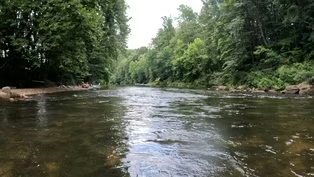
Preview | Science in Unexpected Places
Video has Closed Captions
Snorkeling NC rivers, the ecological role of hemlocks and the ethical implications of AI. (20s)
Providing Support for PBS.org
Learn Moreabout PBS online sponsorship
- Science and Nature

Explore scientific discoveries on television's most acclaimed science documentary series.

- Science and Nature

Capturing the splendor of the natural world, from the African plains to the Antarctic ice.











Support for PBS provided by:
SCI NC is a local public television program presented by PBS NC
Sci NC is supported by a generous bequest gift from Dan Carrigan and the Gaia Earth-Balance Endowment through the Gaston Community Foundation.