
Minnie Evans: Draw or Die
10/1/2026 | 56m 49sVideo has Closed Captions
The visionary art and remarkable story of North Carolina artist Minnie Evans.
Trace the life and work of Minnie Evans, a self-taught African American artist from Wilmington, NC, whose spiritual, dreamlike visions were transformed into vivid works of art she said were from “The Lost World.” Evans’ extraordinary talent eventually earned recognition internationally, cementing her place as an influential figure in American art.
Problems playing video? | Closed Captioning Feedback
Problems playing video? | Closed Captioning Feedback
PBS North Carolina Presents is a local public television program presented by PBS NC
Minnie Evans: Draw or Die
10/1/2026 | 56m 49sVideo has Closed Captions
Trace the life and work of Minnie Evans, a self-taught African American artist from Wilmington, NC, whose spiritual, dreamlike visions were transformed into vivid works of art she said were from “The Lost World.” Evans’ extraordinary talent eventually earned recognition internationally, cementing her place as an influential figure in American art.
Problems playing video? | Closed Captioning Feedback
Where to Watch PBS North Carolina Presents
PBS North Carolina Presents is available to stream on pbs.org and the PBS app.
Providing Support for PBS.org
Learn Moreabout PBS online sponsorship(dramatic music) (gentle music) - Minnie Evans had a direct connection to the divine.
It's what she said and what could be more compelling and interesting than how one pictures the divine.
- All of her life was dreams and all her dreams gave her these beautiful drawings.
- You know, it was just something my Minnie did, but we didn't realize, you know, the impact or the talent.
- The color, you know, her sense of perspective, you know, her deep faith, all of those things, she was able to put on a piece of paper or canvas and that's not easy to do.
- This is the story of my life.
I was born December 12th, 1892 in Long Creek, Pender County in a little log cabin.
At two months, mother carried me to a mansion to live with my grandmother.
I started school at five.
I would love to read about the gods.
I would love to watch the moon and stars.
I have never remembered sleeping without dreams.
My whole life has been dreams.
Something spoke to me like this, why don't you draw or die?
[Nina Starr speaking] [Minnie Evans speaking] ♪ - I'm trying to generate the beginnings of a catalog raisonne of Minnie Evans' work, which means a collection of her work.
What's driving me to do this is that I believe that her work is on a par with some of the greatest visionary art ever created in the world.
And I am talking about William Blake, I'm talking about people like Hildegard of Bingen, the German nun who also had visions.
And I believe that it's quite important, not just on its own merit, but also because we have a Southern black American woman as an artist who is untrained.
And I think that that's part of the power of her work is that it's not something she learned, it's not something repetitive or redundant or reductive, it's quite fresh and original.
And because of that, I think it has a certain kind of power that merits documentation.
(gentle music) ♪ - Anita Stauber was the first one that took interest in her art.
And that's when her art jumped off and started getting recognized all over the country.
[narrator speaking, manual typewriter keys clicking] - Minnie was born poor in Pender County, but her mother sent her to a grandmother to raise in Wilmington.
It was the Mecca for the Black bourgeoisie.
Those freed slaves were sharecroppers.
They sold seafood.
They had a number of businesses.
The populace who were poor White wheat farmers, the Republicans who were then a majority Black and some Whites, decided that they could win elective offices.
And in the 1890s, they did get elected to most of the offices.
The wealthy White Democrats did not like that.
(somber music) Blacks and Whites were run out of town.
Only Blacks were killed, an unknown number.
(somber music continues) And I think that even at six years old, Minnie felt something with her grandmother and probably became frightened.
(gentle music) And had a tendency to call on the angels.
(gentle music) - [Wayne] It's changed so much from what it was or how it was when I was a kid.
Again, remember, we had two churches over, this church and this church, but they're families.
Whenever I look at it, I just think about the times growing up and it's totally different now.
Totally, totally different.
But that's progress.
- The church is still looking pretty, though.
- I do miss it a lot.
But when I stand here and I come, I think about all the people that were here long before me.
- And of course, your great-grandmother was a pillar of this church as well.
- Yes, she and her husband.
- And Julius.
- Both.
- Yeah.
- Papa Julius had to pass many houses that she grew up in to get down to the water to go to the beach.
So that's how they met.
And they got married.
[Minnie Evans speaking] - [Bertha Todd] Minnie and Julius married in 1908.
Julius worked for Pembroke Jones.
Sadie and Pembroke entertained their guilded age friends at oyster roasts and lavish parties.
Sometimes the guests even sat in live oak trees on their property.
That property is now a Landfall and Airlie gardens.
After Pembroke died, Sadie married their good friend, Henry Walters.
And that is when Minnie went to work for Sadie at their home.
[female narrator speaking, manual typewriter keys clicking] - The Corbetts bought this land and they took interest in Minnie.
They turned this into a private home and they picked Minnie Evans to be the gatekeeper.
- Being from Wilmington, I knew about Minnie Evans driving back and forth to Wrightsville Beach during the summer as a child in the back of the station wagon.
Sometimes we'd go to Airlie Gardens and Minnie Evans would be in the gate house with her pictures tacked up on the outside.
And it was a wonderful sight with all the colors and because her work was with crayon, which was so familiar to children.
And so we always really knew about them.
You could buy them for a quarter.
- I have a lot of cousins and Daddy George would drive us to the gate to just to hang out and play around while Mom Minnie was working, taking admission.
And we were kids, so we weren't really paying a lot of attention to what she was doing.
We just knew that visitors would drive up and she would admit them and she would be painting during the time that when it was slow or even if she got a little tired, maybe take a little nap in the chair.
- And it was relatively small.
I just remember going in there and when Mama said, she said that sometimes she had her art board in there, but it wasn't much space in there.
- A lot of times, I think Mama spent a lot of her time, especially in the spring and summer when we would go down there, she was outside.
She sat outside.
- In that same chair.
- In that same chair, so she would sit outside and paint.
But she would often tell different stories about different things that happened in life and all about her artwork and then a lot of times about her younger years and when she started painting.
- We can't say what's in others' minds.
But if you're oppressed, you're gonna get out of that.
Your ego and your soul will strive hard to develop.
And I think this was the beginning of her art.
- When people say the spirit hits them, you see maybe an animated shout or some exuberant expression of thank you God.
And I had never felt that.
But when I sang with the Wilmington Symphony on their Christmas program, I then felt the spirit lift me right out of myself.
And then I knew that I had the experience that Minnie Evans had.
It is essential that people have that avenue for self-expression.
Sometimes when I get so many things coming at me one time, I can get at the piano and just find an avenue.
And that's where the arts fills in that gap.
- Like the boy Samuel in the Bible, when Minnie was a child, she heard a voice calling her name and Minnie thought the voice she heard was Mama Mary's but Mama Mary had not called.
Years later, Minnie again heard the voice and she knew it was God.
[Minnie Evans speaking] ♪ I'll pray my love to the Lord ♪ ♪ And I never will turn back ♪ ♪ Oh, I will go ♪ ♪ I shall go ♪ ♪ To see what the end will be ♪ ♪ When I was a mourner just like you ♪ ♪ To see what the end will be ♪ ♪ God made my vow to the Lord ♪ ♪ And I never will turn back ♪ ♪ Oh, I will go ♪ ♪ I shall go ♪ ♪ To see what the end will be ♪ ♪ God made my vow to the Lord ♪ ♪ Oh, yes I have ♪ ♪ And I never will turn back ♪ ♪ Oh, I will go ♪ ♪ I shall go ♪ ♪ Just to see what the end will be ♪ [Minnie Evans speaking] - The world is beginning to realize that the spiritual, religious, and symbolic art of the African-American South is just so historically important for so many reasons.
- There was a groundswell of African-American artists born in the 19th century who began actualizing their selfhood in the 20th century, in the early to mid decades.
And while these artists were working independently, they had a common vision for, you know, how they could express themselves, how they could put a document of themselves down in a unique and personalized way.
And so she is part of that movement, that Black vernacular tradition, that is today recognized as one of the most important components of 20th-century American art.
- Minnie is as genuine an artist as I think one can find in this field, particularly early on.
There were not as many women acknowledged as there were men that are acknowledged.
That's certainly changed in the last 20 years.
And so in terms of Minnie and her uniqueness, I would put her up with the top, the top, top world artists.
[female narrator speaking, manual typewriter keys clicking] - She was a compulsory artist.
She really just was driven to paint and draw.
And in our research, we've learned that she created as many as seven works in a day.
And those were probably some of her simpler works, because as we'll see, the complex ones just really took a lot of time.
- When she did paint, it was almost like she was almost in a hypnotic state.
I just remember seeing her hands, and she was just doing what she was doing, and then she would erase out a little bit more, and then she would start again.
And I'm not sure why, but the whole while she was doing it, I just remember her whispering, whispering to herself and humming.
And then when she stopped, she stopped.
Then she started, and that was it.
That was it for the night or the day, or whatever she started doing, that was it.
And then she went back to being-- - Minnie.
- Being Mama.
[Minnie Evans speaking] - She saw all of our collective association and interdependence upon one another, crossing worlds.
Her world's crossed, while we are just so intent on segmenting ours.
- Once you start looking at them, you cannot believe all the things that she has placed in here with incredible color work, the bilateral symmetry is just fascinating, the work with perspective.
Her motifs and her forms are quite similar, and yet there is variation in every single one, and there is so much different work that she can do with one media.
There's dot work, there's line work, there's little fizzy pencil work.
There are big and little things in these pictures that are really just amazing, and every now and then I'll come upon one that is not of that style at all.
[soft music] ♪ ♪ This picture is one of Evan's visions.
The sunrise often inspired visions and also serves as a central point that you can see a face is becoming embodied as the sun rises, it's coming into our view, and the effect of these sets of eyes, it's as if her field of vision is fracturing into several planes.
- People often remark on the eyes that appear in Minnie Evan's work so often, and she said somewhere that the eyes would be the eyes of God, putting it a little bit uncertainly.
You know, you have the sense that the artwork is looking at you, and you are looking at the artwork.
♪ ♪ - So faces are one of her very important motifs.
One of the extraordinary things about this that I love so much is the wings at the top.
It's just the icing on the cake.
You know, you have a grassy field, a little bit of forest beyond it, and then, poom, the face is the sunrise.
- Another thing that I find interesting about Minnie's work is that you focused on all these surreal, fantastic, abstract forms and swirls and stars and faces, but also there's the natural world, and Minnie is very much grounded in Wilmington, and she was a sounder, and she was out there on the shore at dawn.
[Minnie Evans speaking] [crickets chirping] [Minnie Evans speaking] [birds chirping] - We don't know really how many works Minnie Evans created during her lifetime.
Some are in museums, some are in important institutions, some are in the homes of Wilmingtonians with whom she bartered for services, attorney's fees, eye doctors' appointments, and during the '70s and '80s, people didn't really understand the value.
[choir singing] - ♪ Trust in the Lord ♪ ♪ And he will strengthen thy heart ♪ ♪ Yes, he will ♪ ♪ If you believe it ♪ ♪ You will receive it ♪ ♪ Oh, Lord ♪ - Can you tell us what aspects of "The Early Oak" make it stand out from Evans' other works?
- It's such a unique piece, right?
I think it's different in almost every way possible.
It has a texture to it, and the way she painted it, it kind of glistens in the light.
It almost looks like it is breathing.
And I think she spent about 3 years working on it, which is very interesting to think about.
That's a very long, contemplative amount of time.
[Nina Starr speaking] [Minnie Evans speaking] - I remember when she first started it, we thought it was just a picture.
Then it--it started growing.
It just grew.
I don't know why she did it like that, but it just grew and grew and grew.
- What I find most unique about the construction of this painting is that she is both a sculptor and a painter, that she is using paint, that she's manipulating paint to create that 3-dimensional relief that is in this work, and you can really see the artist's hand.
In fact, there were many places where we saw her fingerprints.
So as we're looking carefully across that surface, you could actually see where her hands had been, working this surface and crafting this amazing image.
And then to place on top of that all of the imagery that she did, building not only up in the 3-dimensional relief, but then when she went in and painted it, like that little white bench, that adorable little white bench, it's all 3-dimensional beyond the tree itself, and the azaleas that are around it and the beautiful pink colors that she did.
It's a very vibrant piece, and when we removed all the dirt and crime that was on the surface, it really stood out so beautifully.
But I also really admire the surface of this piece.
There is a lot of paint on this surface, plus because it is a sculptural relief, it's actually done on a solid mount support, and in this case, it's a piece of masonite that she used to build this image up.
A canvas would not have been able to support the weight and the amount of paint that she put on this surface.
It's very complex, and there's just such a subtle buildup that becomes such an incredible weighted visual piece to it.
I've had the fortune of actually seeing the tree in person, and being in front of this work when it came in, I had seen the tree some years ago.
When the painting came in, it was, had the same weighted presence as the tree itself, which is pretty impressionable.
It becomes very symbolic materially.
You know, turpentine is a product of the pine forest in North Carolina.
- A naval store.
- Right, yes, such a major part of that state's history, and not an uncomplicated one.
It was a major part of the enslaved labor there, and of course, wartime industry, and the fact that it's an oak tree also becomes very interesting.
I mean, the woods in general were a place of refuge and shelter, and sometimes worship or gathering.
They were also the sites of, you know, much worse things, lynchings.
You know, this tree is, it's a sentinel.
I think it's a very intriguing piece, and possibly one of the most important she ever made.
[dramatic music] [sirens and machine gun sounds] [Minnie Evans speaking] ♪ ♪ - This is the story of the invasion picture.
Miss Minnie reported that the worst of her dreams came in the early 1940s, the late war years, and this followed the death of her dear grandmother, Mary, in late 1934, the event surrounding which she began to draw and paint in earnest.
Newspaper headlines in the Wilmington Star News at that time include May 1940, Nazis take Antwerp and advance within 60 miles of Paris, and December 7, 1941, the catastrophic attack on Pearl Harbor, and the United States is now locked into the war.
Not only are Minnie's sons being drafted, but her home is also under threat, with the ports and shipyards and the bromine chemical factory presenting direct targets.
Blackouts are mandated.
German submarines are moving up and down the North Carolina coast, attacking our ships.
♪ ♪ [Nina Starr speaking] [Minnie Evans speaking] - The next evening, some friends of hers brought her a thick cardboard to use as a canvas, not knowing about the Madame Tula conversation.
♪ ♪ [Minnie Evans speaking] - Within a week, it was June 6, 1944.
The Great Battle of Normandy commences, and by God's grace, brings the turn the Allies' need.
Indeed, someone, somewhere was communicating and cooperating with her pictures.
[female narrator speaking, manual typewriter keys clicking] - My name is Wendy Williams, and my career has been in contemporary art in New York.
I worked at a contemporary art gallery in New York on Madison and 57th, and that's where I met Nathan Kernan, the grandson to Nina Starr.
We worked together for more than a dozen years, putting shows together every month, and it was at one of the openings to these many shows that I was introduced to Nina by Nathan.
Nina would always come to our monthly openings, and she was easy to spot.
- She thought of photography as her third life, as it were, in that the first was her family life.
The second was two decades spent with social justice issues, and throughout her life, she wrote probably scores of letters to the editor, letters to senators, letters to congressmen, letters to presidents, letters to everyone about all kinds of social issues, and artistic issues also.
Nina first saw Minnie's artwork in Gainesville.
By this time, Nina had been photographing the contemporary roadside folk art and documenting that, so some friend of hers thought that she might be interested in Minnie Evans's work, so she brought her a couple of, I guess, crayon works that she had to look at, and Nina said her documentary instinct kicked in right then, and she asked to borrow them and photograph them.
It was hard to see through that brilliance what was going on in the pictures until she got into the darkroom, saw them reduced to black and white, and she was struck by the graphic strength of these--of the drawings.
- We found Minnie very easily and saw a great many of her pictures, but by no means all.
There are too many.
She has them wrapped in bundles on and about a table in her dining room.
She is well-known locally, and in fact, I gather, somewhat of a chamber of commerce attraction.
- Okay.
- She expects to hit the big time and make her fortune, be received by President Kennedy, and travel to Jerusalem.
- I want to say that Minnie Evans has added to my life.
It's been a rich experience knowing Minnie.
It's her mystical revelations and her great beauty of feeling and her incredible insights into all sorts of situations that we know very little about.
I really feel that Minnie has powers that not many of us have.
I'm sure she has.
- In Minnie's home, 1975.
That's wonderful.
I love multi-generational images.
- Yes.
- In looking at this, I can't help but say what an amazing photographer Nina was, and it makes me appreciate even more the sacrifice that she made to give up so much of her own professional life to Minnie, to spending time on taking care of her art and trying to promote her work.
And her own photography must have really taken a back seat.
- She was a crusader and just gave to her, really, her involvement with Minnie, I think.
- That's a beautiful thing.
So it came from the right place.
[female narrator speaking, manual typewriter keys clicking] - Yeah, some of her dreams were about New York before she went.
Because she's mentioned Fifth Avenue and different things about New York, and a lot of things she talked about, she's never been to those places, but she would dream about them.
[Nina Starr speaking] [Minnie Evans speaking] - Oh, look at--this is Minnie on the cover of... - "Folk Art" magazine, which was put out by the Museum of American Folk Art.
1994, '95.
- Is that the one with her article on Minnie Evans and me?
- Yes.
- Okay, good.
- And here's Nina's dedicated, "For Nathan, a true believer."
With appreciation, Nina.
- She wrote about Minnie several times.
The first time was in the Bennington Review in the summer of 1969.
- '69.
- That was one of the first articles on Minnie in a scholarly journal.
And she put together a little group of like-minded people who were also interested in Minnie and started to organize shows for her work here in New York in churches, and there was a gallery here and there.
But at some point, she realized that she really couldn't carry the ball commercially the way a gallery should be doing.
But finally, Louise Ross took the estate on, and that was just great.
So Louise Ross has been a stalwart champion of Minnie's.
- I opened the Luise Ross Gallery in 1982.
And of course, that was a big deal for me.
I mean, it is for anybody, because at that time, self-taught art wasn't a big deal.
It was--I mean, it was just starting.
There was a time that I had worked a certain amount on the Bill Traylor material, and I was seeing that it was of interest to collectors.
So my mind was open to considering somebody else.
I never met Minnie Evans, but I began looking at her work.
This one in the center and the top, it makes me think of a shrine.
You can see Minnie with her religious components, making that beautiful shrine and the feminine aspect of the drawing on the end.
But they're very mysterious.
They're very enigmatic.
They're very intimate.
They draw you in.
And they're like little secret messages for Minnie.
And so it's hard to know exactly what she meant.
But I love the story that Nina said that when she asked Minnie about these in 1969, Minnie said that she had made 144 of this small 7-by-5-inch drawing in total, and she carried them in her pocketbook with her at all times for years because she thought that they brought her good luck.
So I think you look like a very lucky, lucky woman with these six drawings on your wall.
It's hard to pick a most important show.
I think if I had to, it would be the 1975 exhibition at the Whitney that Nina served as guest curator, a woman artist, a Black artist, and a self-taught artist at the Whitney Museum.
That's groundbreaking.
Nina told Minnie that her art mattered.
I thought it was like, wow, a big deal, like people really want to buy my Minnie's art, and you know, that this is really something, it's not just a hobby.
It felt good to the family to see it happen for her.
[female narrator speaking, manual typewriter keys clicking] [upbeat piano music] - Gosh, it's wonderful to be here with you, Esther, in the archives to see these beautiful Minnie Evans' that Nina gave you so many years ago now.
- Yeah, we have an exceptional collection really based very much on her generosity.
Well, and I will say that this one tends to be a staff favorite - - - It's everyone's favorite.
- - At MoMA, just because it's so unusual, but I think incredibly mysterious.
A lot of staff and visitors have fun trying to figure out where the animal has come from and what the animal is.
I feel like in many of the other drawings there's a sense of suspended reality because you don't really know where the figure-- the figure's just floating in a field, and you don't know about the detail within.
But this one, you not only get this fantastic figure, but then you have a very clear horizon with a rising or setting sun and this sense of waves on a beach and the shadow, which feels actually really rooted in reality, which is kind of amazing.
[Nina and Minnie speaking] [Minnie speaking] [female narrator speaking, manual typewriter keys clicking] - Minnie Evans herself said Revelation was like the most important book.
And if you read Revelation, you come to understand that it is all about the tearing down or the sort of supernatural collapse of the existing order.
In Minnie's pictures, you can see elements of Revelation, you know, John the Divine on an island in Greece, and the imagery and the structure of a lot of the visual qualities of his dream are reflective of what Minnie does, like looking up in the sky and seeing, you know, 24 thrones and a figure on a throne with lightning bolts coming out of its, you know, shoulders and the crystal sea as calm as glass.
And when you look at Minnie's pictures, you see all these different dimensions.
♪ ♪ - So Christie's is the only major international auction house that has a dedicated department and sale focused on outsider art.
I definitely get a lot of questions about Minnie's work during these auction previews, and specifically lately, it's been, you know, more and more about how she fits into the larger sort of canon.
We're seeing a lot of interest in Black female artists right now as people are sort of opening up their concept of what art should be, can be, who should be making it, why they're making it.
And so I think Minnie's work, especially if you're talking about some of the more abstracted pieces, people want to know where she's creating this, why she's creating this.
- I think as with any collector, you collect what you're passionate about.
You collect things that you love, you collect things you want to live with, you collect things you want to look at for the rest of your life, potentially.
And there's a way to then look at that art and feel that, and it becomes emotional.
You know, these are the only ones of all of these in the world.
There's more of a connection because there's more of a human touch to it.
There's a story behind the artist.
- Sitting with Nina on her sofa in her living room in the early '90s, she was telling me about the correspondence that she was having with a curator named Charles Lovell who was working on a retrospective of Minnie's work that was going to travel around the country.
He had written her and said he thought he had come up with a good title for the show, and it was "Minnie Evans, Artist."
And I remember Nina saying that she was a little underwhelmed at first because it was so simple, but then with just a little reflection, she decided that she really liked it.
His intention was to get people to look at Minnie's work and judge it on its own merits instead of through the prism of these categories that we like to put people in.
- The labels, I mean, I've come to really believe they don't mean anything.
It's what somebody has in his or her head or, you know, fingertips.
You know, they have a different way of seeing than you or I do.
[Minnie Evans speaking] [music] - Minnie Evans was such an important part of Airlie's history, it was only fitting that we develop a tribute garden for her.
It echoes so many of the themes that Minnie had in her artwork.
The Minnie Evans Sculpture Garden was imagined in 2004 by the Airlie Foundation Board, and they knew from the beginning that they wanted multiple pieces with one larger centerpiece, which is the Bottle Chapel, and it's made up of thousands of bottles and was built by Virginia Wright Frierson.
We also have two clay pieces in the garden.
One is a clay relief from a photograph of Minnie sitting in the gatehouse, and the second is a fountain that features imagery directly from her artwork.
Both of those pieces were done by Hiroshi, who was the artist in residence at the Cameron Art Museum.
- Our institution, beginning in 1962, I believe was one of the earliest museums to bring focus to her work back in the '60s.
And so when we reached the occasion of our 50th anniversary of the museum, we had an idea to construct three studio spaces of the three most prominent artists from our region.
Well, Minnie, as we know, she had no studio, but yes, she did, and it was the modest gatehouse that she occupied for 27 years, selling tickets admission $1.
Furthermore, we know from these windows, she was looking out on Airlie Gardens.
On to the beauty of everything at full bloom in April.
Hundreds and hundreds of artworks were created from this space, this limitless, boundless, imaginative work poured out of this modest little building.
That was why we wanted to recreate the space and have it accessible to the public to today.
♪ ♪ [female narrator speaking, manual typewriter keys clicking] - This is one of the last works, at the time she was at Grotgen Nursing Home out on Oleander Drive, and her eyesight was failing, and so folks would give her markers with a greater girth on them to hold and a broader stroke.
And still we see the revisitation, the repopulation of the monaster, and he's got his wings, and he's in the foreground, and she creates the illusion of space in one of the most ancient forms, but overlapping form.
- Her art is a celebration of life, and it's a celebration of nature, and it's a celebration of faith, and that inspires me.
I love living with her work and having it around me and being surrounded by her beautiful imagery and her loving, positive spirit.
Minnie Evans lived a quiet life, and when people looked at her, they saw an ordinary woman, but when Minnie looked out at the world, she saw wonders.
- What is Minnie telling us as an artist?
She is showing us that right here we have enough in, as she would put it in Christian terms, the created world.
We have light, colors, spectrums, space, minds, and voices.
We have all we need to engage with the splendors of this world and therefore to imagine how we might connect to something beyond.
She is showing us transcendence.
- She was not discouraged.
She was not wealthy.
Nobody knew about her gift, but she kept producing.
So the song, "Why Should I Feel Discouraged?
Why Should the Shadows Fall?"
But in her painting, she felt peace.
I sing because I'm happy.
I paint simply because I'm happy.
I paint simply because He cares for me.
I know.
- It was the purpose that God gave her, I feel like, that she was put here to do the paint and that people would enjoy her paintings and she would be known one day for her artwork.
It was great, you know, a great legacy for her to leave to the family.
[laughs] [Minnie singing] ♪ His eye is on the sky And I know he watches me ♪ ♪ So I sing because I'm happy And I sing because I'm free ♪ ♪ His eye is on the sparrow, And I know ♪ ♪ Yes, I know ♪ ♪ He watches me ♪ [Minnie singing] [music, bright rhythm] ♪ ♪ ♪ Where do we go from here ♪ ♪ It's not to understand ♪ ♪ The key we were looking for ♪ ♪ In the palm of our hand ♪ ♪ Turn around and slow down ♪ ♪ ♪ ♪ Look up through the stars and see ♪ ♪ The morning sun ♪ ♪ ♪ ♪ The morning sun ♪ ♪ ♪
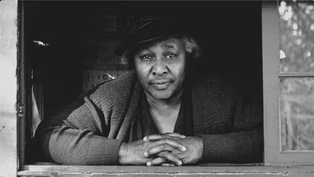
Preview | Minnie Evans: Draw or Die
Video has Closed Captions
The visionary art and remarkable story of North Carolina artist Minnie Evans. (30s)
Providing Support for PBS.org
Learn Moreabout PBS online sponsorship









Support for PBS provided by:
PBS North Carolina Presents is a local public television program presented by PBS NC