
March 20, 2026
3/20/2026 | 55m 36sVideo has Closed Captions
Nicholas Burns; Wes J. Bryant; Michael Lynton; Joshua Steiner
Former NATO Ambassador Nicholas Burns on how American allies are reacting to the ongoing war in the Middle East. Former Pentagon analyst Wes J. Bryant discusses the Pentagon's attitude towards reducing harm to innocents in war. Former Sony CEO Michael Lynton and former Clinton aide Joshua Steiner discuss how to cope with your mistakes rather than letting them control your life.
Problems playing video? | Closed Captioning Feedback
Problems playing video? | Closed Captioning Feedback
March 20, 2026
3/20/2026 | 55m 36sVideo has Closed Captions
Former NATO Ambassador Nicholas Burns on how American allies are reacting to the ongoing war in the Middle East. Former Pentagon analyst Wes J. Bryant discusses the Pentagon's attitude towards reducing harm to innocents in war. Former Sony CEO Michael Lynton and former Clinton aide Joshua Steiner discuss how to cope with your mistakes rather than letting them control your life.
Problems playing video? | Closed Captioning Feedback
How to Watch Amanpour and Company
Amanpour and Company is available to stream on pbs.org and the free PBS App, available on iPhone, Apple TV, Android TV, Android smartphones, Amazon Fire TV, Amazon Fire Tablet, Roku, Samsung Smart TV, and Vizio.

Watch Amanpour and Company on PBS
PBS and WNET, in collaboration with CNN, launched Amanpour and Company in September 2018. The series features wide-ranging, in-depth conversations with global thought leaders and cultural influencers on issues impacting the world each day, from politics, business, technology and arts, to science and sports.Providing Support for PBS.org
Learn Moreabout PBS online sponsorship(dramatic music) - Hello everyone, and welcome to Amanpour & Co.
Here's what's coming up.
- I did not think it would come to this.
- Escalation with the Iran war growing ever more dangerous, frictions between America and its allies, and opportunity for its enemies.
I'm joined by America's former ambassador to NATO and China, Nicholas Burns.
Plus.
- I find this shameful, frankly.
- Civilians bearing the brunt of war and international law increasingly ignored.
A Pentagon whistleblower joins me with his warnings.
Then... - [crowd chanting] - Lessons from history, how the Islamic regime has prevailed in Iran.
And... - We tell lots of stories about our mistakes and other people's mistakes, and in each case, what we found is that mistakes are actually a three-act play.
- From mistakes to meaning, why owning your past matters.
(upbeat music) - Amanpour & Co.
is made possible by the Committed to Bridging Cultural Differences in Our Communities, and by contributions to your PBS station from viewers like you.
Thank you.
- Welcome to the program, everyone.
I'm Christiane Amanpour in London.
Not our war, the message from America's NATO allies to Donald Trump this week after he asked them to help secure the Strait of Hormuz.
Many NATO allies view his war on Iran as illegal, and coming from a president who just two months ago was threatening Greenland, the sovereign territory of a fellow NATO member, the request fell on deaf ears.
This as the war dangerously escalates with attacks on critical gas infrastructure now.
There appears to be friction between Trump and Netanyahu on these infrastructure targets or not.
In addition to friction with America's allies, which is real.
And what of its enemies?
Does China see a distracted America, once again mired in the Middle East, as an opportunity?
As US Ambassador to China and to NATO, Nicholas Burns witnessed Beijing's push for power up close and understands the complexity of America's diplomatic relations all too well.
And he's joining me here in the studio.
Ambassador Nicholas Burns, welcome to the program.
Thank you, Christiane.
Did you think that it would come to this?
Now we've got a major, you know, regional war, frankly, and the latest escalation is a war on gas facilities, the Israeli attack on the Pars field, and then Iran's retaliation on the Gulf State gas infrastructure.
I did not think it would come to this.
You know, 20, 21 days ago, when President Trump and the Israelis started this, I actually thought it was to go back to the nuclear sites as a way to reinforce the negotiations with the Iranians.
But look at what hasn't happened.
Regime change has not happened and is very unlikely to happen.
There's been no unconditional surrender.
The Iranians have been soundly bruised, but they've been fighting back asymmetrically and now you have this situation where there's a world energy crisis.
And it really is a global energy crisis.
I mean, 20% of the oil and gas in the world comes out of the Strait of Hormuz.
And that's critical for the Japanese, the South Koreans, the Chinese, and the global economy.
And you have, here in London, I've been paying attention to this, you have oil prices and gas prices tripling in Europe, and oil prices rising.
So, it's a full-blown crisis.
And, you know, when you start a war, beware the unintended consequences of your actions.
Do you see any off-ramp?
I think there has to be an off-ramp.
I can't believe that the United States would choose to put ground troops into the quicksand of the Middle East.
You and I have known each other a long time.
We remember 2003 and four and five in Iraq.
We remember the good intentions in Afghanistan.
The world community supporting us.
We were caught for 20 years.
So I don't think that's an option.
And if there continues to be a substantial energy crisis that afflicts all the leading global economies I would think an off-ramp.
I think an off-ramp is an order.
And I think there's a case for an off-ramp.
Yeah, okay, they could make a case.
They could declare victory and go home.
But who do you negotiate with?
I mean, if you were in the State Department advising right now, they've killed off the top player, including what they, I think, I've reported and I haven't been knocked back on this.
Ali Larijani was considered somebody who could be a transitional character, who could be somebody pragmatic but very strong in the system.
But the Israelis killed him.
Well, you know, I was the Iran nuclear negotiator for the George W. Bush administration way back in 2005, '06, '07, '08, and we were trying, we the world, China, Russia, Europe, the US, negotiate with the Iranians.
The fellow we thought we would negotiate with was Ali Larijani.
And there is an issue here.
You have to find someone in the Iranian regime, presumably a civilian official in the IRGC or the foreign ministry, who has the support of the clerics, who if you make some kind of a deal to stop the fighting, it'll be honored.
And that person has to be someone of some credibility.
So when I saw that Larajani had been killed-- by the way, no sympathy for this regime whatsoever.
My generation went through, you know, terrible times with them.
They've killed lots of Americans, and they've created mayhem in the Middle East.
But you do have to negotiate with unsavory people to stop a war, and it has to be someone of credibility.
I believe that is an issue now.
- What about allies?
You know, you've been ambassador all over the place, notably to NATO.
We'll talk about China in a minute.
But Trump has been, A, saying, "I don't need your help."
Then, "I do need your help."
Then, castigating them and just insulting them.
And frankly, so does Pete Hegseth.
They show no gratitude.
They show no this.
They show no that.
Here you are in the UK.
What do you think the Allies' posture should be?
You know the old saying, if you want people to be with you, they have to be with you.
You have to let them be with you on the takeoff, and listen to them, and respect them, and accommodate their views if you want them to be at the landing.
And so we're in a pickle right now.
The Strait of Hormuz is closed.
We have to get it open.
We cannot do that with the United States on our own.
We need allied support.
But this is the same administration that threatened to invade Greenland and question Canada's sovereignty.
The President made, I think, unparalleled statements about the British Prime Minister, Kara Starmer.
I've never seen an American President, not just in our lifetime, in the last two centuries of American history, be that critical of a British Prime Minister.
And I was ambassador to NATO during some tough times, 9/11.
I remember the Allies came to our defense for the first and only time in NATO history.
The Canadians, the Germans, the British, the Norwegians.
And that kind of alliance is precious for us.
And as I look at the balance of power in the world, we are so much stronger trying to contain Putin in Eastern Europe with the NATO Allies and to limit Chinese aggression in East Asia with Japan and South Korea and the Philippines and also with the NATO Allies who are very much involved in the issue of trying to support Taiwan.
So a fundamental mistake is disparage your allies, make life difficult for them at home.
You really can't expect them to be with you in a fight that they didn't start.
And one more point I've been thinking about, Christiane.
We're the North Atlantic Treaty Alliance of Democracies.
We're not the Warsaw Pact.
In the Warsaw Pact, Moscow called the shots and ordered the satellite countries around.
We're dealing with countries that have parliaments and that have public opinion and the free press.
And so I think probably the most important lesson I learned in my career - be nice to your allies, honour and respect them, and that has not happened.
And as you just said, sort of glancingly, but it's a big deal, Trump's actions are harming these governments' internal politics, their economy and everything else.
They're harming their interests.
Yes.
So, I get that point.
Let me ask you about China, because China, could it be taking advantage?
Is there an opportunity for China to, you know, make out... I was going to say make out like a bandit, but that's not correct.
But make out well.
And also Russia.
You know, I think the Chinese are in a difficult position where you can see them being a potential gainer from this conflict.
But I think the reality is right now because we don't know how this plays out that the Chinese made a very big deal about the fact that they hosted two years ago the Saudi and Iranian foreign ministers.
Foreign Minister Wang Yi of China presided over this handshake.
And the Chinese were crowing to me and others in Beijing at the time.
We're now a substantial Middle East player at least diplomatically.
Well, they haven't lifted a finger diplomatically to help the Iranians.
They didn't help the Venezuelans.
So I think if you look at those two crises, the Chinese look like a fickle friend, not some country that can be counted upon.
On the other hand, and this is very cynical on the part of the Chinese leadership, they've been saying over the last couple of months, we are the upholders and the guarantors of the world order.
We play by the rules.
We honor the United Nations system.
I don't believe this, but this is what they say.
And I think a lot of people look around and say, "Well, Xi Jinping is the stable global leader right now."
So I'm sorry that we've given them that opportunity to assert that.
And Russia, because they really are making out like bandits and they are illegally invading Ukraine and they have now had the administration, the US administration, give them a sanctions holiday on oil, and also the oil, you know, the price has gone up so it benefits them, and Trump seems to be still constantly favoring them, i.e.
pressuring Putin much less than he pressures Zelensky.
So this is, tell me what you think this means for Russia in its war right now.
- I think it's a great mistake, with oil over $100 a barrel, to give the Russians the ability now to take the sanctions off, allow them to sell that.
That just fuels the Russian war machine, and that's not in our interest.
Secondly, I agree with you, how you framed it.
We should be President Zelensky's lawyer.
We should continue to be arming Ukraine, because the American national interest is we have an existential, I would say a vital interest in a free, democratic, unified Europe.
Everything that was accomplished between 1989 and 1991 when the Soviet Union-Warsaw Pact fell, that's all up for grabs now because Putin is re-dividing Europe, largest land war in Europe since World War II, and we're acting as if we're Putin's lawyer.
And I think that is directly contrary to the American national interest.
And that leaves Europe in an exposed position, having all the responsibility to try to contain the political movement.
- Yeah, I mean, - It does.
- Really, it's been dropped in the so-called, you know, whatever, overnight, and made to fend for itself overnight, rather than with a decent interval.
That's my observation.
But I want to ask you this.
You're a loyal, career, foreign service.
Do you think Witkoff and Kushner are up to this job of negotiating, either with Iran or with Putin?
And concurrent with that is, it appears that this administration has literally eviscerated its Near East, its Middle East department and many other departments in the State Department.
So who's there with actual historical knowledge, negotiating expertise, knowing what's in the... knowing the files, knowing the actual issues?
This is a major problem for the United States.
We have a first-rate military, first-rate intelligence community.
We had a first-rate and very non-partisan Foreign Service.
But the entire senior levels - and I just left the government 14 months ago when I was ambassador to China - the entire senior level of our diplomatic corps has now been fired, essentially fired.
There was no one in the room with Mr.
Whitcoff and Jared Kushner who spoke Farsi, who had dealt with the Iranians, who understood over a course of a long career how you deal in that kind of environment, to read the other side culturally and linguistically, and I think that's malpractice.
And so I don't know the two of them.
I don't want to disparage them personally.
But you need to have career people in the room helping to interpret what they're hearing and holding the line against the regime.
You know, we've been dealing with this regime for 47 years.
And we know that there was no imminent nuclear attack coming from Iran.
We know that there was a diplomatic conversation underway.
Now that was a very difficult one because the Iranians are difficult.
The government of Iran.
But still you've before you go to war you have to in your own mind exhaust diplomacy.
And we are at a time when I think the American Foreign Service, 102 years old this year, is at its weakest point in 102 years.
Every president and secretary of state has trusted our career diplomats to help them and to analyze very complicated situations like this.
And President Trump is not electing to listen to our career experts.
>> And look where we are, literally up a creek, the straight of Hormuz without a proper paddle.
Nicholas Burns, Ambassador, thank you so much for being with us.
>> Thank you, Chris-John.
Thank you.
>> Three weeks into this war, and much of the U.S.
rhetoric points to a worrying lack of regard for human life and rules of engagement, including Pete Hegses' pledge of "no quarter, no mercy" for our enemies.
This implies enemy combatants would be executed rather than taken prisoner.
That would be a war crime.
And lest we forget that alleged US strike on a school on day one of this war in Iran, at least 168 children were killed.
Horrifying images of little school bags, blood-stained amongst the rubble.
Not too long ago, the Pentagon seemed serious about reducing harm to innocents, setting up a civilian protection centre of excellence, as they called it.
That was until it was dissolved last year under Trump and Hegseth.
Air Force combat veteran Wes Bryant was a senior advisor before he was forced out in government cuts.
And he joined me from Raleigh in North Carolina to explain the perils.
Wes Bryant, welcome to our programme.
- Thanks for having me.
- Can I first start by asking you, since you are a former Air Force, what do you, how do you assess this now three weeks of US and Israeli bombing of Iran and their mission to either topple the government or severely and utterly cripple any kind of offensive capability it might have?
- Well, you know, this is another inception, another carrying out of illegal use of military force on part of the Trump administration.
It's illegal per UN charter, per international law, per even US law and mandate.
And really all Trump is doing here is completely destabilizing the Middle East, creating, you know, Iran, of course, has been our enemy for decades in many aspects.
We're certainly not going to get Iran to submit, and they're certainly not gonna be our friend anytime soon in the next few generations.
And now we have regional war, essentially, in the Middle East.
- Listen, your speciality is international law, civilian targets.
You had a bureau to deal with that.
And then it was essentially, you were specifically tasked with reducing civilian harm.
What do you make of the way this is unfolding?
Because not only did we see the girls' school targeted, well, hit, hit, but now we're seeing, certainly from reports from the inside, more and more civilian targets either targeted or caught in the blast.
What do you think about how that's going?
- Yes, exactly, and that's the key here, is not just this tragedy against the girls' school, but how many more cases are there?
And there's likely a lot.
My colleagues at Air Wars are tracking upwards of 80 separate incidents so far between U.S.
and Israeli strikes of civilian casualty instances.
And we're tracking upwards of 1,800 civilian casualties so far, and that number will very likely rise.
- I find this shameful, frankly.
Let's go to the girls, the example with the strike on the girls' school.
Shameful that our administration, our Secretary of Defense, or war as he calls himself, and our senior military leadership can't even to this day acknowledge that they actually struck the school, let alone provide some kind of a half semblance of an apology and then address the situation appropriately.
But for our own Secretary of Defense and commanders to not even be able to tell the American people where they've dropped their own bombs and missiles, you know, that's a problem in and of itself.
And then we have the problem of just the sheer recklessness and bloodthirst of this campaign.
And we're joining with Israel, who has been committing genocide in Gaza.
We are essentially, what I see now, the horrifying aspect of this is that we're importing in the U.S.
military, importing the standards that Israel has created in the war in Gaza of utter recklessness in targeting, blatant disregard for international law, and an incredibly high tolerance for civilian casualties, and brushing them off saying things like you know civilian casualties will happen in war, the enemy embeds in urban areas, and no other military takes as much care to prevent civilian casualties.
Well both have said that.
They sound exactly like what Netanyahu's been saying for years.
Well, he's saying that now about the Iran, we're the most moral army in the world.
And not only that, the Secretary of Defense, Hegseth, has also said that.
I am going to play a little bit of a soundbite that he said from the Pentagon podium.
Take a listen.
- No nation takes more precautions to ensure there's never targeting of civilians than the United States of America.
from the boat strikes in the Caribbean, where every single strike is assessed to this campaign here.
No nation in the history of warfare has ever attempted in every way possible to avoid civilian casualties.
- Wes, is that true?
And I am surprised that he brings up the boats because so many said that those were not legitimate targets in terms of warriors.
There just wasn't enough evidence to prove that they were warriors, so to speak.
- Exactly, it's almost laughable if it wasn't so enraging.
These boat strikes on so-called narco-terrorists, that was a summary execution, that was murder, even if they're drug smugglers, completely illegal per US and international law.
You know, to go back again.
Hegses sounds exactly like what Benjamin Netanyahu and the Israeli government have been saying for years in their war in Gaza in response to the genocide and the war in Gaza, that no other nation takes as much precautions.
Yes, I can attest, you know, I carried out strike campaigns and strikes for over two decades in the war on terror.
I can attest that yes, we have a lot of precautions built in, but we've also made a lot of mistakes and continue to make a lot of mistakes.
And that is why the Civilian Harm Mitigation and Response Enterprise was established under Secretary Austin under the Biden administration, in which Hegseth came in and completely slashed under the construct of, you know, woke.
It's not fitting with his concept of lethality and killing, right?
So I would argue that if we are so good at protecting civilians, how did we just kill nearly 200 young schoolgirls in Iran?
And how have we not even acknowledged that that's the case?
- So Wes, tell me, how could it be possible?
Because I've heard and read separate things, either that it was targeted or it was crossfire, but more likely that it was based on a 10-year-old map and coordinates of what that area was that they were going after, apparently military targets.
So do you know about that?
- Yes, I've been doing analysis of the strike since it happened, and from all of the evidence we have so far, and really this is what struck me when I first looked at the strike, the day all this information came out, was that we have a case of misidentification where this entire naval compound, this Iranian naval compound, which was a missile headquarters, was targeted, seven to nine buildings within this compound.
I would add within that compound, a Iranian Navy medical facility that's also protected per international law, that was targeted.
And then the school adjacent to the facility.
Now, if you look at old imagery, over 10 years old, that what is now a school that was struck was not separated from the rest of the compound, appeared to be a part of the compound, it was not listed anywhere online digitally as a school.
Well, as of 2016 to 2020, we have a wall separating the rest of the compound from the school.
You know, it's the closest military building to that school is over 100 meters.
We have play areas erected, pink and blue walls that we see.
And then online, in Iranian digital mapping, it's listed as a school on Google Maps.
Online, it's listed as a school.
And so what that tells me is that we use somehow, incredibly, over 10-year-old targeting information and map data and didn't verify any of it before targeting.
That's actually a fundamental failure in targeting doctrine and standards that we've had for over two decades.
- So Wes, are you concerned that this could repeat itself?
And do you think that it is repeating itself?
That other targets that might be civilian or civilian adjacent, and now we're hearing from Israel that they are not only going to continue their assassination campaign to try to sow chaos, as they say, within the system.
So far, it doesn't seem to be happening.
But they're going to expand onto what is civilian infrastructure, like the electricity grid and gas, I think.
Not the oil industry, but that which is, I guess, designed for internal use.
Is that -- Are those legitimate targets, and are you concerned about that?
-I'm incredibly concerned.
And, you know, this is their playbook.
This is their Gaza playbook and their playbook for everywhere else.
They're truly Israel, the government of Israel, is conducting itself truly as a rogue state.
These are blatant violations of international law, hitting civilian infrastructure en masse as is happening and as they're intending.
We also have Israel now targeting, for example, besieged military police forces in the middle of the street, you know, and using low collateral weapons, meaning with small explosives, but they're using them in incredibly dense urban populace.
So still exposing the civilian populace to these effects and causing civilian casualties.
The same thing they do in Gaza.
You know, I'll go back to this notion of precision warfare, which Hegseth frankly does not understand.
Precision warfare is not using precision munitions to mass bomb urban areas, which is what's happening here.
- You said, you know, it's not precision warfare and it's got this fallout.
So I want to ask you furthermore, then, what you make, and do you think it was loose lips from Hegg Sess?
Do you think he even understood what he was saying when he said, "We will take no quarter, no mercy for our enemies"?
What do you understand that to mean?
Because Senator Mark Kelly has tweeted, "No quarter isn't some wannabe tough guy line.
It means something.
An order to give no quarter would mean to take no prisoners and kill them instead.
That would violate the law of armed conflict.
It would be an illegal order.
It would also put American service members at greater risk.
Do you agree with that?
- I absolutely agree.
You know, we have to take a look here and ask ourselves, who are we as a people?
When we have people like this in extreme positions of power, you know, he sounds and acts maniacal.
He has already carried out war crimes and continues to state the intent to carry out war crimes.
And that's horrifying.
- Well, we will clearly try to get some reaction to that because it is a serious allegation, but others have made that now, and it is very, very concerning.
You blew the whistle on the Pentagon for gutting your program, precisely for the reasons and the concerns that you express right now.
But even beyond that, the retired General, former Army Commander, General Stanley McChrystal, talked about, quote, "insurgent math."
He said, "For every civilian killed, at least 10 new enemies are created."
Talk about that for a moment.
- When the Trump administration states that part of their mission here anyway is to free the oppressed Iranian people, well, killing hundreds, likely thousands of civilians, including, you know, small children, and then on top of that, showing absolutely no remorse for it, doesn't send that message whatsoever.
And then what you have is, you know, you're very clearly, you're going to turn the population against the US cause.
I mean, put yourself in that situation.
If another country came in to remove the Trump administration and bombed your child's school, would you really view them as a liberator?
Not at all.
- Wes Bryant, thank you very much.
- Thank you so much for having me.
- History, as ever, has much to teach us at this moment.
Ayatollah Khomeini started by wanting to export the Islamic revolution around the world.
Ultimately, that failed.
But they did birth militant organizations like Hezbollah.
Many thought that the Islamic revolution would be a good thing for the world.
to have all these organizations like Hezbollah.
Many thought Iran's theocracy might moderate after the founder Khomeini died in 1989.
Instead, it became a deeper-rooted theocracy, with increasingly military influence through the IRGC, the Islamic Revolutionary Guard Corps.
This has persisted apart from short periods of reform which were quashed in the early 2000s.
It was Donald Trump who ended the most successful U.S.-Iranian diplomacy with the 2015 coup.
And since then, Iran's nuclear program continued apace, and hardliners have solidified power.
There was some hope that once Ayatollah Ali Khamenei died, the country again might moderate.
However, this war and his assassination has put paid to that for now.
Here's a look back at some of the history of how the revolution started and adapted over the past 47 years.
It's from a 1985 CNN series called "In the Name of God," which I assisted with while still an entry-level recruit.
And here's part of it narrated by correspondent Larry Lamont.
[ Chanting ] >> When Ayatollah Khomeini assumed command of Iran in 1979, he said his mission was to convert the world to Islam.
The message sent shockwaves throughout the Middle East Today, government officials say the mission remains the same.
It is an idea that we want to introduce to the world, and we have done it so far.
But have they done it successfully?
Some say no.
When Khomeini first came to power, he hoped, he seemed to hope, that his inspiration, his model, would lead to similar revolutions elsewhere.
In Egypt, in Saudi Arabia, in parts of Islamic Africa and Asia.
It didn't happen.
One reason, Iran's war with Iraq.
It has not been able to channel large sums of money to a variety of Muslim revolutionaries while financing a war.
But Iran has been able to help organize and provide funds for a Lebanese group called the Hezbollah, or Party of God.
The Hezbollah is believed responsible for masterminding the hijack hostage crisis in Beirut.
And intelligent sources say the bombings of the U.S.
Marine compound and embassies, the kidnappings of Americans in Lebanon, are all linked to Iran through groups called Islamic Jihad, which have claimed responsibility for the attacks.
Iran denies U.S.
charges it is involved in terrorism.
I'm saying that Imam himself, in his speech, in the highest level, said that we are against this thing, it doesn't have anything to do with us.
These are not the way that we encourage.
Despite the denials, the foreign ministers of Iran, Syria and Libya met in Tehran in January, according to Arab sources close to the Syrian government.
The countries reportedly agreed to escalate terrorism against U.S.
interests and personnel worldwide.
There is no question Iran's overthrow of the Shah six years ago became an inspiration for militant fundamentalists across the Muslim world.
They agreed with Khomeini's plea to run the U.S.
out of the Middle East and Europe.
Today, thousands of Muslims flood to Iran's holy cities for training and revolutionary know-how.
Muslims from Africa, Asia, and the Gulf states.
Iran even pays for those who can't afford the trip.
In Egypt, fundamentalists have made important political gains and now face the government in a test of wills.
They are demanding that Egypt immediately adopt Islamic law, the same 1300-year-old legal code that's used in Iran.
Signs of Islamic revival abound across Africa's Muslim nations in Saudi Arabia and the Gulf states, even in the Soviet Union, which has 23 million Muslims.
[Chanting] But Khomeini's dream of developing pure Islamic republics all over the world has not materialized, and some experts believe it never will.
I do not, repeat, not believe that Islamic revolution is sweeping or is going to sweep the Middle East.
What happened in Iran was a response to a specific problem, and Iran doesn't have Arab nationalism, which is a shield against Islam in the Arab countries.
And we've seen in specific Arab countries that the Islamic opposition has not done very well, most obviously in Syria and Iraq.
They've been very hard hit by the government, and we see no sign that they're going to take power.
But Arab leaders can no longer afford to be branded anti-Islam.
Muslim militants may be a minority, but they are a feared few.
And the threat of a revolution is not over yet.
The high priests of fundamentalism say their crusade has only just begun.
The pictures from Iran today tend to make the western mind swirl in confusion.
But some Iranians have been caught in that same swirl.
We have become humiliated in the world and 15, 16 year olds are indoctrinated to fight for a war which is totally absurd as far as the interest of Iranian people are concerned.
On what basis could a people support such a regime?
I mean, what is in it?
[Chanting] During the revolution, Iranians thought democracy was in it.
They thought ousting the Shah meant automatic freedom.
Most did not know they would become part of a 7th century religious experiment with 20th century interpretations.
What Khomeini is experimenting with in Iran today is as novel to the Iranians as it is to ourselves.
It's as radical for them as it is for us.
Iranians have been told that the radical changes are God's will.
After six years under Ayatollah Khomeini, more and more are questioning whether it is God who guides them, or a man in a turban who controls them.
I can try and search and search and I cannot think of a positive thing that the Ayatollah has done for our country.
He's made all Iranians who live in Iran miserable.
He's made all Iranians who live in the States miserable.
He's killed thousands of people, political executions.
The entire country has become a scene of spying and reporting and perpetuation of fear in order to contain activation of opposition.
If all that is true, it has not fazed everyone in Iran.
People like Mohammed and Ali and their families praise the Ayatollah and say they will give him anything he wants, including their lives.
But how many in the country feel that way?
Now we're not saying that 80 or 90% of the Iranian population is enthusiastic or supportive.
But we've seen over and over again that if you have 20%, 25%, 30% base of support, then that's enough to stay in power.
And this is what's happened with this regime.
Whatever the percent, even Khomeini opponents credit him with having charisma and shrewdness and the ability to indoctrinate.
Those who believe in Khomeini have such fanatical devotion that forces opposed realize they will probably have to wait until the Ayatollah dies before they have any chance of overthrowing the government.
Bani Sadr, former president of Iran, now in exile, is one of those who would like to step in.
The late Shah's son is another.
They death will trigger a bitter struggle for power from within, which will weaken the government and allow another coup.
But Mansur Farha, who supported the revolution and who is a friend of Bani Sadr, isn't so sure.
I'm not, unfortunately, very optimistic about crack the regime from within in the immediate post-Romanian period.
It will eventually develop, but immediately it's possible that they will, it's likely, in fact, that they will cooperate in pursuit of their common objectives because they know losing means total decimation of the present political elites.
An Iranian now living in the U.S.
was one of many who left her country disillusioned after the revolution.
She too believes Iran's theocracy will survive Khomeini.
I'm afraid that this is going to stay for a long time.
Maybe it will be a little more moderate.
It will have some reforms, but I don't think we will have a revolution.
I think Iran is likely to moderate too.
It's a very special leadership right now.
A very special man.
I don't think it can be maintained.
No one can inherit his power and his authority.
In Iran, Ayatollah Khomeini is a legend.
He is the spiritual leader of the revolution.
He has joined history's revolutionaries who rule with fanaticism.
In most cases, the deaths of those men of destiny were not followed by more revolution.
They were followed by moderation.
For those Iranians who feel their revolution was merely the exchange of a crown for a turban, moderation could well be what they will have to settle for.
- For now, at this point, three weeks into the war, U.S.
intelligence says the regime maintains its grip.
Now, do you own your mistakes?
Do you confront them?
Our next guests say they've both made life-defining errors.
Michael Lynton was the CEO of Sony Entertainment.
His decision to greenlight the Seth Rogen movie, The Interview, led to a massive hack of the company by North Korea.
Joshua Steiner was a young aide in the Treasury Department during the Clinton administration, and his diary entries helped pave the way for Clinton's impeachment.
They've just written a book, From Mistakes to Meaning, Owning Your Past So It Doesn't Own You.
And they're with Walter Isaacson to discuss why it matters.
Thank you, Chris-John and Josh Steiner, Michael Lynton.
Welcome to the show.
Thanks for having us.
You have this book called From Mistakes to Meaning, and you talk about your own mistakes.
Let me start with you, Michael.
Which mistake do you discuss in the book?
Well, the mistake that I talk about is the mistake that I made when I agreed to greenlight the interview, which was a movie starring Seth Rogen that involved the assassination of Kim Jong-un and resulted in the largest cyber attack on a U.S.
company, namely Sony Pictures.
Remind us of the fallout from your mistake.
What happened with the hack and how you dealt with it?
Right.
So just to relive it for two seconds, we decided to make the movie.
When we finished the movie, we put out a trailer in June of the Christmas period where the movie was going to come out.
And we were immediately warned by the North Korean government that there would be a, they threatened us were we to put it out.
And we continued with the putting out trailers and ads for the movie.
And then in the fall, one day when I was driving into work, I was informed that all of our systems had been hacked.
They had destroyed 70% of our computers.
The North Koreans, they leaked vast quantities of emails, finished movies, movies like "Annie," "Karate Kid," the script of the newest James Bond movie, which had not yet been starting production.
So they really wreaked havoc upon the studio, which couldn't function for almost a month.
- What do you wish you had done?
- Well, one could argue, one thing I wish I had done was not made the movie.
That's for starters.
You actually feel that now?
You know, it's an interesting question.
I think the issue for me, once we decided to make the movie, was that you had to put the movie out regardless, because that's where you go into the realm of censorship.
I think in retrospect, it probably wasn't the best idea to make that movie, just given who we were, who, you know, the fact that at the very end of the movie, you were assassinating the leader of a hostile power, Kim Jong-un.
And in retrospect, that was probably a mistake to do that, yes.
But why was that a mistake?
I mean, would it have been a mistake for the publisher to publish Salman Rushdie?
Shouldn't we be doing these things?
Well, no.
I mean, no, the mistake was not putting the movie out.
But to be clear, the issue was that when I decided to make the movie, we threw out the process that we normally had to make those decisions.
Normally, we came together with a group of people, finance, marketing, creative, and deliberated over this.
But in this particular case, we just charged, I charged right in and said yes right after a read-through of the movie.
What made it interesting to me reading about it is you had to look deep in yourself and you said, "Okay, why did I do that?
Why did I want to be the cool person who greenlit this movie?"
Right.
So, backing up for a moment where, you know, the origins of this was that Josh and I were walking one day, we've been friends for many years, and Josh had this idea that he thought we should both explore our mistakes and potentially write a book about it.
He knew that I had harbored this problem or this issue in me that I had made this mistake many years ago, Josh equally had one, and he thought by exploring those mistakes and trying to get to the bottom of why we made them, we perhaps could release ourselves of, you know, both of us had been avoiding talking about them.
And so when we went through the process of this, it really involved an investigation.
We recruited a professor of psychology from Johns Hopkins and Alison Papadakis.
And in the course of that, I looked back in my life to try and understand what was it in that moment that really made me throw that process out the window.
And what I really discovered was all along I had this deep-rooted desire to be part of a group, the cool group, so to speak, that had come about because when I was a kid I got moved to Holland from the United States and I, you know, developed this... I was a very, very... it was a lonely upbringing and that sort of gave birth to this, what we describe as schema way of seeing the world.
So, Josh, I first knew you when you were a very obscure Treasury Department official and suddenly one day you wake up and you're famous.
You're... and it's like going viral, as we say today.
Explain your mistake and how that happened.
I'm not sure I love the use of the word obscure.
And unfortunately, I'm not sure famous was the right characterization, Walter.
So I was 28 years old.
I was chief of staff at the Treasury Department.
And I had a great job at an early age.
I was really lucky.
I was working for Lloyd Benson, who was a fantastic person.
And as part of the Whitewater investigation of the Clintons, all of my personal records, my professional records got subpoenaed.
And I turned over my personal diary, which included references to Whitewater.
And those ultimately got splashed across the front page of the New York Times and required me to testify before Congress.
So, as I said, famous is a little generous.
It was an unhappy period of my life.
Why didn't you turn over the diary?
You know, the speed was very clear, Walter, which said you have to turn over all of your personal and professional records.
And I did something really dopey, which is I kept notes on a very sensitive matter in my personal diary, and I didn't describe it clearly or accurately.
And that was a mistake that I had made.
But it's very different to make a mistake like that than it is to disobey the law.
And the subpoena was clear, and I had a legal obligation to turn it over, and so I did.
Michael just told us that he made his mistake because of a yearning to fit in, a fear of missing out, a wanting to be part of the cool kid crowd.
Your mistake, what caused it, or was it just something that happened?
Well, as we got into studying both of our mistakes, we realized we had to unpack them and unpack them.
And we tell lots of stories about our mistakes and other people's mistakes.
And in each case, what we found is that mistakes are actually a three-act play.
Act one is what happens before you make the mistake.
To Michael's point, it was his child growing up in Holland.
For me, I had gotten practice writing a diary in a different context.
Act two is the decision where you make the mistake itself, when I actually wrote down what I wrote in the diary.
But the third act is really important, and that's where I made my biggest mistake, which is how do you get over the mistake that you made, that sense of regret, the embarrassment and the shame.
And that just lingered for way too long with me.
It metastasized on the inside.
And long after everyone else had forgotten about it, people could joke about it.
And yet I still allowed it to bother me.
And so mine was really an as much as it was an Act II mistake.
- Michael, you talk about Alison Papadakis, a professor who helped you do the schema for the book.
Explain who she is and what she taught you all.
- Alison was terrific and a wonderful partner and very, very brilliant.
Josh actually found Alison to help work with us and she really helped us in many ways.
The first was to ground us in some of the academic literature.
We're not academics.
A lot of what we were talking about overlaps with much of the research that has been done in this arena, and Allison was very helpful in guiding us in terms of what to read and not read.
As the second piece of it is, this was done by conducting a series of interviews with a group of individuals whose stories are here, all of whom have made mistakes.
It was done over the course of two interviews, so we would interview these folks over Zoom and then wait a couple of weeks and then interview them again for an hour.
Alison reviewed those interviews with us, and she was extremely helpful in trying to understand and unpack what was at the bottom of what motivated these individuals and caused them to make these mistakes.
So it was on many levels that we worked with Allison.
Josh, Michael spoke about the fact that you did so many interviews in the book.
They're wonderful chapters, each one.
A lot of them seem to be mistakes of omission rather than commission.
Things I should have done but I didn't.
Give me a good example of that.
Well, exactly to your point, Walter, and going back to your question about Allison, there's this great study where people were asked at the end of their lives what they regret the most.
75% of people regret things that they did not do, not things that they did do.
So we think of regret as making a mistake and regretting having made it, but in many cases, as you say, it's a mistake of omission.
So Michael Govan, who is the director of LACMA, an extraordinary, accomplished man.
Museum of Contemporary Art, exactly.
So he's an art director of a museum in Los Angeles, very talented.
And he told us this powerful story of how coming out of college, he went to art school.
And his expectation was that he was going to be an artist for the rest of his life.
And then through a variety of circumstances, he ended up at the Guggenheim, which put him on a path to this remarkable career as a curator and museum director.
And the basic story is one of possible selves, which is his path could have gone left, it could have gone right, and he has regret about the fact that he chose this career, which while very, very successful, prevented him from being an artist.
And it's that path question that was very powerful for many people.
Yeah, you see that path question and so many others in the book.
And Michael, your friend, Malcolm Gladwell, had sort of the same thing, which is the regret over the path not taken.
Yeah, very much so.
Malcolm, which not many people know, you would not imagine Malcolm Gladwell, who is clearly one of the most successful authors alive today, regretting his career decision.
That doesn't sound like an obvious thing.
And we certainly didn't expect that to be the case when we asked him in our course of interviewing, what was the mistake he wanted to talk about?
But indeed it was.
And he was, when he was 14 years old, he was one of the best long distance runners, medium and long distance runners in Canada, and had the possibility of going on to have a much bigger career in running.
And at that point, and he loved running, but in that moment he decided to quit running and focus on his academics and really double down on that and didn't return to running for a very, very long time afterward.
And that decision, that moment, similar in a funny way to what we talked about moments ago with Michael Govan, he views it as a mistake and he regrets it.
Well, did you ever like look him in the eye and say, you know, with this incredible career he has had as one of the bestselling authors in the world and said, "You got to be kidding.
You really would rather have been a runner?"
You know, to your point, Walter, we did.
And I think the story is actually even less about running than it is about what the decision to run revealed about himself.
And what we found when we talked to him about it is that pattern of making these decisions and not fully understanding why he made those decisions followed him throughout his life, including as it relates to relationship and career choices.
And like many of the people with whom we spoke, it was both a positive and a negative, which is to say, there are aspects of Malcolm's success as a writer, which can be correlated very closely to his decision to quit running pretty precipitously.
And also that decision reflected some things that caused him pain also.
And so these stories aren't black and white.
And one of the reasons why we found them powerful when you had people like Malcolm is that they were deeply layered.
And some of our strengths, obviously, are some of our deepest weaknesses as well.
You all had trouble opening up to each other, close friends early on.
It's got to be tricky getting people to really open up.
Josh, what was the best tactic or trick you used to get people to open up, and how could people like myself use it in life when we're dealing with our friends?
We made a bunch of mistakes, first of all, when we first tried it.
And the temptation is to rush to a conclusion.
Michael would tell me something, I thought I'd figured it all out.
And he would say, "Whoa, whoa, whoa, whoa, slow down there."
So one technique that we found very helpful is one that actually didn't come out of psychology, but came from Mr.
Toyota, who was the founder of Toyota, which are the five whys, which is keep asking why, why something happened five times before you come to a conclusion.
That was very, very useful.
Just be curious, keep asking questions.
There's some other basic groundings, which is you need to demonstrate empathy.
When people are talking about their mistakes, just show compassion for them and try to get them to forgive themselves just as you're willing to forgive them if it affected you.
And you've got to demonstrate trust.
You can't be someone who's going to go off and gossip about this mistake, as tempting as it is.
So if you're curious, you ask the five whys, you demonstrate empathy, you convince them that you're trustworthy, it makes it much easier for people to open up.
Josh, does our society now permit people enough room and leeway to admit their mistakes?
We would certainly argue no.
And one of the reasons why we wrote this book, Walter, was there's so many great books about success and triumph, entrepreneurs, scientists, politicians, and their heroes journeys.
They may have had obstacles, but they're constantly being overcome in some remarkable pursuit of accomplishment.
We also talk about failures, these grand expeditions, and we think of them as siblings.
Success and failure, groups of people come together, they try to do something great, and the difference is just on the outcome.
But mistakes, we stick off in a closet, and we try to hide them, and they get buried under these layers of embarrassment and shame.
And our hope is that people will read the book, they'll go down to their dining room table and say, "You know what?
There's this thing that's been bothering me, and I've never spoken about it."
But if these guys are willing to go and write a book or go on television and talk about their mistakes, if really successful people like Joanna Coles and the late great Irv Gotti, who are in the book, talk about their mistakes.
You know what?
What the hell?
I'm going to talk about my mistake, and I'm going to talk to my colleagues about it, if it's something that happened at work.
I'm going to talk to my children or my spouse or my partner, and let's demystify these and allow people not to carry them around and have them cause such pain, and hopefully as a result just make fewer of them.
Your book is about individuals who make mistakes.
Let me ask both of you, starting with Michael, to what extent should this also apply to societies as we enter the 250th birthday of America?
To what extent should societies, communities, neighborhoods, groups collectively try to acknowledge mistakes and rectify them?
There are times, and we are observing maybe some of them at the moment on both sides of the ledger, where passions rate are such that emotions are really what lead decision-making.
And I think in those cases, society is capable of making mistakes.
And I think in those moments, it is a good idea for us to look ourselves in the eye and say, is what we've done in any particular moment a collective mistake?
So I think our current times maybe suggest that we could look at our mistakes as a society as opposed to individuals.
Josh?
Michael's correct.
There's no question that there are aspects of communal action which lead to deep regret.
I think in the end, our hope though, is that we'll do a little less of, "Oh, it's someone else's fault," or "Those groups of people are acting badly."
And if each of us was willing to take a moment, be a little bit more accountable for the mistakes we've made, a little more open about what we've done, a little less quick to rush to judgment, the likelihood is the temperature would go down.
We would be more empathetic to our fellow citizens, more willing to listen thoughtfully to difference of opinion, more willing to acknowledge that, as Michael said, in moments of deep emotion or anger, we've acted in ways that we regret.
And that might try, encourage us to do a little bit less of that in the future.
And that, I think, would be a terrific way to celebrate our country's history.
- Joshua Steiner, Michael Lynton, thank you all so much for joining us.
- Thanks for having us.
- Walter, thank you.
- Keep owning it, guys, and owning up.
- That's it for our program tonight.
If you want to find out what's coming up on the show every night, sign up for our newsletter at pbs.org/amanpour.
Thanks for watching, and goodbye from London.
 New
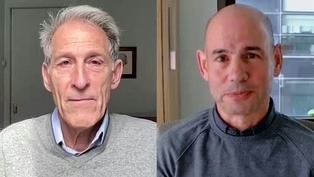
NewEx Sony CEO & Fmr. Clinton Official on What You Can Learn From Their Mistakes
Video has Closed Captions
Michael Lynton and Joshua Steiner discuss their book "From Mistakes to Meaning." (17m 32s)
Providing Support for PBS.org
Learn Moreabout PBS online sponsorship
- News and Public Affairs

Top journalists deliver compelling original analysis of the hour's headlines.

- News and Public Affairs

FRONTLINE is investigative journalism that questions, explains and changes our world.











Support for PBS provided by: