
Learning
10/16/2026 | 26m 46sVideo has Closed Captions
Three NC schools are doing things schools don’t normally do, from childcare to disaster housing.
Schools in NC are trying to shorten the distance between a classroom and a paycheck. Learn how a state-funded lab in Sampson County lets students earn credit for finished tech projects, how Forsyth Technical Community College in Winston-Salem tracks down childcare so student parents can stay enrolled and how a Yancey County carpentry class frames houses for neighbors displaced by Hurricane Helene.
Problems playing video? | Closed Captioning Feedback
Problems playing video? | Closed Captioning Feedback
ncIMPACT is a local public television program presented by PBS NC
Learning
10/16/2026 | 26m 46sVideo has Closed Captions
Schools in NC are trying to shorten the distance between a classroom and a paycheck. Learn how a state-funded lab in Sampson County lets students earn credit for finished tech projects, how Forsyth Technical Community College in Winston-Salem tracks down childcare so student parents can stay enrolled and how a Yancey County carpentry class frames houses for neighbors displaced by Hurricane Helene.
Problems playing video? | Closed Captioning Feedback
Where to Watch ncIMPACT
ncIMPACT is available to stream on pbs.org and the PBS app.
Providing Support for PBS.org
Learn Moreabout PBS online sponsorship- [Announcer] ncIMPACT is a PBS North Carolina production in association with the UNC School of Government.
Funding for ncIMPACT is made possible by... - [Announcer] Quality public television is made possible through the financial contributions of viewers like you who invite you to join them in supporting PBS NC.
- Schools are changing in North Carolina.
In some places, classrooms barely resemble the ones many of us sat through.
In this episode, we'll explore three communities where leaders are working together to rewrite how and what students are learning.
This is ncIMPACT.
[gentle dramatic music] Welcome to ncIMPACT.
I'm Anita Brown-Graham.
For most of us, school meant sitting at a desk and listening attentively or not to our teachers.
In Sampson County, the rural district decided that just wasn't working for enough of its students.
We head to Union High School to see what the district and its partners tried instead.
- From the outside, Union High School here looks like just about every other public school in North Carolina, except for one classroom inside.
Inside that classroom are no letter grades, no bell schedule, just students doing real high-tech work, earning credit, building portfolios, and chasing careers that did not used to feel possible.
More than 70% of students here qualify as economically disadvantaged.
Can a single classroom change what's possible for them?
[machine beeps, whirs] Inside this room, the rules are different.
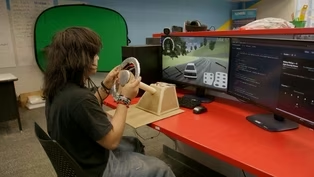
- What the robot car does, it's self-driving and it has ultrasonic sensors.
- [David] Students like Sophia King choose what they want to learn.
- I really don't really care about the grade situation, but I also like that it's not based on your grade because I feel like if it was, I feel like I'll have more pressure to make more mistakes.
- Where you can experiment, make those mistakes in here and not worry about... - Not worry about getting like a test grade or you did this wrong or something.
- [David] Sophia is a freshman at Union High.
She has never taken a computer science class, but right now she's building a self-driving car.
- I want to build inventions and help like the world like get easier for everybody.
- The room is part of a state funded program called SparkNC.
Students pick from fields like AI, cybersecurity, and software development and work at their own pace.
What do you like about this program that regular school doesn't offer?
- I like how it's student led, very student led.
So instead of like the teachers telling you what to work on and stuff, you get to choose what subject.
You get to choose which unit you choose on making... There's Makey Makey, there's soundtrack for a game where you can make soundtracks.
And if you're uninterested in a certain unit, you can always leave it and go straight to another one.
- Some of our projects are digital builds.
- [David] Ashley Knowles is a Spark Lab leader at Union High, and in her class, getting it wrong doesn't cost you.
- If they finish and they receive all six units and they get the credit perfect, that's what we want.
But if they don't, no harm, no foul.
We're not holding it against them.
There's no numerical value assigned to SparkNC.
You either get the credit because you've completed or you don't get the credit because you didn't complete.
But when you leave, you have learned something.
- But how do you convince a school board to sign off on something like this and scrap everything they know about school?
This is a pretty innovative model.
Was there any skepticism or pushback initially?
- Yeah, I think there's always skepticism with something new.
It's, you know, it's why are we doing it?
It's what are the outcomes?
And sometimes you got to just say, "You know what?
What we're doing isn't working, so we got to try something new."
- [David] More than 70% of students at Union High come from low income families.
On state tests, fewer than one in four pass math and fewer than half pass English.
When SparkNC came to Sampson County, Superintendent Jamie King had seen enough of what wasn't working.
- My job, it's looking at how do we reach those kids that we're not reaching?
How do we change outcomes for kids that we're not being successful for?
And so this was one of those, you know, "Hey, everybody says great things about it.
Let's try it.
Let's see how it works."
- [David] In Sampson County, most students grow up around farms or factories.
Those industries aren't disappearing here, but the jobs inside them are changing fast.
- Maybe our students don't necessarily want to leave Sampson County, but Spark Lab gives them that opportunity to really embrace that technology and kind of get that experience.
And there's just one more avenue that we can provide for rural Sampson County.
- [David] And tech jobs aren't just coming to Sampson County.
In some ways, they're already here.
Star Communications has run fiber internet through rural Sampson County for decades.
Now, they're partnering with Union High and watching to see who comes out the other side.
- It gives them an opportunity that they, if they want to stay around home, they would have a employer that would employ them within the technology field because we're constantly evolving and growing.
- [David] But SparkNC didn't start here in Sampson County.
It started with a moment North Carolina wasn't ready for.
- Apple is coming to the triangle.
The company has promised to invest more than a billion dollars in North Carolina.
- [David] On April 26th, 2021, Apple announced it was building a campus in Research Triangle Park.
The company promised 3,000 jobs with an average salary of $187,000, jobs in some of the fastest growing fields in the world.
That same day, the founders of SparkNC were writing their proposal.
- Social media kind of went on this buzz of all those jobs will go to people from California.
They won't be from people in North Carolina.
We won't be qualified for those jobs.
So the dream was that our students would be the ones walking through those doors to get those high wage competitive jobs.
- But those doors are on the Research Triangle Park, not in Sampson County.
The question was whether a program like SparkNC could change that.
Is this for all students or are there some students who struggle with the autonomy and gravitate more towards that structure?
- We do believe it's for all students.
Students will make a choice around how they want to learn it.
So you'll see students pairing up in a team where other students really like to work individually.
So when you go into a Spark Lab, you may see all kinds of things going on at one time, and we just have to sit down and say, "What's your goal?"
- But can a model this different actually deliver?
State lawmakers have the same question.
They're funding SparkNC at $3 million a year, so they brought in the Friday Institute at NC State to find out.
The report came out in March of 2025.
It showed that 78% of students said SparkNC made them more interested in a tech career, and 59% had a portfolio, internship, or certification by the time they were surveyed.
Well, the report leaves one question open.
Do these students actually get tech jobs?
Well, that data won't exist for years.
So what does success look like right now here in Sampson County?
Has it changed at all sort of benchmarks in terms of student success?
- What's grand about Spark is Spark gives that student the opportunity to one time in their lives pick the educational route that they want to go.
And that's what you're going to see in the difference in what Spark provides our students is intrinsic motivation of them sitting saying, "I want to do this, therefore because I want to do it, I'm going to be successful."
Instead of the teacher saying, "I'm going to hold a grade above your head."
- It's an idea that landed for students like Sophia King the moment she walked through the door.
Is it tough to go back to a regular class after being in here?
- It is.
It really is because in here I'm like more keeping myself and like no rules and stuff.
- You're able to be creative in here?
- Yes, and be able to be myself.
- [David] For students like Sophia, something shifted the moment she walked in.
Whether it changes what comes next is still to be determined.
For ncIMPACT, I'm David Hurst.
[machine beeps] - While SparkNC asked what school should look like to engage students while there, one North Carolina Community College asked a slightly different question, "What keeps a student from finishing?"
For student parents, it's often not having access to affordable childcare.
We head to Forsyth Tech to see how the college is trying to keep those parents in class.
- She almost quit college, not because the classes were too hard, but because she couldn't find anyone to watch her kids.
Nearly six in 10 student parents who drop out cite childcare as the reason.
Most colleges don't even track how many student parents they have, but Forsyth Tech built a program to fix that.
We're here to find out if it actually works and whether any other school can do the same.
This is Kayla Connor.
She's got two boys, one nine and one about to turn six.
This year, she finished her degree at Forsyth Tech.
How challenging was that to try and balance school and motherhood?
- I'd say it was really challenging because I really wanted to be there and be like, do things with my kids at their schools as they started to get older.
And so trying to see what they need to be doing and be active with them and then trying to make sure that I'm getting my work done.
- Balancing school and motherhood was hard enough, but sometimes life throws in something harder.
Were there ever times when you though, "I can't do this?"
- Yeah.
Yeah, there were.
I went through like a few family losses and so that mental, it was hard like mentally sometimes.
- [David] Kayla almost became one of the students who never finish.
Nearly six in 10 student parents who leave community college without a degree named childcare as a reason why.
And more than half say they simply couldn't balance coursework with caring for their kids.
Most colleges don't even know how many students like Kayla are on campus.
Shanta Reddick has spent her career trying to close that gap.
My cohost Anita Brown-Graham sat down with her to find out how.
- Tell me a little bit about how you even got into this work.
What was the driver, the motivation?
- Wow, well, you know, the driver and motivation was my own life experience.
Of being a single mom, going back to school as a adult and having to kind of navigate in those different hard spaces and places led to definitely my work with student parents.
- [David] Reddick's team wanted to know exactly what was standing in the way, so they asked.
Students kept naming childcare as a barrier.
- Not only do we not have enough childcare centers, we don't have enough childcare workers, and then we don't have enough funds for them to pay to be able to go to the childcare centers.
- It just keeps going.
Yes.
- Yes.
It just keeps going.
- [David] So Reddick and her team looked for a solution, but they didn't have to look far.
It turns out the college already had a childcare center.
It just wasn't built for student parents.
It's called the Early Childhood Lab.
Forsyth Tech built it to train future preschool teachers.
Students get real hands-on classroom time with real kids.
- They're knocking down things, trying to see what works and what doesn't work.
So it's really fun to see what they can build and create.
- But during COVID, Reddick looked at that room and saw something else.
She saw childcare for the student parents trying to get to class.
So now the children of student parents get first priority for those 15 spots.
How long are the kids usually with you?
- They're usually here for two years.
- Two years?
Okay.
- So they start when they're three and then they'll eventually when they're five.
- Okay, I imagine you're able to see a lot of growth in those two years.
- Yeah.
So it's really fun to see them grow.
We have, sometimes they come in shy and then they're blossoming into who they are.
- [David] Kayla's boys were two of those kids.
- I knew that my kids would be able to go somewhere where they'd get like a good education.
And then I also like that they have that two-way mirror.
So like my son, he was kind of clingy, he wants to cry.
He was crying, so they were able... I was able to watch and make sure that like he got acclimated.
- [David] But 15 kids only go so far.
What happens to everyone else on the waiting list?
- When it comes to childcare, we partner with Childcare Resource Center.
They're one of our big partners.
We're able to send students to them to help try to find those childcare spaces and places, whether it's even an in-home daycare, whatever we can do at that moment to get some sort of childcare so the student can still come to class.
- [David] Reddick calls it a soft handoff.
Every childcare request her office gets goes straight to that regional center, and most students hear back within a day or two.
- We partner with KidSpot, who's about probably three minutes from here.
It's a drop-in childcare facility, so we're able to partner with them with the discounted rate for our students to be able to go there.
- [David] Childcare was one piece of the puzzle, but what about everything else student parents say is standing in the way?
Reddick's office calls itself Forsyth Tech Cares.
They try to catch whatever a student needs before it becomes the reason they leave.
- The first thing that I do is I always, when they're coming into my office or we're on the phone is the first thing I do is I listen and I really hear them out because most time, by the time they come to my office, they have a lot going on and they really just want someone to hear them out.
- [David] For a lot of students, it's food.
So Forsyth Tech opens seven food pantries, one on every campus.
Students are able to access them twice a month because SNAP benefits only stretch two weeks.
Food and childcare may get a student through the semester, but Reddick says the real payoff shows up somewhere else.
- If I said helping a parent helps a kid, most of them would go, "Well, of course."
But if I pointed out that helping a parent accomplish their academic dreams actually results in better academic outcomes for their children, our listeners might be surprised.
Why is it that this two generational strategy is so powerful?
- I think it's empowering.
I think it changes generations.
I think it allows kids to be extra proud of their parents and see where they are and be able to have the same image of if they can do it, then I know I can definitely do it.
- [David] That's Reddick's vision for what this work can do.
- Generations to come because they're going to be able to pass it along.
- [David] The question is whether it's actually working.
[student chattering] In the Fall of 2025, about 9,900 students were enrolled at Forsyth Tech.
620 of them, about one in 16, got help from Forsyth Tech Cares.
81% of those students came back the next semester.
Forsyth Tech isn't the only college doing this.
As of 2025, 17 of North Carolina's 58 community colleges offered some kind of on-campus childcare.
- The goal is not just for Forsyth Tech to do this work, but every community college to be able to give these resources.
- [David] Even so, Reddick says real challenges remain.
She still needs resources, partnerships, and people willing to do this work every day.
- Finding the people who have the heart, because this work takes heart, and to do it every single day and show up in a space for students, you've got to be able to be transparent because that's the one thing a student can do.
They can tell when you're not genuine, and they will completely shut down.
- [David] It's one of the things that mattered most to Kayla.
- I feel like that was one of the biggest things that helped me, just making me feel like I belonged.
- [David] Forsyth Tech didn't build something new.
It found a use for something it already had.
Reddick's hope is that other community colleges can find a way to do the same.
For ncIMPACT, I'm David Hurst.
- So far, these schools and their partners have been working to ensure that students thrive.
Our last story flips the emphasis.
In Yancey County, students are solving a challenge for the school's neighbors.
We head to Mountain Heritage High, where a class is helping build back what Hurricane Helene took away.
- High school students in Western North Carolina are rebuilding homes destroyed by Hurricane Helene, but they've been doing this work years before Helene made landfall.
The housing crisis in Yancey County didn't start with the storm, it's been building for decades.
This high school decided their students were the ones to fix the problem, but can a high school carpentry class sustain that pace?
And what happens to the neighbors counting on them if they can't?
- This house is sitting right on the footprint of the old house.
- [Melody] Her new home nearly complete, Sharon Hughes has made peace with her neighbor, the Cane River.
The new home built by local high school students sits above the river, beside the camper that became her makeshift home, and below the hillside ledge where Sharon scrambled for safety when Helene flooded the river and swept her cottage away.
- The current, I mean, it created an unbelievable current.
There were actually waves.
There was debris churning underneath like an agitator in an old washing machine.
- [Melody] Sharon says her 120-year-old cottage sat untouched through every documented flood.
She did not expect Helene to bring 1,000 year rainfall totals, inundating Yancey County with the two highest totals in the state.
- This was my sixth flood.
So I felt as though I knew the personality of this river.
I knew where the water would go.
I knew how it would react and everything else.
And so I really wasn't worried about it.
- [Melody] When the water climbed from the middle of the road to halfway up the cottage foundation in one hour, Sharon sought refuge in her shed.
- I was in that shed for 15 minutes and water was coming up through the floor and it was raised off the ground.
I turned around and by the time I got back to the house, it was mid-thigh and I went straight up on the hill with the cat.
- [Melody] Where she watched flood waters carry the shed and cottage away.
The storm destroyed more than 1,400 homes and buildings in Yancey County, which sustained more housing damage per household than anywhere else in Western North Carolina.
- Can't imagine living anywhere else.
- [Melody] After the storm, the question facing every displaced family in Yancey County was where would help come from?
For Sharon, the answer came from an unexpected place.
[tools whirring] [hammer pounding] - Go ahead and attach that piece to the floor.
- [Melody] Jeremy Dotts and his students at Mountain Heritage High School built homes right here on campus.
- The building that you are in is the Michael D. Orr Construction Training Facility.
It was the brainchild of Michael Orr and Jim Swain about 20 some years ago.
- [Melody] The Yancey Mitchell Pillars nonprofit started the program, fundraising for building materials.
Initially partnering with Habitat for Humanity, students built and donated one home each year to neighbors in need.
Then Helene hit.
- Two weeks after the storm, I knew we were in a situation here where we had a lot of people without homes.
I knew our program was in a unique position to be able to help our community.
I just didn't have the money and I didn't know how we were going to find it.
- [Melody] The answer was closer than he thought.
- I said, "You start building.
I'll find the money."
- [Melody] Stephanie Johnson launched Rebuilding Haulers from a parking lot after the storm.
What started as food and supplies has grown into a grassroots rebuilding operation, raising nearly $2 million to get displaced families back home.
The school's homes are funded by Rebuilding Haulers, but Rebuilding Haulers is managing hundreds of other families at the same time.
591 requests since the storm, 172 helped so far, and that includes 25 full rebuilds.
And right now, the money to make it all happen is getting harder to find.
Do you ever worry about continued funding and also just the amount of need?
- All the time.
I'm always worried about money.
It is so hard getting... Doing the fundraising now.
Things have really changed.
Everybody thinks we're okay, and that there's these different programs that are rebuilding homes, but it's just not the case here.
[tools whirring] - [Melody] But while the funding fight continues, the students are still building.
A program that once built one home a year is now building four each year.
- [Jeremy] It was remarkable, incredible, and I hope we can continue at that pace.
- Were you a little bit nervous about having that sort of responsibility?
- Yeah, definitely a little nervous, but kind of gave me a sense of belonging, like I'm helping people.
I'm actually doing something for people that... It's really awesome.
[tools buzzing] - First house we did, it was like really nerve-wracking because I was like, "I don't want to mess this up.
I don't want to do this wrong."
- [Melody] Their teacher sets a high bar to meet or surpass construction codes.
- The house right here beside us didn't exist nine weeks ago, and this is double the size of the tiny homes that we were building.
So they built a 1500 square foot home in nine weeks, which was very, very impressive.
- The other day, the homeowner of this house, she came in and she lost her house during the storm and she has a special needs son, so that makes us feel really good, like knowing that we're helping that person out.
She did start crying.
I mean, I'm just glad we got to make her happy and give her a place to stay, you know?
- I can go home, sleep easy knowing that I did something good for somebody at least today, and I know someday it'll come pay me back.
- [Melody] But for Yancey County, the bigger question isn't just how many homes get built, it's who will be around to keep building them?
What are you thinking about for the future and might it include carpentry or welding?
- Absolutely.
Definitely carpentry.
It's funny because growing up with my dad, he's a contractor and I'd always work with him.
I'd tell myself, "Oh, I'm never going to do this.
I hate this work."
But then as you just get accustomed to it and you realize we're impacting people's lives with this and we're giving ourselves a sense of belonging.
- [Melody] The region doesn't just need more homes, it needs more people who know how to build them.
In Yancey County, that pipeline starts in high school.
That's a lot of space.
- It's a lot of space.
- I just love how open the cathedral ceiling is.
- Oh, absolutely.
- While the students build their futures, Sharon is almost ready to move into hers.
The home Sharon is moving into was built by the students at Mountain Heritage High School.
- I went over to the high school to see it the first time.
I did not know it, but they used my CAD drawing, so this is what I actually laid out.
- [Melody] When you saw that, what did you... [Sharon sighs] - I was shocked.
I was shocked and so grateful to be heard.
- [Melody] When Rebuilding Haulers delivered Sharon's house, the students were there.
- And it's just crazy seeing the thing that we built finally being set on a foundation for someone.
- I am so grateful.
Rebuilding Haulers in conjunction with the high school and the Cougar Carpenters are such a blessing.
There are no words.
Sorry.
There are no words to explain how this feels.
I never cried over losing everything, but the gratitude breaks me down every time.
- [Melody] One family is almost home, but hundreds are still waiting.
For now, these students keep building.
For ncIMPACT, I'm Melody Hunter-Pillion.
- Every story on ncIMPACT starts the same way.
People in a community see a problem and they decide to take it on together.
That's the magic, pure and simple.
So thank you to the local leaders featured in this episode who so generously allow us to share their work and dreams, and thank you to you, our audience, for watching and engaging at such high levels.
I want to hear from you.
Tell us what your community is doing or how we can help, because that's what we do best in North Carolina.
We work together.
[upbeat theme music] [upbeat music continues] [upbeat music continues] [upbeat music continues] [upbeat music continues] [upbeat music concludes] [upbeat music resumes] [upbeat music concludes] Coming up on ncIMPACT.
- Just because we are the only resource for a period of time doesn't mean that we're the best resource.
- [Reporter] When we call 911, we often expect a police officer or an ambulance, but in these three North Carolina counties, that's not always who shows up.
We'll explore communities rethinking who answers the call.
- [Announcer] ncIMPACT is a PBS North Carolina production in association with the UNC School of Government.
Funding for ncIMPACT is made possible by... - [Announcer] Quality public television is made possible through the financial contributions of viewers like you, who invite you to join them in supporting PBS NC.
 New
NewThe NC Schools Where Students Have No Grades
Video has Closed Captions
NC schools are experimenting with letting students earn credit by finishing tech projects. (7m 8s)
Video has Closed Captions
Three NC schools are doing things schools don’t normally do, from childcare to disaster housing. (20s)
Providing Support for PBS.org
Learn Moreabout PBS online sponsorship New Episode
- News and Public Affairs

Top journalists deliver compelling original analysis of the hour's headlines.

- News and Public Affairs

Today's top journalists discuss Washington's current political events and public affairs.
 New Episode
 New Episode

 New Episode


 New Episode


Support for PBS provided by:
ncIMPACT is a local public television program presented by PBS NC