
History Meets Science
10/1/2026 | 26m 46sVideo has Closed Captions
A discovery of a 1748 shipwreck, 250-year old bullet holes at a historic site and parasitic wasps.
Student archaeologists discover a centuries-old shipwreck, and crime-scene technicians study 250-year-old bullet holes at a Revolutionary site. Plus, Adrian Smith of the NC Museum of Natural Sciences takes a close look at parasitic wasps.
Problems playing video? | Closed Captioning Feedback
Problems playing video? | Closed Captioning Feedback
SCI NC is a local public television program presented by PBS NC
Sci NC is supported by a generous bequest gift from Dan Carrigan and the Gaia Earth-Balance Endowment through the Gaston Community Foundation.
History Meets Science
10/1/2026 | 26m 46sVideo has Closed Captions
Student archaeologists discover a centuries-old shipwreck, and crime-scene technicians study 250-year-old bullet holes at a Revolutionary site. Plus, Adrian Smith of the NC Museum of Natural Sciences takes a close look at parasitic wasps.
Problems playing video? | Closed Captioning Feedback
Where to Watch SCI NC
SCI NC is available to stream on pbs.org and the PBS app.
Related to This Episode

Providing Support for PBS.org
Learn Moreabout PBS online sponsorship- Coming up on "Sci NC," a Spanish shipwreck lost for nearly 300 years, bullets holes you can still touch from the American Revolution, and a wasp attack like you've never seen it, next.
- [Announcer 1] Quality public television is made possible through the financial contributions of viewers like you who invite you to join them in supporting PBS NC.
- [Announcer 2] "Sci NC" is supported by a generous bequest gift from Dan Carrigan and the Gaia Earth-Balance Endowment through the Gaston Community Foundation.
[gentle music] [gentle music continues] - Hi and welcome to "Sci NC."
I'm Laura Smith.
We are so glad you're here.
You really never know what the ocean is going to cough up.
Lately, erosion has been exposing history hidden beneath our coast, and the latest, the La Fortuna, a Spanish ship that sank off North Carolina in 1748.
That was a long time ago.
Producer Frank Graff joined East Carolina University archeology students helping uncover its story.
[waves crashing] - It was pretty overwhelming.
I didn't know it was a shipwreck at first.
I just was like, this could be part of the wharf.
I have no idea.
[waves lap] - [Frank] Our story starts on the lower Cape Fear River, south of Wilmington.
Archeology students measuring the remains of an abandoned colonial wharf literally hit the historic jackpot.
- And then I stumbled upon just pieces of wood sticking out of the sediment and there was planking at the surface, and I told someone that, hey, there's some weird wood kind of stuff down here.
- [Frank] Sometimes big discoveries just happen by luck.
The skill lies in recognizing not only what happened, but what it means.
- It's kind of emotional.
I'm not going to lie.
I don't think I've told anyone else, but I did cry in the woods a little bit when I was walking back by myself, just realizing that if I didn't stumble upon that last year, it would've been gone and we would've never came back, and then we would've never found all these other wrecks eroding.
- [Frank] Tests of the wood showed the timbers were made of Mexican cyprus.
That's significant and an important clue to solving a mystery of history.
This stretch of the lower Cape Fear was the location of Brunswick Town, a British port in colonial America.
[jaunty colonial music] History shows, in September 1748, toward the end of King George's war, a Spanish privateer ship called the La Fortuna attacked the port.
Privateers were individuals hired by governments to attack an enemy.
The privateer could keep part of whatever loot or bounty was captured.
The La Fortuna was sunk during the week-long Spanish occupation.
- This incident was a major development in early, you know, colonial North Carolina.
A Spanish ship to come up and attack Brunswick Town and then to eventually be sunk and sort of lost to time.
You know, it's been looked for since the 1960s.
People have been interested in trying to find the site.
So I would say that Fortuna, La Fortuna, is probably one of the sort of holy grail sites of, like, what happened to it.
The idea that what we are looking at could represent the remains of La Fortuna are really exciting.
- I think something on board her blew up, a barrel of powder that was on the deck, and it caused a catastrophic fire in the rigging, and that's what does in Fortuna.
- [Jason] And in a way, it's also tragic, because the only reason we think that no one was ever able to find it before is because it's been buried under a marsh that is now rapidly eroding.
- [Frank] The water is a double-edged sword.
Over time, it created the marsh that preserved the remnants of Brunswick Town, but now, erosion caused by climate change fueled sea level rise and stronger storms is exposing what remains of the colonial period.
Waves created by boat traffic are also washing away the riverbank.
- We are using this as an opportunity to study what is eroding out of the bank.
So scattered along our feet here, you have all of the debris coming out of the wharf structure itself, but also things that people dropped and broke like glass bottles or ceramic sherds.
I mean, just right here, you can see a beautiful redware ceramic sherd.
- [Frank] That's a piece of pottery?
- Yeah, this would've been, it's not big enough to really show, but it probably would've been a mug of some sort.
I'm probably the first person to touch it since the last person that dropped it and then threw all their broken pieces into the river, and that's a pretty cool thing to really feel that connection to a site like this.
- [Frank] Researchers combing the beach never know what they will literally stumble upon.
While pottery shards are common, pieces of shipwreck are not.
- One of the things that we tend to look at is, you know, what are the fastener patterns?
What are the overall dimensions?
What are some of the characteristics of how the shipwright shaped the timber?
We have a large assemblage of frames that sort of match with this.
You have wooden trunnels, which are basically wooden fastenings.
There is some but not a lot of iron fasteners on these, and each one of these frames, you can see sort of here how the shipwright used and adds to basically chop the tree branch to form the shape of the frame.
- Researchers recovered 63 pieces of timber from the waterfront.
So this would've been under the ship and the planking would've gone over that?
- Yeah, so you would've had outside planking basically running perpendicular to this, and then these trunnels would be fastened to that, and that would be the outer hull planking or the outer skin of the ship, and then on the inside, this would've been also planked, and we call that the ceiling planking even though it's basically the bottom inside of the ship's hold.
- And maybe this is just my imagination, but I'm just picturing this, and somebody, you know, some shipwright, correct?
Just pounding away to drive that in.
- Yup, so you would use basically a hand auger to sort of bore out a hole and then you'd use a mallet and shape the wooden dowel.
- [Frank] Early analysis shows the artifacts are from four different shipwrecks, but the majority of the pieces appear to be from the La Fortuna, and each piece has its own unique story to tell.
- [Jeremy] And you can see here that you have the carved Roman numeral nine, essentially.
That is indicative of maybe the ninth frame of whatever component this came from, whether that's, you know, part of the actual ribs of the ship or part of, like, a stern structure like the transom.
- I'm just looking at this.
Is this a tongue and groove?
I mean, another piece of wood went right in here.
- Yep, so- - Wow.
- [Jeremy] And so another plank would've slotted in there and then this probably went into another wall of some sort.
- I'm holding something that someone worked on a couple hundred years ago.
That is so cool.
- Yep.
- I mean, look at the craftsmanship.
I mean, you know, it's a ship, but still, look at- - Yeah, yeah, I mean, they would take a lot of time and care into making these vessels, you know, to the best of their ability.
[whimsical music] - [Frank] The shipwreck artifacts are being analyzed at the conservation lab for the North Carolina Office of State Archeology at East Carolina University.
The segments are also beginning the slow several-stage process of desalinization and preservation.
- We want to do everything that we can to prevent decay, collapse, any detrimental effects as we're working on these things, and we don't want to do anything that will suddenly shock an object and it react adversely.
- [Frank] The timbers are laser-scanned, creating virtual copies that show exact shapes, colors, textures, and it's all done to scale.
- We can have a full 3D digital reproduction of this original timber that then we can minimize our impact in just handling this and manipulate the pieces of the shipwreck virtually to try to reassemble the site as it would've been.
- [Frank] Think giant historical puzzle.
- [Jeremy] When you have a virtual copy of it, you can spin it in full three dimensions and manipulate it which way or another, and that's how, really, we're going to match these fastener patterns to the planking that we see on the hull and piece the puzzle back together.
[gentle music] - [Frank] Smaller artifacts, like this broken punchbowl, provide context and add to the tapestry of the 18th-century waterfront that archeologists are creating.
- And then when it came back to the lab and was conserved, it ends up saying "the other bowl and then," and that's a traditional 18th-century English custom of drinking rum punch out of a bowl.
So it was like passing the rum punch bottle or bowl around, having another sip, and it's sort of that "one more before we hit the road" kind of custom or activity.
- When we're talking about seeing different, you know, cultural origins of these types of artifacts on shipwreck sites, that can certainly be an indication of the origin of the ship, but also, you know, something to think about is that, during colonial times, there are all different kinds of trade networks and all different kinds of people sort of living together at different spaces.
So things could have been imported from anywhere.
- The history of Brunswick Town is a jigsaw puzzle with three quarters of the pieces missing, and every day, that's the beauty of this place.
Every day, we find a little bit.
You know, we might find a quarter of a piece that fits right here.
- On the one hand, we are excited, because with the erosion of the marsh, this whole 18th-century landscape is just coming to life for us, but it's also destroying a natural barrier to the shore.
It's destroying cultural heritage, because as we're seeing it, we're excited, we're recording it, and then it's being lost because we can't keep all of it.
We can't stop the erosion.
[waves lapping] - From history under the water to history still standing, some you read about, this one you can literally touch.
The House in the Horseshoe is the only home in North Carolina still wearing its bullet holes from the American Revolution.
Can you believe that?
Producer Frank Graff shows us how crime scene technicians are treating it like a case to figure out what happened.
Take a look.
[jaunty colonial music] - This place is so cool because it's the only place in North Carolina that has bullet holes from the American Revolution.
This is the only physical evidence that you can still go up and feel for our fight for independence.
It's one of only a handful of places in the country you can go to still see these physical scars from the American Revolution.
- [Frank] And that evidence allowed historians to treat this battle from the American Revolution kind of like a crime scene.
The forensic analysis would either confirm or debunk the story of the House in the Horseshoe.
First, the weapon.
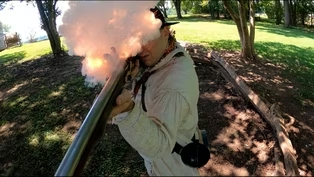
[gunshot bangs] - So this weapon is a flintlock musket.
What that means, it has this flintlock mechanism.
You could shoot every 10 to 15 seconds with this.
[gunshot bangs] - [Frank] Now, to the history.
It is July 29th, 1781.
- The Tory War, which is this kind of revolutionary civil war that happens within North Carolina, is really about fear.
You know, one of the reasons why the battle happens is they're trying to fear people in this area, terrify them to either go patriot or whig, the term they called themselves, or Tory, a loyalist, to try to force people to decide on what side they're on, and they commit some pretty brutal acts along the way.
- These reenactors paint the story.
Philip Alston and his whig party militia, which supported the American Revolution, are attacked by a loyalist militia.
The plantation was called The House in the Horseshoe because it sits on a horseshoe bend on the Deep River.
The loyalists were coming up this way.
- Mhm.
- And it wouldn't have been a good idea to stand here, but if I was standing here- - Yes.
- I would've seen what?
- You would've seen a line of loyalist militia start to surround the house, and they would've been mounted on horseback.
Someone probably would've stayed on horseback.
Some of them would've dismounted, used the fence for cover, but also the building, the structure that was over here in the side of the yard as well.
[gunshots banging] - [Frank] So they were behind this fence shooting at- - At the militia.
Yeah.
So, by this point, Alston's men have run inside, the windows are open, and they're firing from both stories, the second story and the first story, out at these loyalists.
- [Frank] The muskets could hit a target about a hundred yards away.
[gunshot bangs] That's roughly the length of a football field.
[jaunty colonial music] - So the weapon works by pouring gunpowder in the pan here, shutting the pan, which is held in pressure by springs here and this piece called the hammer, and you have right here, really the key to the whole mechanism, a piece of flint.
You then pull this cock back right here with a piece of flint, a sharpened piece of rock, and when you pull the trigger, it releases all the pressure in the springs, which creates a spark, ignites the gunpowder there, sends it through a pinhole.
Ignite gunpowder, you pour it and ram it down the muzzle of the gun and then send your bullet down range.
[gunshot bangs] - The firefight lasts, like I said, two to three hours, and it's not going to be volleys of fire like we think about on a regular battlefield.
It's going to be very, very intentional.
Very, you know, aiming and shooting.
There's probably a couple of volleys to begin with, but we have about 20 to 25 men inside, around 30 men on the exterior, as the loyalists are, you know, attacking the house.
- [Frank] And here's where the crime scene investigation begins.
About 30 bullet holes from the battle pockmark the pine panel walls inside and outside the home, physical scars of the American Revolution.
- These walls are not insulated.
I mean, they're two layers of board, but as is evidenced still today, the bullets are coming all the way through.
We know casualties occurred on both sides.
We don't have exact numbers.
There was a number of men who were wounded here.
- There's some more bullet holes that I can see through now.
- Yeah.
- If you get just the right angle, you should be able to see inside.
- Oh.
Well, that's the bed.
- Yep.
- This thing went, so it went all the way from- - All the way through.
- Wow.
- Yeah.
[dramatic music] - [Frank] Forensic scientists from the North Carolina State Bureau of Investigation studied the bullet holes and discovered a lot more information about what happened early that summer morning, almost 250 years ago.
- We love updating the narrative and updating what we're able to teach people about the site, about the history.
We love learning new information.
It just makes the interpretation richer, deeper, and more human.
- [Frank] Trajectory analysis reveals where the shots were fired from, confirming the history of the battle that was passed down.
- And what's interesting is all the bullets on this side of the house kind of come from that direction, almost like this was the approach.
- [Frank] And musket balls, I'm assuming?
- Musket balls.
So these are 69 to 72 caliber, a musket ball about this size, and you can see the impacts that would've had here on this house, and, of course, once they impact, they'll spread and they'll open up, but this is what it's going to look like coming out of the musket itself.
This one, interestingly, you can look through there and see a piece of the frame, and these are six-inch timbers that frame the house.
So some of them probably would have lodged in the frame.
A lot of them would have passed through both interior and exterior siding.
[jaunty colonial music] [jaunty colonial music continues] [gunshots bang] This did back up the historic record that they approached from the north because most of these are coming from that area.
This was probably the first firing was on this side because they are so angled.
On the other side of the house, they're more straight on, like they had kind of improved their stance a little bit, got a little bit more, a little bit more thought about what they were going to do, and then the ones upstairs, of course, are all angled down.
- [Frank] Alston and his militia surrendered to the loyalists.
- Ultimately, Philip Alston and his men are paroled to put down their arms for the duration of the war against the king, and Philip Alston himself is put on house arrest.
Now, he has about 4,000 acres of land so it's not like he's stuck right here on this little footprint we have today.
- [Frank] But Alston was not involved in any other action during the revolution.
That deprived the colonists of a capable military leader.
It was a small battle with lasting consequences.
- This house was lived in up until the 1950s, but we're happy that the residents that lived here recognized the significance of those bullet holes, but to see those bullet holes and see an evidence, you know, a physical tangible object from this fight is really incredible and very rare.
[gunshot bangs] - Isn't it amazing just how much history we have here in North Carolina?
It really takes you back in time, that story there.
All right, onto the next.
Most of the time, we're running away from wasps, but next, we're zooming in closer than you ever thought you would.
At the North Carolina Museum of Natural Sciences, Adrian Smith uses slow-motion video to capture something almost no one ever sees, literally, exactly how a wasp hunts, strikes, and feeds.
- These two shots of what is sometimes a predator-prey interaction and sometimes the beginning of a parasite-host relationship are some of the most scientifically interesting clips I've ever captured.
What you're looking at is a solitary wasp with incredibly specialized vice-gripping claws going after planthopper nymphs.
The planthoppers, with their spring-loaded jumps, as you'll see, aren't the easiest things to grab ahold of, and this footage is part of a new study I contributed to describing how these incredible wasps work.
To get those shots, I spent a day in the biocontrol lab at the University of Rhode Island.
Those two sequences you saw at the beginning were the main products of six hours of filming with two collaborators helping me wrangle the insects in front of the camera.
The reason why I filmed them in a biocontrol lab is they specialize on parasitizing plant-feeding insects like this planthopper nymph that you're seeing now.
Planthoppers and leafhoppers can be crop pests, so the lab I was filming in was studying these wasps as potential biocontrol tools.
Now, in these shots, you're actually seeing both the hopper nymph and the wasp.
That brown bulge sticking out the side of the hopper is the developing larva wasp.
The body of the larva is positioned in that structure, which is made up of larval molts that have hardened into a protective shell called the thyloceum.
The head of the larval wasp is inside the hopper and feeding even while its host is still alive, moving and feeding itself.
Now these wasps belong to a family of insects commonly known as pincer wasps in the taxonomic family Dryinidae.
Dryinids can be found worldwide and there are just under 2,000 described species.
Some of them are winged, some are wingless, but all of them are solitary parasitoids depositing their eggs into hoppers and feeding on them all the way through larval development.
The adults can be variable in size, but here's a larger species next to the tip of a pencil for scale.
Now, what I was interested in filming was how these wasps capture their host prey.
Planthoppers, along with all the other hoppers that these wasps target, have spring-loaded hind legs that produce some of the fastest escape jumps ever recorded.
The wasps need to catch these insects pretty frequently too because they don't just use them as a host.
They also feed on them as prey, like you're seeing this one do.
So one of the main challenges with trying to film this was getting a wasp that perceived the particular hopper nymph as either prey or a potential host.
Sometimes, we could get the wasp and the hopper in front of the camera, but the wasp didn't seem to care and would even walk right over what we thought they would see as prey.
The hoppers, however, still did care and were quick to escape from that situation.
So the secret weapon these wasps have is this, extremely modified front legs that end in a foldable spring trapping claw.
This one's showing you the claw as it unfolds it to clean it.
One of the things our new study does is describe how the anatomy of this claw works.
In doing that, my collaborators made models like this from micro CT scans of the front legs and claws.
Now, the part that you saw open and unfold is this part at the end.
When they strike, this snaps shut on the target when it makes contact.
What blew my mind about the anatomy of this claw is that this sharper half here is a modified version of one of the paired tarsal claws that all insects have.
This thing down here is the other smaller half of that standard tarsal claw.
To give you an idea of what a normal set of tarsal claws looks like, here's a leg of a roach ending with the claws.
Even looking back at the pincer wasp, if you move back to the middle and hind legs, you can see that they end in a more normal-looking arrangement with small tarsal claws at the end.
On the front leg's trap claw, the other part here that snaps shut under the target prey is a modification of the fifth tarsal segment.
All of this is held folded back up on the leg and this part, the arolium, which is normally an adhesive pad on the tarsal claws of other insects, is used by the wasp as a foot when they move around.
In these slow motion shots of running, look at the front legs and you can see the trap claw folded up, and each step taken with that arolium pad interacting with the ground instead of the claw.
Okay, now that you've got a good idea of what these wasps are and what they're doing, let's look again at those two slow-motion clips I captured of their attacks.
You might have noticed that all these wasps have huge eyes.
Well, the first step is visual recognition of a target and orienting the body to be in striking distance.
Next, the front legs go up, but still with the claws folded away.
This one spends a bit of time inspecting the hopper from this position before deciding that it's worth getting the claws out and going for an attack.
Next, the legs are raised up and the claws are unfolded into attack position.
At this point, we're pretty sure that they're setting them into place and loading an internal spring that will make the claws snap shut once they make contact with the body of the hopper.
When it starts raising its abdomen to point upwards, a strike is about to happen.
It throws the open claws at the body of the hopper and they clamp down.
Of course, all this was filmed in slow motion at 6,000 frames per second, and it only took 3.7 milliseconds from when the claws started moving towards the hopper to when they clamp down on it.
From here, the wasp injects paralyzing venom into the hopper and either decides to feed on it or use it as a host and inject its eggs into it.
The second shot I was able to capture is from a different perspective, focusing on the hopper so that we can see what the claws do when they hit the target.
Once the strike starts, I'll slow it down to go frame by frame so we can see how the claws stay open until they hit and clamp into the hopper.
This one immediately responds with an escape jump that rips one of those claws loose, but the other claw stays attached and the hopper yanks the wasp into the air with it as it goes.
I'll wind it back and play it again at one fluid speed so you can see that spectacular sequence of predator-prey behaviors happen all together.
[gentle music] So most of what you just watched is part of a research project describing the functional anatomy and strike behavior of those wasps.
That's it for now.
Thanks for watching.
- Wow.
What an incredible story.
Well, that's it for "Sci NC" this week.
If you want more "Sci NC," you can get more.
Be sure to follow us online through our website at pbsnc.org and on YouTube and Instagram.
Make sure you give us a like and subscribe.
I'm Laura Smith.
Thank you so much for watching.
We'll see you next time.
[gentle music] [gentle music continues] [gentle music continues] [gentle music continues] [gentle music continues] [gentle music continues] [gentle music continues] - [Announcer 2] "Sci NC" is supported by a generous bequest gift from Dan Carrigan and the Gaia Earth-Balance Endowment through the Gaston Community Foundation.
- [Announcer 1] Quality public television is made possible through the financial contributions of viewers like you who invite you to join them in supporting PBS NC.
Preview | History Meets Science
Video has Closed Captions
A discovery of a 1748 shipwreck, 250-year old bullet holes at a historic site and parasitic wasps. (20s)
Providing Support for PBS.org
Learn Moreabout PBS online sponsorship New Episode
- Science and Nature

Explore scientific discoveries on television's most acclaimed science documentary series.
 New Episode
- Science and Nature

Capturing the splendor of the natural world, from the African plains to the Antarctic ice.


 New Episode







Support for PBS provided by:
SCI NC is a local public television program presented by PBS NC
Sci NC is supported by a generous bequest gift from Dan Carrigan and the Gaia Earth-Balance Endowment through the Gaston Community Foundation.