
Faith & Harmony | Podcast Interview
Special | 41m 30sVideo has Closed Captions
Faith & Harmony share their family gospel story, rooted in the traditions of eastern North Carolina.
Faith & Harmony share their multigenerational gospel story, tracing their lineage to the Glorifying Vines Sisters and the deep musical roots of eastern North Carolina. With joy, humor and heart, they explore family, faith and the powerful tradition that continues to shape their sound. Hosted by PBS NC’s James Mieczkowski.
Problems playing video? | Closed Captioning Feedback
Problems playing video? | Closed Captioning Feedback
Shaped by Sound is a local public television program presented by PBS NC
Made possible through support from Come Hear NC, a program of the N.C. Arts Council within the N.C. Department of Natural and Cultural Resources.
Faith & Harmony | Podcast Interview
Special | 41m 30sVideo has Closed Captions
Faith & Harmony share their multigenerational gospel story, tracing their lineage to the Glorifying Vines Sisters and the deep musical roots of eastern North Carolina. With joy, humor and heart, they explore family, faith and the powerful tradition that continues to shape their sound. Hosted by PBS NC’s James Mieczkowski.
Problems playing video? | Closed Captioning Feedback
How to Watch Shaped by Sound
Shaped by Sound is available to stream on pbs.org and the free PBS App, available on iPhone, Apple TV, Android TV, Android smartphones, Amazon Fire TV, Amazon Fire Tablet, Roku, Samsung Smart TV, and Vizio.
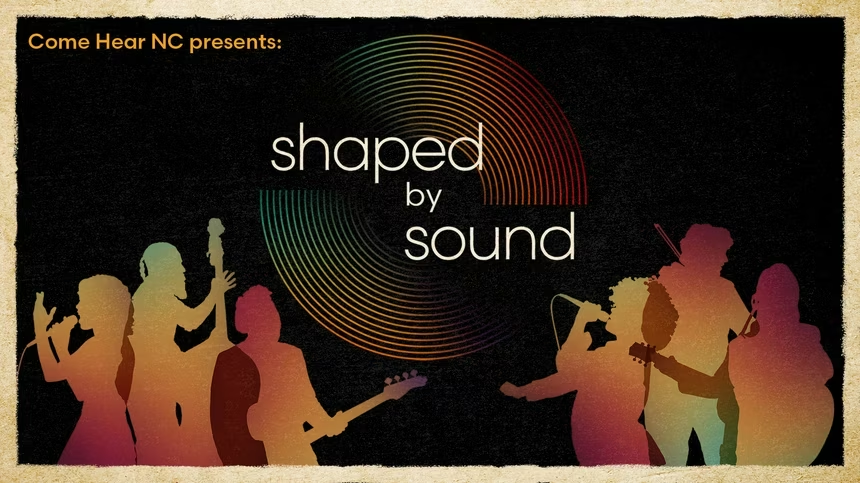
Explore Shaped by Sound
Dive deeper into Shaped by Sound. Explore the standout artists from Seasons 1 and 2, meet the show and podcast host, James Mieczkowski, and discover more ways to watch and listen.Providing Support for PBS.org
Learn Moreabout PBS online sponsorshipThe Shaped by Sound podcast is made possible through support from Come Hear NC, a program of the North Carolina Arts Council within the North Carolina Department of Natural and Cultural Resources.
Christy and Tinesha from Faith and Harmony, thank you so much for being on Shaped by Sound.
Thank you for having us.
Of course, we are very excited to have you all.
And I kind of want to start off, so y'all are from Greenville, North Carolina, is that right?
Yes.
Yeah.
And I'm going to try and explain this.
So you, Faith and Harmony is two sets of three sisters.
Is that right?
I can't say that three times fast, but we will, we'll try.
And you're all first cousins?
No.
Okay.
So that is, so no cousins.
I'm so glad you started with this.
So let's clear the air now.
Thank you.
Nobody is cousins.
No, we're all first cousins.
We are cousins.
Oh, wait.
So it's one set of three.
So me, her, and there's another one, Andrea.
Then the other three set, the Daniels sisters, right?
Their dad and our mom are brother and sister.
So the two sets of sisters are cousins, but we're not cousins.
And every time people make it sound like we're all first cousins, we're like that.
Right.
Okay.
So the sets are first cousins.
Yes.
To be totally honest with you, I still feel like I'm all cross-eyed here, but you know what?
It's a family affair.
Yes.
Just two sets of sisters.
Yep.
Yeah.
So can you sort of talk to us a little bit about how Faith and Harmony came to be?
So the two sets of sisters, probably back in like 2011, well, we've all sung our whole lives together as a choir or a praise team, we'll come together and sing.
But so around 2012, we both had separate groups and KeAmber, she's one of the older, they're the oldest, she came, she was like, "What if we just combined the groups together?"
And we were like, "Yeah, we sing together all the time, so why not?"
And so we were in, my grandmother has a shop, it's like a shop, she did like seamstress work, she would sew and stuff.
And the back of it was a studio.
So they would record back there.
And we were all in the shop because we were practicing there.
And they were like, "Okay, we got to figure out a name if we're going to come together.
We can't be the Edward sisters and the Daniel sisters mixed together.
We got to come up with a name."
So we opened up the hymn book.
And we were like, "Okay, whatever word we tap on, that's what it's going to be."
So we stopped on Faith.
It was like, "Okay, Faith.
Now what?"
And I think it was, it might have been Kadesha.
She was like, "Well, we harmonize, so let's put Harmony with it."
So that's how we got Faith and Harmony.
We just combined two groups together.
Boom.
Yeah.
I was not a part of that.
Okay.
In the initial group, I was not there.
I was not there.
They actually had this other girl that was not even a sister.
Really?
They did.
Huh.
Yeah.
So how did you get into the group then?
My uncle said, "Why are you not singing with the girls?"
And I said, "Wooo."
Was there a family meeting and you were like, "All right, come on in."
He was just talking to me randomly.
"Why are you not singing with the girls?"
And so I said, "Mmm."
So they sung one time at church and they let me come.
And so then I joined.
And there's no bad blood there now after that, after the initial not in, but now you're in?
I'm in now.
Heck yeah.
Yeah.
Been in since 2012.
Yeah.
Okay.
So you were there early days.
Yeah.
Okay.
Just not the very, very beginning.
She's talking about that specific story.
She won't dare when we pick the name.
She's going to never let that down.
I'm not.
Good for you.
I'm not.
They had a whole other girl.
Correct me if I'm wrong here, but you all are descendants from the Glorifying Vine Sisters?
Yes.
That's pretty awesome.
And I will say for those who don't know, they're sort of like the matriarchs of Eastern North Carolina as far as the music scene goes.
Yes.
So you come from a very renowned musical family.
Yes.
What's that like for y'all?
It's pretty awesome.
Do you want me to be honest with you?
Oh no.
It was awesome.
I think all of us grew up listening to them.
For some people being younger, it was like they had their people that were celebrities to them, but we went to their concerts.
So that's who was the most important and celebrities to us, our grandparents.
What was it like to sort of see your grandparents as celebrity?
Amazing.
Yeah?
Absolutely amazing.
We wanted to be up there with them.
Any chance we got to get up there, we wanted to be up there.
It was amazing.
It was different, but it was absolutely amazing.
When they would come down off the stage and kind of sing to the crowd, we would get up and follow them around and sing with them.
Try to inch in there.
Try to inch in there.
So did they get a chance to see Faith and Harmony and you all sang?
Oh yeah, definitely.
Yes, absolutely.
My grand- They were alive when we started the group.
In 2012, they were alive when we started it.
So we would be on some of the same- Sometimes we would get to open up for them.
Oh, cool.
They're the final act.
They're the grand finale.
Right, the headliner.
But we didn't mind.
We wanted to open up for them.
Yeah.
Sometimes being in the opening act, I feel like you get to really set the tone.
Yeah, definitely.
And maybe surprise some people, right?
Yeah.
It seems like, and from what I can understand, you all can trace your musical heritage back very far.
Is that true?
Centuries ago?
Well, listen, me?
I don't know.
If you get our uncle in here and the great uncles and stuff, they can trace it back for you.
But see me?
Yeah, no.
Not so much.
But I do know it's back there.
They can trace it all the way back.
Yeah.
I can tell you a little that I know.
Yeah, I would love to hear.
So the Glorifying Vine Sisters consist of my grandma and her sisters.
And then her husband, some of their husbands would play instruments or sing as well.
Our uncle would sing.
And then also our granddad, which was her husband, was a part of Little Willie and the Spiritual Heirs.
So he was pretty famous too.
And then him and his brothers all sung together.
So we come from a big family of singers.
We would get together.
I remember one family reunion, part of it was a church service.
And so everybody's at church and they bust out with a song.
And everybody started singing.
It's like this mass choir in harmony.
It was pretty cool.
Whoa.
Well, it's probably amazing.
I'm just trying to think of what your family reunion would be like.
Church.
Yeah.
It was always church.
Especially with so many musicians in one family and singers.
What was it like being who you are and being musicians and growing up in Eastern North Carolina?
Well, we all started when we were young.
Our dad was a pastor.
And so he kind of locked us in the church and said, "Learn something."
So we did.
She learned the drums.
I learned the keyboard.
He had us traveling kind of around to sing.
Our granddad gave us a chance to sing with our half of the group, opening up for him and his group.
So that was pretty cool.
But I don't know.
Eastern North Carolina is what's soulful.
Religion is okay here.
It's normal.
So it's kind of like we're just going with the culture.
Yeah.
Well, it seems like there's a very deep and rich musical heritage in Eastern North Carolina.
Even outside of gospel and soul music, I feel like within funk and jazz.
So what does it feel like to sort of be a part of that?
It's humbling.
Yeah.
Because like, you know, there are so many talented people and then, you know, we get the opportunities to travel and to express ourselves with our music.
So, you know, it's a wonderful feeling.
Yeah.
What's it like to travel as a big group together, as a big gospel group together?
Is it fun?
It's definitely fun.
It's very adventurous for us.
I think as a family, we all have a very wonderful sense of humor.
So it's never a dull moment.
I promise it's never a dull moment.
We went to, I want to say last year, we were in Colorado and it wasn't the guys first time because they had already been.
But so they gave us the pre-warning like, you're not going to be able to breathe at all.
Oh, because of the elevation?
Yes.
And so we got there, jumped off the bus and I was like, oh, I'm great.
I'm fine.
Took three steps and I was like, I am exasperated.
I can't breathe at all.
And so I'm like, where's the water in the air?
I need a little.
But it's always, you know, we're laughing.
I would say it feels safe because it's not just us because we're girls, we're women.
And so it can be a little iffy, but we have the guys with us.
And so we feel protected.
Of course, we have the good Lord with us, but it's fun.
It's absolutely fun.
Yeah.
I'm kind of curious for you all, what do you love about performing gospel music?
That's a good one for me.
The way, for me, it's the way it makes me feel.
And when I look out the way the audience reacts to it, because we've had people to come up to us and be like, "You know, I really don't believe in the Lord, but you guys sound absolutely wonderful and I think I might listen to you guys."
And so it's like touching people.
I love that part.
Yeah.
Because that's what we're here for.
We're here to spread the good news, the gospel.
Definitely.
Do you have an answer for that one too?
I mean, I agree with her.
I feel, I don't know, it makes me feel happy inside.
Even if you're going through something small or pretty terrible, if you listen to gospel or you start singing, you feel better.
It may not, your problem may not be solved instantly, but you may feel like, "Okay, I can carry on.
Let me figure out something to push forward."
Yeah.
So it's sort of a part of it that you're approaching music with mostly trying to inspire and give people hope.
And because of that, you get, you kind of get this extraordinary feeling from it.
Yes.
How do you know that you're able to do that when you're performing?
A bunch of different ways.
So some people stand up when they dance, we hear them hollering, watching faces and they're smiling or they're swaying.
I like to get them to be involved in the concert just to kind of gauge how we're doing.
Yeah.
In what ways?
I'm like, "Stand on up.
Come on, we're gonna dance."
And so we came up with the Faith and Harmony Shuffle.
And to see people that don't normally dance and they'll come down to the middle, close to the stage, and they're like shuffling all around.
It makes me feel like, "Okay, we're doing good."
I am very excited to see the Faith and Harmony Shuffle.
What is it really too?
I want to kind of keep going down that a little bit further.
What is it that keeps you kind of going through with gospel music specifically?
I feel like you could probably make music of all kinds.
Very talented musicians, but why do you stick sort of the course with gospel?
I can say for all of us to carry on the lineage, from our grandparents to keep it going, because we all grew up in church.
Like she said, our dad's a pastor.
The other girls also in church our whole lives.
We were probably born in church.
But it just feels right.
I don't know how to put that into words, but it just feels like this is what I'm supposed to do, because me and KeAmber and from the other group, the Dedicated Men of Zion, our Uncle, Aunt, we sing backup sometimes for blues and different stuff.
It feels nice.
It's fun to sing, but it doesn't give me the same feeling.
If I'm being honest, I don't feel the same.
I enjoy singing it because it's music.
Music feel good.
But it's just something about the inspiration.
Like you said, it comes from gospel music.
And I know that when I'm singing it, sometimes I'm singing to myself.
It may seem like, "You know, she's a great performer.
She's singing to the people."
But sometimes I'm really singing to myself and I'm encouraging myself because I've had a hard week or anything could happen.
And so that's how it is for me.
Are you singing for yourself while you're on stage?
Absolutely.
Yeah.
Absolutely.
We have gotten into... We're women.
So we have gotten into an argument right before the set.
It was like, "Look, just stop right here."
Because we all grew up together.
We've been around each other probably only maybe a few years.
I think we lived in Florida with our parents.
We had to move, but we still came back.
We've just been around each other.
We grew up... I mean, some of us, we drove for the first time together.
Probably shouldn't have.
We didn't drive together.
Nobody drove without their license.
We didn't drive illegally.
But we, you know what I'm saying?
We grew up together.
But yeah, I'm definitely singing to myself.
Yeah.
And what do you think that's doing for other people?
I feel... I could be wrong.
I feel that they can feel it.
The encouragement that I'm giving myself that they can use... Because some of the things that I say... Okay, so it's one song that I sing, and it's "Don't Be Dismayed."
And in a part that we call it the drive, where we keep... The background's saying the same thing, and the leader's probably saying different things.
And I say in there, "I tried my mom, and my mom couldn't help me.
And I tried my dad, and my dad couldn't help me.
But I called Jesus, and I had a solution.
He gave me a solution, or he gave me strength to make it through."
So that's what I mean when I say that I'm singing to myself, because that stuff is real.
We all go through stuff.
We've lost people.
And I think that everybody can identify with that, that we've all lost people.
And you feel... And you've been in a place where you felt alone, like you were the only person that ever went through that.
And that's not true.
I feel like me letting them know, "Hey, I'm up here, I'm singing, but I also go through stuff.
And I'm singing so that you can know that you're not alone, and that you're not the only person, and there's another side to what you're going through."
Yeah, absolutely.
You mentioned something called the drive.
Can you explain that a little bit further?
Okay, so what song is it?
Okay, so my song is "Stand Up."
And I'll be like, "Help me praise him."
And so the whole time, the background is saying, "Praise him, praise him, praise him."
And I'm saying things to let people know, "When I praise him, this is what happens.
When I call on the Lord, this is what happens."
Like that.
That's the drive.
Is that sort of like a standard within gospel?
I would say so.
Like, not with every song.
Quartet.
But with those... Yeah, with quartet, with those more upbeat songs, you'll notice that there's definitely a drive in there.
Yeah.
That's really cool.
I feel like that's sort of specific to gospel, too, right?
You perform sort of traditional gospel songs, but you also have your own music.
What is that sort of, for you all, like, what's it like to do both?
You're kind of more proud when you're doing your own music, because it's like, "Oh, I made this."
You know?
We were trying to find... I wanted my own song, because I sang this song on our album, and I'm like, "Oh, it's kind of old sounding.
I want something fast.
I want something more like me."
And I put down some different ideas, like, "This is kind of the stuff that I've been through.
This is what I'm thinking about."
And then we sat down one Saturday late, and we went back and forth, and she was like, "I hear it like this."
And so then we recorded it, just our voices.
And then we sent it to our cousin, who plays the keyboard, Antoine, and he was like, "Come down to the studio.
Let's record it."
So we're like, "Right now?"
He's like, "Yeah."
So then we recorded it like that.
Wow.
And then hearing that and watching somebody else in the audience singing your song, it's surreal.
It's pretty cool.
I bet it is, yeah.
Yeah.
I mean, I have a lot of respect for someone else's song and other people enjoying it, but it's a little bit different when it's yours.
Yeah, I bet.
And what about with the traditional gospel?
Do you feel like you're kind of tapping into history there a bit, or just maybe people that came before you in some way?
Absolutely.
And also, we sing some of the songs from the Vines Sisters, which my grandmother wrote some of those songs as well.
And so definitely tapping it.
We want to do it better than Justice, because we watch them perform those songs.
I think with that, it's a little bit different, because that's family.
So it's like, we want to do this.
And we've modernized some of the songs too.
So like Renay, her song, we will work, the Vines Sisters sung it, but we just sing it the same way, but just a little bit different our way.
Just to keep it going.
A little pizzazz.
And Tinesha, you were saying that it feels really great whenever people are singing your songs back to you, your originals.
What do you want people to feel when you're putting yourself out there like that and putting out new music?
What do you hope that they're feeling from that?
Inspired, encouraged.
I want them to feel happy.
I want them to like, "Oh, this is a nice, feel-good song."
Like Christy said about when you're going through something and it's uplifting, I want them to feel hope.
Like, "Oh yeah, I'm not the only one going through this."
"Oh, she wrote that song about me."
Is it interesting to have something that feels so personal to also be then so personal for somebody else who could be a total stranger?
Yes.
I hope that that's exactly... I say, okay, so, because we sing, I listen, I have favorite songs and I'm like, "Oh my gosh, this is my favorite song."
Then I hear my own song and I'm like, "I wonder if anybody says, 'This is my favorite song.'"
I hope so.
I hope it becomes very personal.
Like, "This is my favorite song.
I love when she sings this song."
Yeah.
Why do you think gospel is so timeless?
I feel like it's sort of evolved over the years, but it still feels like it's rooted in the same tradition, obviously, because of religion.
But why do you feel like the music is so timeless?
I feel like because it's passed down.
I had to take your encore and whatever it's called in college, your extra class.
I had to take a music class and I'm thinking, I'm like, "I'm going to ace this."
I did orchestra.
I did chorus.
I'm going to ace this.
No, it was the history part.
It was boring.
Okay?
I was reading.
I was like, "Oh my gosh."
And sacred.
They kept using that word.
But I feel like it's like that because it's passed down.
Gospel music is so timeless.
The way you said it, it is timeless.
It's the beginning, I feel like, of music.
And it's just passed down.
People use it and make different genres and stuff like that.
But I feel like that's why it's timeless, because it's passed down from generation to generation, just like ours.
It's passed down.
Yeah.
I think that people go through things.
Even if you're rich, you have a lot of money, then there may be relationship issues or family issues that you may go through.
If you don't have a lot, and then there still may be other things you're dealing with, with that.
Right?
And so when you hear gospel, it's all about God is going to make a way.
I may not be strong enough, but God's got my back.
He's going to make a way.
I'm going to tell you, thank you, in the midst of everything that I'm going through.
So it's very inspirational and encouraging.
And so as long as the world exists, I feel like we're going to have something going on.
So that's why gospel will forever be relevant.
Like it changes from slavery days, where everything was about, "Help me.
Just help me.
Help me.
Help me."
And then it went from that to as things changed and people were afforded more opportunities, now it's like, "Okay, I can praise you because you helped me.
I can see how things are better.
I feel happy."
And so I feel like gospel will continue because we're going to see how we're being delivered and helped through different situations.
We're going to go through different situations.
Everybody's situation is different from the other person.
What I think is small, she may think is huge.
So gospel isn't going anywhere because there's always going to be something.
Yeah.
- And as you're saying that, just making me think, it seems like there are fundamental elements of gospel that is truly connected to the human condition.
There will always be people or people will always feel afraid or alone or in doubt.
So it seems like a gospel can always resonate with all of those things no matter what.
- Right.
- But it's also, it's not just like playing.
Some of the songs that we sing, they sound bluesy, right?
But they have a religious point of the song.
Some of the songs are like a choir song, it's uplifting.
Some may be contemporary.
Some are acapella foot stomping type of songs.
We sung like this rock song before and it had like a gospel message as well.
So gospel is a genre, but then we take the other genres and make, put the gospel message into it.
- Right.
So you're kind of just mixing and matching.
- There's country gospel songs.
- Yeah.
- That's really cool.
So how are you still doing that?
You mentioned there's a rock, you did some rock music.
You're doing a little bit of everything.
What sort of inspires you to do that?
- To be honest, because it's fun.
Now Faith and Harmony did not sing a rock gospel song.
It was more like choir based.
But it's fun.
It's fun to experiment.
I think that we're all the same, all six of us like all different kinds of music.
- All types of music.
- Yeah.
- I don't think that there's not one type of music that we don't like or haven't listened to pull creativity from.
So I feel like to add on to what she's saying, it's the creative side of it too.
We like to be creative.
We want to be different.
I want to be able to, if somebody only listens to rock music, to be able to, for them to be able to say, "Oh, I actually like that song.
I didn't know it was gospel, but I actually like that song."
- Check this out.
- Yeah.
- So I have a question I try and ask everybody that comes on the show.
And it's one of the reasons why we sort of developed this show was we were thinking about how music can sort of affect people and how it affects who we are in our communities and how it affects our daily lives.
And so we were thinking, okay, well, how are people shaped by sound?
I was wondering, how do you all believe that you're shaped by sound?
- Ooh, that's good.
- That is a good question.
- Thank you for saying that.
Nobody has said that to me yet.
- For me, music and sound is, I feel like it runs through me because I love music.
I sing when I clean.
I think that's all of us.
I sing when I clean.
I had a baby with colic and my dad said, "Have you tried to sing to him?"
And I sung him to sleep because I was losing sleep.
So in everything, I feel like because we grew up in it, it's just like, it's who we are.
My grandmother had a dog and the dog would sing.
We would be at my grandma's house and the dog's name was Pookie and Pookie would be singing with us too.
So it's just in us.
I feel like we're shaped by it because that's what molded us from the beginning.
I was probably three years old and they would stand me up in a chair because people couldn't see me in a choir stand.
They would stand me up in a chair and I would sing.
We've been singing since we probably could talk, all of us, all six of us.
We probably sung first.
- When we have babies, we play singing with them.
I'm like, "Ooh, practice with a little baby."
And we've been like that since we was small.
- Yeah, it shapes us because it's literally who we are.
We love music.
If there is music on in the store, I'm singing.
Look past the aisle and, "Who is that?"
It's probably me.
- I love Walmart.
I have the sound all the way in the parking lot.
I'm pushing the car like, "Oh."
- Oh, I do that at Food Lion all the time.
- Yeah.
- And it's funny 'cause you get a really... Whoever's running the playlist at Food Lion... - It's always the best.
- It's always killing it.
- Always.
- Yes.
- Always the best.
- Shout out to them.
- Shout out to Food Lion DJ.
- They're not sponsoring us, but if they want to.
Yeah.
And I feel like I always try and sing along too, if I can.
- What do you hope to pass down to the next generation of gospel singers or just people in your family that are gonna be, hopefully, playing music as well?
- We've already started.
We'll get our kids together and make them sing.
My son doesn't even like singing, but I'm like, "You're gonna sing today."
He's like, "Mom."
- The girls too.
I know that.
I know Mackenzie, KeAmber's daughter.
Mackenzie loves to sing.
- Aubrey.
- All of, yes, all of... I feel like I'm hoping that they also, they don't have to sing.
If they want to play an instrument or something.
- They can.
- But they need to do something in the music area.
- Right.
Keep us going.
- They don't want to sing.
They don't have to, but I hope that they want to carry on what we also picked up to carry on.
That's what I hope.
- Yeah.
- My favorite part is some of the kids like my song and they'll bust out, "I heard the voice."
I'm like, "Yeah!"
- Is there anything as far as passing things down that you hope kind of just keeps the history going?
I guess there's so much historical, like music history within your family.
Do you just hope that that generation, that lineage just keeps going also just because of that in a way?
- If I could say one specifically, one thing that I hope keeps going is the song "Friends."
Because coming from, she was talking about slavery and they use songs and stuff to communicate.
In the song, if you listen to it, KeAmber says, "This is our way of communicating."
So music is our way of communicating.
So that specific song, now I do hope that even if they modernize it or change it, that they use that because that does, it started back before we were even thought about with our way of communicating with each other.
We say certain stuff like when you don't have the words, you can sing it.
You might not know what to say, but there's specific songs that you can think of that resonates with you in certain situations.
So because that's how we communicate as an entire family, I hope they carry that song on specifically.
- You know what?
That goes with the shaped by sound.
It's our way of communicating.
That's how we're shaped.
- That was good.
- That's good.
I like that.
- She brought it out.
- That's our way of communicating.
- For folks who say maybe aren't religious, what do you want them to take from gospel music?
- That's a good question.
Even if you're not religious or you don't believe that you can still be encouraged by it.
Just because you don't believe what I believe, I still want you to know that it's okay and that you're going to get through it, whatever.
Just because you're not religious doesn't mean that you don't go through things.
I want you to know that it's going to be okay, that you're still not alone.
I don't mean to get too biblical on y'all or anything, but Jesus, he didn't force himself and that's not what we're trying to do.
I just want to inspire you.
If my inspiration makes you say, "Hey, I might catch a church service," then I've done what I'm supposed to do.
- I'd love to go through the set list with you all and get to hear a little bit more about some more context behind the songs.
The first one is "Like a Ship."
Can you tell me a little bit more about "Like a Ship?"
- "Like a Ship" is sung by KeAmber.
It's also one of the songs that were passed down.
My grandmother sung that song.
Bring it all together.
Like she said, our grandmother and grandfather, they passed away not too long ago.
We were all thinking about, you guys said, "What's the theme?"
We were thinking about what could the theme be?
I was thinking, brainstorming, whatever.
I was like, "What if heaven had a concert?
What if we could literally have a concert with them?"
Because we get to hear them.
We're blessed.
We get to hear.
It can be very saddening sometimes to get to hear their voice, but we get to.
If we could have a concert in heaven, what are the songs that we would sing and what would we do?
We start with "Like a Ship" because she says in there, "Like a ship, I'm tossed and I'm driven."
You're battling the angry sea.
You're trying to connect with people.
You're going through stuff.
You're on earth.
You're going through stuff.
That's the beginning of the journey to our concert in heaven with our grandparents.
- What about "We Will Work?"
- "We Will Work" is sung by Renee.
In that song, it says, "We will work till Jesus come."
Now, that song was sung by our aunt.
We call her Aunt Boo Boo, but her name is Maddie.
But Aunt Boo Boo sung that song.
So it says that we will work till Jesus comes.
So this is another one I feel like it's on land still.
We're working because we're doing what we're supposed to do.
We're trying to inspire and spread the gospel so we can make it up to the pearly gates.
- Yeah.
So, sidebar, how did your aunt get Aunt Boo Boo?
Where did that come from?
- I didn't know.
- I didn't know either.
- That's when her sister was in her childhood.
- Listen, from the time I was born, that was Aunt Boo Boo.
I probably didn't learn her name, her real name, until I was probably 10.
I don't know.
- Older than that, I'm sure.
- Right.
That's Aunt Boo Boo.
That's a question for our uncle or something because I'm not sure.
- Her sister called her that, so that's her name.
- Exactly.
That's her name.
And our grandmother was Sis.
Her name is Dorothy, but we call her Grandma Sis.
- Like sister.
- So she's a sister.
And we call her Grandma Sister.
- Grandma Sis.
- Yeah.
- Aunt Boo Boo.
- Uh-huh.
- Is there any other ones that we're missing?
- Aunt Bay.
- Her name is Alice.
- Mm-hmm.
Aunt Audrey, we just call her Aunt Audrey.
- Yeah.
She must have really liked her own name.
- Yeah.
- She was like, "Y'all ain't messing up my name."
- She was a baby, so I'm sure she was sassy about her name.
- Yes.
- Can you talk to us a little bit about King's Highway?
- Oh, man.
So I sing that song.
My name is Tinesha.
So it's also one of our grandma's songs.
And I will tell you right now, when I sing it for, or when I listen to it for inspiration to be able to sing it my way, I just cry.
The first time that I heard it in a while, I forgot that my granddad was on the back of it.
And then he comes in there and I'm like, "Oh my God."
And I'm just kind of passed out crying.
But it goes with our theme of going up to heaven to have the little concert with our past loved ones.
Yeah, you gotta do the work.
You gotta be right so that you can make it up to heaven.
- Right, 'cause that's what the song says.
It says, "There's a highway to heaven.
None can walk up there but the pure in heart."
And then it's a clean way saying, "You want to be pure and clean to get up to heaven."
That's basically, yeah.
- And you said it's about sort of like ancestry in a way and that your grandfather used to sing on that song.
What's that like to sing a song about ancestry and be thinking about your grandfather?
- Good and hard.
- Good and hard.
- Yeah, like two things can be true.
Very good 'cause you're inspired and it feels good, but at the same time, you're trying to keep it, you're teetering on the line of, I'm trying not to bust out crying into your face, 'cause it's like you can hear them.
We've heard these songs, we had the cassette tapes.
And so the 12 hour drive to Florida, yes, that cassette tape was on replay.
My dad loved that tape.
And so we heard that song a thousand times.
And so you can hear it, you can't unhear it, you can hear his voice in your head when you sing it.
And I love it because I love to sing it, but then it's like, trying to keep it together up here.
- Can you imagine being nine and like feeling the weight of the song?
Like you don't really know what you're singing about.
- You don't understand until you're older.
- Yeah, I've been like that.
Like I've been sitting in the back of the church and my dad would play the tape and I'm sitting there like, it's a highway to heaven.
And I'm like nine years old.
I'm like, what is wrong with that girl?
And it is kind of difficult because you do hear their voices like while you're singing the song.
But it's awesome.
- I bet so.
And it must be really special to have that though, because you have this like a whole another way of memorializing them and like keeping them alive.
But most people don't have.
- That's what I'm saying.
It's a blessing.
I feel like, I know KeAmber at first, it was kind of hard for her because she spent the most time with my grandparents.
She took care of them.
And so for her at first, it was kind of hard for her to hear the songs and stuff, which we understood or whatever.
But it's amazing now, like once you, you know, grieving is a process.
So now being able to hear it, a lot of people can't hear their loved ones voices again.
After they pass on.
Like my husband, he lost his mother, but he doesn't have any like recordings.
He has pictures and stuff, but he doesn't have any recordings.
So it's definitely a blessing.
- And you all get to like sing that music.
It must be so profound.
- And it reminds me of when we were younger, like we would sing songs and they would be in the audience and then we kind of look like, and then our grandma's like, but if you're not doing it right, she's like.
- She did not lie to us.
Nope.
- Immediate reactions.
- Yeah, that is not right.
- It's a lot of pressure for y'all then.
- It is.
- And then I'm like, oh, I better get this right.
- Can you talk to us about the song "Stand Up"?
- So "Stand Up" we got a story about this.
I sing "Stand Up."
She wrote it.
I stole it.
As a younger sister, you know, like I used to steal all her stuff.
So it's just nothing.
She should be used to it by now.
- I am I am.
- You see how she said we have a story.
It shouldn't be all of this riffed with - no, but really.
She had a song and I was like, no, I really want this song.
She gave it to me though.
It was no fight.
We didn't lie or anything.
- How do you feel about it now, Tinesha?
- She's awesome.
You know?
- It was perfect.
She wrote it for me.
That's how she feels.
- Yep.
- Well, what was the intention behind "Stand Up"?
- I like fast paced, I can holler a little bit type of songs and that's what it was supposed to be.
- Yeah.
- But she's the one that can riff and run.
So I'm like, how are you going to take my, you know, hollering song and your, your who, who, who?
Like this is not a who song, but you know.
- It just fits.
- She is amazing.
It fits.
- Yeah.
- It just fits.
- I'm not jealous at all.
- No.
- I'm kidding.
- You were talking a little bit about "Friends" earlier, but I'd like to kind of circle back on that.
Can you tell us a little bit more about "Friends"?
Something that maybe you didn't touch on already?
- Yeah.
So "Friends" was written by our grandma.
It was actually sung by our grandma and our granddad.
Like he would like finish our songs for her.
- Oh, that's cute.
- Yeah.
So yeah, it was a little love thing, you know, a little singing love thing.
- They were just so connected.
They could finish each other's songs.
- That's right.
That is right.
- Hmm.
- Yes.
But yeah, so basically, like I was saying, it says, this is our way of communicating to tell you what the Lord can do.
And it just basically tells you, you know, He can save your soul.
He'll make you whole, but that's not all that He'll do for you.
What did it say?
When it seems like everything is like pressing you.
So it's basically inspiration, another inspirational song, just to let you know, like, this is how we communicate.
We sing it, but we use it in our day to day life.
Like we use this.
Like I know that if I'm feeling stressed or if I'm going through something, I can pray.
I can call on the Lord.
I, funniest story.
So we lived in a neighborhood where it was like a U shape.
So you could ride through.
I was riding my bike in there.
And all of a sudden, the neighbor's dog who had like, it had, I thought it was a Rottweiler.
It could not have been.
I could have been, you know, as a kid, stuff seems scarier than what it really is.
- Sure.
- And I was on that bicycle and I was like, Jesus, Jesus, Jesus, Jesus.
I look back, the dog was gone.
So he solved the problem.
My shoe was also gone.
But you know, even as a kid, you just, I tell you what to do.
Just call him.
I promise he'll answer.
And even down to my grandmother, I still use this.
She gave us this.
She said, if you lose something, say reach, Jesus reach three times.
I have always found it.
It works.
So if y'all lose your keys, lose anything, say it three times.
- Say it three times.
- Say reach, Jesus reach three times.
It's going to work.
- I'm going to do that.
- I'm telling you it's going to work.
- I've done a lot of stuff.
- It works.
Even I said it, listen y'all, I said it.
My mom had gave me a ring and I said it and I said it and I was like, this is the first time it didn't work.
I moved and I found a ring.
- Just takes a little bit more time.
- May not come when you want it.
Always on time.
- And I think this last one on the set list is, "I don't know what you come to do."
Can you tell us a little bit about that?
- So that song got added in there, literally off the spirit.
We were practicing and my uncle was in the practice with us and was it Antoine?
I think he started it.
He started singing it and it was just, he was like, we were like, oh, that goes in perfectly.
But it's basically saying, I'm not sure what you come to do, but I come to lift up the Lord.
I come to dance.
I come to praise him and thank him for everything that he's done for us.
That's another song that our grandparents sung.
- Well, that's all that I have as far as questions.
I'd like to also just leave some space for both of you and just ask, is there anything that you all would like to say or touch on that maybe I haven't asked so far in the interview?
- You know what I'm going to say?
I'm just so excited to be here on PBS.
- Yes, definitely shouts out to music makers because they took us under their wing and they have been guiding us through, getting us in places like this, touching bases with people.
We get to meet people we've never met before.
We get to sing places we've never been before.
So we're definitely appreciative to Music Maker, the foundation, because it's been absolutely amazing.
It's been a great journey also.
Absolutely amazing.
And of course, this is awesome because we're PBS kids.
- We are PBS kids.
- We grew up on PBS.
- I'll forever be a PBS kid.
- You just can't go wrong.
You just can't.
Well, thank you both so much for being here and thank you to the entire band for being here.
We are just so excited to have you.
So thank you so much.
And thank you again.
- Thank you.
- Thank you so much.
Thank you guys.
- Thanks for joining us on the Shaped by Sound podcast.
If you'd like to hear some of the songs we discussed today, you can find them on our website, pbsnc.org/shapedbysound.


- Arts and Music
The Best of the Joy of Painting with Bob Ross
A pop icon, Bob Ross offers soothing words of wisdom as he paints captivating landscapes.









Support for PBS provided by:
Shaped by Sound is a local public television program presented by PBS NC
Made possible through support from Come Hear NC, a program of the N.C. Arts Council within the N.C. Department of Natural and Cultural Resources.