
Let My People Go
2/3/2026 | 52m 24sVideo has Closed Captions
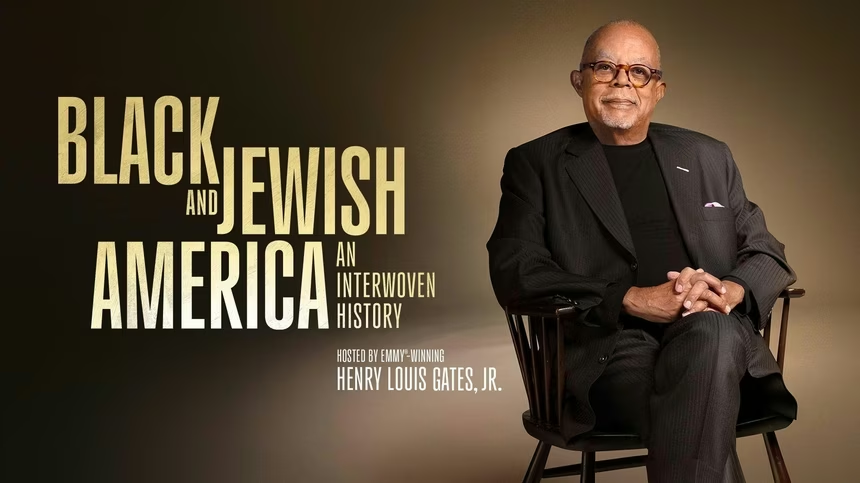
Episode One of BLACK AND JEWISH AMERICA explores overlapping struggles and forming bonds.
From intersecting histories of persecution to diverging fates on American shores, episode one of BLACK AND JEWISH AMERICA: AN INTERWOVEN HISTORY traces the early forces that shaped the Black and Jewish connection in the U.S. Journeys of exile, faith, resilience, terror, migration, early civil rights partnerships, and tests of solidarity define the relationship by the early 20th century
From
Problems playing video? | Closed Captioning Feedback
Problems playing video? | Closed Captioning Feedback
Corporate support for BLACK AND JEWISH AMERICA: AN INTERWOVEN HISTORY was provided by Bank of America and Johnson & Johnson. Major support was provided by the Corporation for Public Broadcasting....
Let My People Go
2/3/2026 | 52m 24sVideo has Closed Captions
From intersecting histories of persecution to diverging fates on American shores, episode one of BLACK AND JEWISH AMERICA: AN INTERWOVEN HISTORY traces the early forces that shaped the Black and Jewish connection in the U.S. Journeys of exile, faith, resilience, terror, migration, early civil rights partnerships, and tests of solidarity define the relationship by the early 20th century
From
Problems playing video? | Closed Captioning Feedback
How to Watch Black and Jewish America: An Interwoven History
Black and Jewish America: An Interwoven History is available to stream on pbs.org and the free PBS App, available on iPhone, Apple TV, Android TV, Android smartphones, Amazon Fire TV, Amazon Fire Tablet, Roku, Samsung Smart TV, and Vizio.
Community Engagement & Discussion Guide
This guide will point you to resources, partners and suggestions that allow you to create the engagement opportunities that truly connect, invigorate and inspire your communities.Providing Support for PBS.org
Learn Moreabout PBS online sponsorship-When I was growing up, I only thought of race in terms of Black and white.
It wasn't until much later, when I learned about anti-Semitism and the Holocaust, that I realized how endlessly flexible the idea of difference can be.
Across history, Jews have been mocked and feared, blamed and banished, envied and imitated, and so have Black people.
We share that experience.
And we share something else, as well -- a duty to keep fighting hatred wherever it shows up.
-Blacks and Jews were able to come together for what, in retrospect, was a pretty brief period and create enormous change in the country.
-Why did the NAACP support the creation of the State of Israel?
Why did Jews support the civil rights movement?
Black and Jewish people recognize only when everyone is safe are we safe.
-There is a history that we need to regard and respect.
We would not have got certain things done without those alliances.
-But I don't want to be accused of romanticizing the golden age of racial relationships between Jews and Blacks.
It wasn't an untroubled relationship.
-There's been a death, and no one is in jail.
-There are moments of real tension, moments of betrayal.
-The old alliance between Blacks and Jews -- is that in jeopardy now?
-Very much so.
-It's dangerous to make it all the same.
We're not the same.
We come from different histories.
-Jewish people get to be white, with all the privileges that that implies.
-And when the relationship disintegrates, the argument that's made by the African-American community is, "You had access to things that we never had."
-I don't consider myself white, and when I once told our class that, they laughed in my face.
-[ Laughs ] -You laughed in my face.
-I did.
-[ Chanting ] What do we want?
-[ Chanting ] Justice!
-When do we want it?
-Now!
-So, I decided, let's get into it.
Let's just put it on the table and figure out what's left.
Where is the area of overlap?
Because anti-Semitism is not the same as anti-Black racism, but both are ever-present, and they're not gonna go away.
-It's dangerous 'cause it's a really hard time to talk about either Black people or Jewish people.
It's just become fraught in so many ways.
But anything that's dangerous is worthwhile.
-♪ Ooh, ooh ♪ ♪ Ooh, ooh ♪ -You can pass them around.
-Are we ready?
-I'll start it, but everyone join in on the "Let my people go."
Here we go.
-Heard.
-♪ When Israel was ♪ ♪ In Egypt land ♪ -♪ Let my people go ♪ -♪ Oppressed so hard, they could not stand ♪ -♪ Let my people go ♪ ♪ Go down, Moses ♪ -We've come together tonight for the Passover Seder, a moving holiday tradition that commemorates the story of the Jewish people's exodus from slavery in Egypt.
Though I'm not Jewish, I love this ritual because it celebrates a narrative at the heart of both the Black and the Jewish traditions.
-Borei Pri Ha-Gefen.
-So I've gathered a group of friends -- journalists and teachers, a novelist and a renowned chef, and even a pair of rabbis -- to talk about the deeply intertwined histories of Black and Jewish Americans.
-When we talk about the power of this Exodus narrative, which is so foundational for Black people, for Jewish people, and the fact that it has not just united us, but oriented us, our identity is very much based on this story.
Why do you think it's so foundational, and why do you think it's endured?
-So, Blacks and Jews, discursively, have been united without thinking about it for a very long time.
And I start off a lecture course at Harvard by saying, "Under the floorboards of Western culture run two streams, continuously.
One is anti-Semitism and one is anti-Black racism."
-They're absolutely connected, and we can't defeat either without defeating both.
They are intertwined.
They have been.
Like you said, they're part of the floorboards.
-Mm-hmm.
-But I believe that they can be dismantled.
-Uh-huh.
-We built racism.
Humans built anti-Semitism.
-Right.
-And we can un-build them.
-Mm-hmm.
-And if we un-build them, doing that requires us to talk about these challenges and talk about these issues in a different way than we have.
-We share persecution in common, even though it has played out differently for each of our communities.
To unravel those differences, as well as the ties that bind us, we have to start centuries ago and an ocean away.
-Jews have lived throughout most of the history of Jewish civilization as a scattered people.
The ancient Hebrews were concentrated in the land of Israel, but the Jews were scattered even in antiquity.
-Jews trace their roots back thousands of years to a people and a faith centered in the land now known as Israel.
As their homeland was conquered by outside powers, Jewish communities were driven far and wide, becoming a people of the diaspora.
-There's probably few countries in Europe that Jews have not been kicked out of because they were Jews.
-They didn't want to assimilate.
They worshiped their own God and didn't want to worship local gods.
And on top of that, then, was grafted the most important source of anti-Semitism, which was Christianity, because Jews were accused of having killed Christ and of having rejected him.
So you can't understand anti-Semitism without understanding this deep-seated religious hatred.
-And you have the non-Christians, the Jews.
Jews are terrorized, traumatized, hated.
They are the despised and degraded other in so much of European history.
That was the target.
-For one thing, Jews couldn't own land.
Also, you had to be a Christian to join a guild to be a craftsperson.
So, what could you do?
Well, some Jews were money lenders or merchants.
-It's impossible to really understand anti-Semitism without that economic component.
The notion that Jews control the economy -- it's the notion of the Jew as preternaturally evil, as conspiratorial, a malicious being.
-One of the most infamous episodes of Jewish persecution came during the Spanish Inquisition.
In 1478, King Ferdinand and Queen Isabella, eager to consolidate their power under the banner of religious unity, began targeting Jews and Muslims in the name of Christian purity.
-The Spanish Inquisition had a horrendous impact on Jews, who faced extraordinary discrimination.
-There were riots demanding the Jews convert.
And masses of Jews did convert.
Well, a suspicion arose -- "Are they really sincere converts?"
They brought in the Inquisition to investigate.
By 1492, they decided, "Okay, all the Jews have to get out."
-Ferdinand and Isabella gave Jews until July 31st, 1492, to flee their kingdom.
Just three days later, Christopher Columbus set sail on his fateful voyage.
-So, when you think in terms of 1492, you know, we're taught it's Columbus sailing the ocean blue.
But even Christopher Columbus, when he's leaving, there are vessels of all sizes filled with Jews who are being expelled from now-Catholic Christian Spain.
-Many went to the Ottoman Empire.
They went to the East.
Some went to Western Europe, to Amsterdam in particular.
The expulsion of the Jews in 1492 was a very crucial moment in Jewish history and a crucial moment when we think about modernity.
-In 1492 was the Inquisition and the beginning of an incredible horror -- the erasure of the native people in the Western part of the world.
Then the introduction of slavery to replace them.
Then a kind of dehumanization, you might call it.
A brutality had been released in the world.
-Columbus' arrival in the Americas marked the beginning of a new era.
It set the stage for European exploration and colonization, the tragedy of native dispossession, and the rise of the transatlantic slave trade.
In the centuries that followed, more than 12 million African men, women, and children were captured, sold into slavery, and shipped across the Atlantic into lives of perpetual bondage.
As America took shape, a new social order would emerge, one in which race and the sharp Black-white color divide set African-Americans and Jews on dramatically different trajectories.
-The United States is a very, very distinctive moment in the history of both peoples.
-The first people of African descent who came to what became the United States -- British America -- arrived circa 1619, but slavery would still take another 30 or 40 years to evolve into the system of chattel slavery that we know of today.
-You start to see laws passed that now, by stature, if you were a child born to an enslaved mother, you are born as a slave for life.
That was your destiny.
It was a business decision to increase our slave labor through breeding.
-So, you get the racialization of enslavement, the deep white supremacy that's going to continually and more deeply inform the enslavement of Africans.
So, you got the whole group brought on barbaric slave ships, confronting barbaric slave auctions, and put on barbaric slave plantations.
Now, in the Jewish case, when they arrive in the United States, they got a different experience.
-In the mid-17th century, the first Jews make their way to North America and begin to settle along the eastern seaboard.
-Initially, there were examples throughout the colonies where Jews were actually denied civil rights, the right to hold office, the right to vote.
But when the US Constitution is drafted, it has in two different parts protections of religious freedom.
There was a notion that on the first day of the United States, Jews would be able to be full and complete and active citizens of the new country in a way that, for more than 1,000 years in Europe, they never could.
-In the summer of 1790, President George Washington visited Newport, Rhode Island, and actually penned a letter to its historic synagogue.
His words underscored a commitment to religious liberty in the fledgling nation.
-George Washington, when he wrote his letter to the Touro Synagogue in Rhode Island, he said, "Our Hebrew brothers are gonna be welcome."
-May the children of the stock of Abraham, who dwell in this land, continue to merit and enjoy the goodwill of the other inhabitants, while everyone shall sit in safety under his own vine and fig tree, and there shall be none to make him afraid.
-It was extraordinary.
Very rarely in the history of Jews in the diaspora have you ever had the leader of a country address a Jewish place of worship and make those kinds of affirmations.
-After centuries of discrimination as religious and racial pariahs, Jewish people seem to have found a safe haven.
Here, even if anti-Semitism persisted, they would be granted the full privileges of citizenship.
-There's a naturalization act in 1790, and it says that people are eligible for citizenship in the United States if they're white.
And more or less from the get-go, Jews, in that formulation, are counted as white.
But white is a nuanced category.
It gets defined differently in different eras, and ideas of lesser degrees of whiteness exist.
They underpin a huge amount of anti-Semitism, but they aren't driving the legal system in the way that difference between Black and white is driving the American legal system.
Because, in an American racial system, the penalties to not being on the white side of the line are really steep.
-"You shall keep the Feast of Matzot, of unleavened bread, for on this very day, I brought your hosts out of Egypt."
-When I think about the Seder, the Seder is an evening about telling stories.
It's about telling the story of the Exodus.
And for many American Jews, the American Dream is a true story.
American Jews came to the Promised Land, but many Black Americans never left Egypt.
That's a very real divergence.
-Along those lines, something that I often think about during Passover is, you know, every year we commemorate our freedom as Jews, but as Black Americans, we're often told to get over slavery and forget about it, being told, "Oh, well, that's in the past, get over it," of something that was of modern time, but something that happened a long time ago is something that we hold on to and sit around a table and remind ourselves of and remind ourselves about what it means to come into freedom.
-Right.
-I think the miracle is this story that we're reading is not of one hermetic community.
I got to college, and I took a course on Dante.
And all of a sudden, we're reading "The Inferno," and it's quoting from this very story that we're reading in the Haggadah.
And then hearing it constantly referred to in the music that I was listening to, which was, inevitably, Black music.
It's a story for everybody who chooses to adopt it and make it an inspiration.
-Right.
I think for a lot of African-Americans, they found their language and posited their identity through the Hebrew Bible as translated through the King James Version.
-Okay, 2 mark, A and B.
-I mean, the Hebrew Bible really is like sort of the grammar of Black religion because it provided a window into a world in which people who had been enslaved found freedom.
-Enslavers wanted enslaved people to embrace Christianity, but they wanted them to embrace Christianity so that they would be more accommodating, more docile.
They would emphasize verses with that particular message.
Of course it didn't work.
People of African descent drew inspiration from the Hebrew Bible, the Exodus story in particular, because they could see themselves in the text.
-When the enslavers were telling folk, "Your reward is in heaven," they're like, "No, we actually have real evidence in which people have been enslaved before and found their freedom."
-There's just so much power there, that the God of the universe makes a covenant with a hated, despised, enslaved peoples in Egypt and picks out a Moses over against a pharaoh.
And we haven't got the Amos or even Esther yet.
All of those different stories meant much to a people who were told they're less moral, less intelligent, less human.
Turn to Hebrew scripture.
-They would gather at night to have their own private clandestine services, some real religion.
And the oral tradition, the music tradition, helps to carry the importance of the stories.
Slave owners did not teach any slaves how to sing "Go Down Moses."
That did not happen.
-With Negro spirituals, there are all kinds of messages within these songs that in some ways speak to the lived reality.
"Go Down Moses" -- right?
-- is a sort of classic sort of spiritual that is both retelling the story of Moses, but also preparing people for resistance.
-We see someone like Harriet Tubman, who was nicknamed "Moses" significantly because of her efforts to free those who were enslaved living in the US South.
She was a person of faith.
I think she believed that ultimately God was on her side.
-♪ Let my people go ♪ -The spirit of Moses that Harriet Tubman embodied would remain central to the Black church and the Black freedom struggle.
But while enslaved Africans identified with the mythic Israelites of the Hebrew Bible, Jews in Antebellum America didn't necessarily recognize this symbolic kinship.
-This is one of the ironies of people who talk about "the grand alliance" of Blacks and Jews, as if it were timeless and inevitable.
Jews were not disproportionately slave owners or disproportionately slave traders, but they were certainly part of the white community in that larger sense.
In fact, the highest serving Jewish person in any of American historical presidencies is Judah Benjamin of the Confederacy.
-Judah P. Benjamin, whose face would appear on currency in the Confederate States of America, served as its Attorney General, Secretary of War, and finally Secretary of State.
Called both "the brains of the Confederacy" and derisively Jefferson Davis's "pet Jew," Benjamin was one of the most influential Jewish Americans of his day.
-Judah Benjamin was a politician from Louisiana.
He was one of the first two Jews to be elected to the United States Senate.
The other was David Yulee from Florida.
Both Judah Benjamin and David Yulee were plantation owners, and in that capacity, they were enslavers.
They felt a certain investment in Southern society because they had been successful there and had been able to achieve a level of status and inclusion in the South that was really unprecedented in modern history.
-But even as Benjamin scaled the heights of Southern society, he was never free from prejudice and suspicion.
Though American Jews enjoyed the rights and privileges of whiteness, they remained a liminal other.
The concept of race is complicated and contested when it comes to Jewish identity.
In fact, there were Jews of African ancestry present from the early days of the Republic, even if their numbers were small.
Some were converts, some were mixed ancestry, and others were possibly from Jewish communities in Africa or the Caribbean.
Our Passover meal, designed by chef and historian Michael Twitty, honors these layered histories and identities.
-We have the West African brisket.
Then we have the kosher soul collards, which are always a big hit.
The potato kugel is the first time doing it.
Sweet potato and white potato with Creole spice... -Ooh!
-...mixed together.
The food will reflect the fact that we have all these different parts to us.
Just like there's Ashkenazi, Mizrahi, Sephardi, there's also, um, the chocolate chosen.
[ Light laughter ] So, the whole purpose of this meal is to let you know we are Jews, too.
We've been in this country since the era of enslavement, and I worry sometimes that these ancestors are forgotten.
-If I may, I just want to -- -Please.
-I grew up Chabad.
My family on my mother's side has been here as African-American Jews since I got here in the 1780s.
-Since the 1780s... -Yep.
-...you've been -- your family's been Jewish?
-Yeah.
-That's amazing.
-That's my cousin.
[ Laughter ] -Although Jews of African descent have long embodied both identities, the fates of most Blacks and Jews ran on independent tracks in the Antebellum era.
That would change at the turn of the century with two significant waves of migration.
One occurred within the United States, as Black people began to leave the South en masse as a matter of economic opportunity and survival.
-Jim Crow segregation, the kind of legal apartheid in the Southern states, comes to the forefront in the early 20th century.
For Black people in the South, you had to behave under a very strict set of social codes and standards, and if you didn't adhere to that, then your life was at risk.
There were moments when Black people were falsely accused of various crimes that led to mob violence in a spectacle kind of way.
-There would be picnics and parades and celebrations of these killings, which we call lynchings, all over the South.
It became incredibly dangerous for Black people, and that was in addition to economic crisis.
So, we have masses of African-Americans moving from the South to the North in order to get more economic opportunity and also to be safer.
And so that migration, which is so large that historians call it "the Great Migration," happens pretty much simultaneously with the migration of Eastern European Jews.
-Between 1880 and 1924, about 2.5 million Jews come to the United States from Eastern Europe.
-Most of the push from Eastern Europe and Southern Europe is economic because people cannot survive.
But for Jews also, the economic problems in Eastern Europe then foster a series of attacks on Jews that are called pogroms.
The nobility are eager to blame all the problems on the Jews so that they're not blamed.
And so all over the place, there are these pogroms, and it becomes increasingly dangerous to be Jewish.
-Millions of Jews came to the determination, in no uncertain terms, that they could not live, could not exist as Jews anywhere in Eastern Europe, given the repeated violence that occurred with state sanction.
They understood that they had no future in Eastern Europe.
And they boarded ships and sailed to America.
-They come, primarily, to cities, primarily to Northern cities.
And so Blacks and Jews meet in these cities.
And that's where they start recognizing that their plight is not exactly the same, but it's often remarkably similar.
-Some commentators, both Jewish and non-Jewish, drew comparisons between the suffering of Russian Jews and the plight of African-Americans in the United States, who were the victims of racial massacres, were the victims of riots.
-Black newspapers will cover some of the violence in Europe against Jews, and Yiddish newspapers, they'll cover riots against Black people or lynchings, and they will call them pogroms.
And so, yeah, they were -- they were quite explicit about making those links.
Even if nothing political necessarily came of it in the beginning, they were really made quite well aware of the plight of the other.
-The burgeoning kinship between Black and Jewish Americans would deepen dramatically in 1908.
That summer, a devastating race riot occurred in Abraham Lincoln's hometown of Springfield, Illinois, sparked by an all-too-familiar accusation.
-We see this again and again.
A white woman named Mabel Hallam accused a Black man named George Richardson of coming into her house in the middle of the night and assaulting her and beating her up.
George Richardson is arrested, and before long, a mob gathers in front of the courthouse.
-In hopes of preventing a crisis, the sheriff smuggled Richardson and another Black prisoner out of town under cover of darkness, but it was too late.
-More people from other towns start coming in, and it explodes.
-White people felt like they needed to take matters into their own hands.
It is very much part of this twisted notion of a vigilante kind of, um, justice.
-Black people's homes were terrorized, vandalized.
Black people were beaten.
-Two men were lynched.
-The police did not do anything about what was going on, and it allowed this systematic violence to continue.
-Those who were involved would simply face no repercussions for their actions.
-And it turned out -- I mean, this is kind of the cherry on top.
Mabel Hallam, the woman who was raped -- she admitted to a grand jury that it was not George Richardson who had done this.
Springfield is a real turning point because it's picked up by the national papers.
It makes people recognize that lynching, violence against Black people, is not just something that is specific to the South, but that it's actually a national problem.
♪♪ -Among the journalists on the ground in Springfield were William English Walling and his wife, Anna Strunsky, a Russian-Jewish immigrant.
-An unlikely couple, William English Walling, a Kentucky-born aristocratic man who is a radical social reformer, married to a remarkable Russian-Jewish immigrant woman named Anna Strunsky.
And Strunsky was a bohemian, an intellectual, a radical, and they were aghast at the 1908 riot and massacre.
-Having just returned from reporting on pogroms in Russia, what they saw in Springfield was a painful echo -- America's homegrown version of racial terror.
Within a year, Walling and a coalition of Black and white progressives, including several prominent American Jews, called for a new organization dedicated to ending racial violence and securing true equality.
They called it the National Association for the Advancement of Colored People -- the NAACP.
-There was a real meeting of minds, I think, between a certain kind of white, liberal Christian and white Jews, like the Spingarn brothers, Arthur and Joel, and prominent Black Americans, like W.E.B.
Du Bois and Ida Wells, in the founding of the NAACP.
-Not only were Jewish people part of its founders, but Jewish people were central to the development of the NAACP in its first decades.
-You'll see from these early beginnings that Jews are disproportionately involved in civil rights, if you compare their population numbers with their proportion among white activists.
-The organization really focused on the issue of lynching for about its first decade, and not only trying to spread awareness about lynchings, but also trying to hold Southern governments accountable.
And by the 1920s, this looked like a pretty robust legal arm trying to provide justice and safety for Black people.
-One of the NAACP's earliest board members, Arthur Spingarn, led an ad hoc legal team from his Manhattan law office.
Spingarn and his mostly Jewish volunteers took major cases all the way to the Supreme Court, challenging housing segregation, grandfather clauses, and other assaults on civil rights.
But it was W.E.B.
Du Bois, the only Black person on the NAACP's board, who was the heart and soul of the organization.
-Du Bois winds up being its chief spokesperson.
So, as head of The Crisis magazine, which is the official publication of the NAACP, his writings and his influence loom large.
He is the most celebrated Black intellectual of his day.
But he also has the ability to communicate to common people who consume The Crisis, as well.
It's also an organ that provides an opportunity and a conduit for Black scholarship, for Black thinkers, for Black artists, visions of Black excellence.
♪♪ -One of the things that W.E.B.
Du Bois also writes about in The Crisis is the significance of the Jewish experience in Europe, that they're also being marginalized or also being shut out of different industries, of different communities.
He's telling Black readers that this is a moment, this is an opportunity to come together with Jewish people in order to advocate for rights on US soil.
-Du Bois' interest in the Jewish experience was inspired in part by his friendship with Joel Spingarn, an early chairman of the board and later the president of the NAACP.
-Du Bois finds a kindred spirit in Joel Spingarn.
They become friends because they're both men of letters, academics and thinkers, and that friendship is one of the things that helps to sustain Du Bois in the work.
But also, Du Bois is quick to point out that Spingarn is not an American.
In that sense, as a child of Jewish immigrants, he knows what it feels like to be an outsider.
-From 1913 to 1915, Spingarn visited more than 20 American cities, at times with Du Bois at his side, spreading the gospel of what he called "the new abolitionism."
-You see, in the language of Joel Spingarn, this recognition that the purpose of this organization is to elevate Black people.
He says in 1914, "I believe that you should be the generals and that we should be fighting alongside you."
It was about true allyship.
-I did not enter this movement because of any mere sentimental pity as a philanthropist.
I did it because I realized that no human being in America was free until every Black man was free.
-Spingarn and Du Bois disagreed, sometimes passionately, about strategy and tactics, but their friendship endured until Spingarn's death in 1939.
When Du Bois published his seminal work, "Dusk of Dawn," the following year, he dedicated it to Spingarn.
Alliances like that between Du Bois and Spingarn were more than symbolic.
These partnerships led to real transformative change in the lives of countless Black Americans.
Among the most consequential was the collaboration between Julius Rosenwald and Booker T. Washington.
-Julius Rosenwald and Booker T. Washington, I think, are just incredible figures in terms of -- at least think about African-American education, Jewish philanthropy, and also this idea of really being co-partners.
-Julius Rosenwald and Booker T. Washington, two men from very different backgrounds, found common cause in a bold idea -- education as a pathway to freedom.
Washington, born enslaved in Virginia, grew up watching white children go off to school while he labored.
After the Civil War, he worked his way through college as a janitor and would become the founding president of Tuskegee Institute.
Rosenwald, the son of German-Jewish immigrants, followed in the footsteps of his father, a peddler turned storekeeper in Springfield, Illinois.
Julius went into the clothing trade and eventually became the president and part owner of Sears, Roebuck and Company.
-Rosenwald was told about Booker T. Washington in 1911.
He read "Up From Slavery" and was really impressed.
He invited Booker T. Washington up to Chicago, and then Booker T. Washington, as smart as he was, was like, "Hey, I think you should come down to Tuskegee and look at my operation, as well."
And apparently, the word goes that Rosenwald took a number of his colleagues and friends from Chicago.
They went down to Tuskegee and spent three days, you know, in the middle of Alabama on Tuskegee's campus.
And there grew a kind of friendship and partnership.
And from that, Rosenwald Schools really emerged.
-At the time, there were fewer schools for Black kids than for white kids, more pronounced in the rural South.
Some Black children, therefore, forego education altogether.
But Washington believed that an educated public was key to a certain kind of civic democracy and that being able to provide the basic education also meant that you could fight some elements of discrimination.
And Rosenwald understood that argument.
-For Rosenwald, it was this idea -- he was aware of ongoing Jewish persecution in Europe and also understanding what's happening to African-Americans in the US.
I think what's so powerful about the relationship is that they both used individual success as a way to think about broader issues.
-Washington presented Rosenwald with a plan to build schools for Black children across the rural South, beginning in Alabama, But it would entail a novel approach.
Rosenwald would contribute one-third of the cost, the school district another third, and the local community would supply the rest, often through land, lumber, and old-fashioned sweat equity.
-This is a cooperative.
Cash is only one part, but building the schools, setting the schools, framing the schools, all of that requires community buy-in, as well, showing that they have some skin in the game.
-The first six schools proved so successful that the program soon expanded to dozens, then hundreds, then thousands across the South.
By the time Brown v. Board of Education declared "separate but equal" unconstitutional, one in three Black children in the South had been educated in a Rosenwald school.
-Many of the graduates went on to do incredible things.
Maya Angelou is a graduate of the Rosenwald School as well as John Lewis.
-Rosenwald's philanthropy didn't stop at schools.
He donated millions of dollars to the NAACP, historically Black colleges and universities, and Black health institutes.
He also created a fellowship program for Black writers, artists, scientists, and activists.
-Many very prominent German-Jewish individuals, like Julius Rosenwald -- they supported African-American causes because their status was somewhat assured in American society, and so it made it easier for them to access that part of Jewish identity which suggested a connection or a similarity with African-Americans.
-But in the early decades of the 20th century, that status was becoming more and more precarious.
As destabilizing economic changes took hold and as the number of Jewish immigrants grew dramatically, so, too, did anti-Semitism.
One tragic episode in 1913 pulled back the curtain on this surging anti-Semitism, revealing just how easy it could be to pit the Jewish and the Black communities against one another.
-Leo Frank was a Jewish man from Texas, raised in New York City with a Cornell education.
-He came to Atlanta to manage a pencil factory that was owned by his uncle, and he became a very prominent member of the Atlantic community, a respected businessman.
He married into a very prominent Jewish family.
[ Indistinct shouting ] -On Confederate Memorial Day in 1913, there was a huge parade in Atlanta.
There was a young woman who worked in the factory.
Her name was Mary Phagan.
She was a young teenager.
And she came in to get her pay and was never seen alive again.
And so her dead body was found in the basement.
The case immediately got a huge amount of press attention.
-Frank became the primary suspect and the focus of the investigation, even though there was an African-American employee, Jim Conley, who was also for a time under suspicion.
-And Jim Conley became the real key to the case.
He provided the testimony that it was Frank who had done it.
-Conley testified that he had helped Frank move the body from Frank's office to the basement.
And his vivid accusations against Frank went even further.
-Part of Conley's testimony is that he had been kind of coerced by Frank to operate as a lookout for him while Frank had inappropriate dalliances in his office with the young women who worked in the factory.
And so there's a whole narrative that develops that Frank, as this Jewish interloper, is a sexual predator.
So, there are some really good reasons to worry about anti-Semitism in the case.
There are, you know, mobs, you know, of white Southerners outside the courthouse.
There's, you know, some testimony that people were yelling, you know, "Hang the Jew."
There's incredible purple journalism created primarily by this Southern Populist leader, Tom Watson, what we would now call conspiracy-theory stuff.
It's about, you know, Jewish power, you know, exploitative Yankee Jew.
♪♪ You know, Frank is a boss.
He's in the employer class.
There's a whole kind of folk culture that develops, and there are songs.
-In a climate of anti-Semitic propaganda, Frank was found guilty of the murder of Mary Phagan, and he was sentenced to death.
The conviction of Leo Frank was in part based on some of the testimony of Jim Conley.
And in the South at that time, it was very unusual for the testimony of an African-American to be accepted in incriminating a white person in a Southern court.
-Now, within the case, there's this fascinating competition between the Jewish man and the African-American man, who essentially are the only two who could have done it.
So it's this kind of bizarre zero-sum game of, "Did the Jewish guy do it, or did the Black man do it?"
Jewish press and lots of Jewish leaders and Frank's own lawyers articulated all manner of really familiar and rancid anti-Black racism.
♪♪ The mythology of the Black beast rapist is very familiar in the culture at the moment.
I mean, literally, that's the same year that the movie "Birth of a Nation" comes out, the plot of which is completely tied up with the idea that young white women are in danger because Black men want to rape them.
Frank's lawyers and the journalists in the Jewish press present Jim Conley as that familiar caricature.
-Leo Frank, whom experts today believe was innocent, appealed his death sentence, and ultimately it was commuted to life in prison.
But that decision ignited a great deal of anger in the community.
What happened next was a tragic incident all too familiar to Black people in the Jim Crow South.
-Frank was kidnapped from jail by a group of well-off white Southerners and hanged near the town where Mary Phagan was originally from, Marietta, Georgia.
-It's a moment of shock and disbelief for the Jewish population.
There had certainly been anti-Semitism in the United States, but this was a particularly dramatic example.
-The murder of Leo Frank served as a wake-up call for American Jews, a stark reminder of their own vulnerability in the face of rising white supremacy.
-William Joseph Simmons leads his followers up Stone Mountain in Georgia for the first initiation ceremony of the reincarnated Klan.
-After Frank's lynched in 1915, you know, the Klan is reborn on Stone Mountain outside Atlanta.
-This is a new iteration of the Klan.
We usually think of the Klan as being anti-Black, which it was, but the Klan was also anti-Catholic, anti-Jewish, people they considered non-white.
-When the KKK reinvented itself, the KKK's focus was 100% Americanism.
-Foreigners were particularly suspect because of their threat to something the Klansmen were fond of calling purity of the American race.
-The resurgence of the KKK in the early 20th century was not just in the South, but across the entire United States.
-In Ohio, Klan-supported candidates became mayors of Toledo, Akron, Columbus, and other cities.
By 1925, almost six million Americans now belonged to the Klan.
-The Klan and its racist, xenophobic, and anti-Semitic venom surged at a time when industrialization, migration, and economic hardship were rattling the country.
-It's during this period that the dominant white society doubles down on the importance of a clear racial hierarchy.
-In 1924, Congress passed a draconian bill, cutting off immigration from Asia and sharply limiting arrivals from Southern and Eastern Europe.
The bill reflected theories of eugenics and scientific racism that had gained widespread popularity at the time.
-There were all these different races of whiteness.
You have the superior white races, like the Teutonic or Anglo-Saxons, and the inferior people, like the Irish.
It's the Italians.
It's the Slavs.
It's the East European Hebrews and so forth.
-The Immigration and Naturalization Act of 1924 enshrines a lot of these "scientific" principles into law, making certain groups more fit for citizenship than others.
-There's a tendency today to think of Jews who had come from Europe as simply assimilated white people, but, in fact, Jews also navigated the color line because there's this concern that the gene pool, essentially, of the country would be impacted by these inferior immigrants.
-They're very poor.
They're not necessarily well-educated.
They, you know, have "old world ways."
They have beards, and they speak Yiddish.
And honestly, the more acculturated and assimilated Jewish community is not thrilled about them, either.
So there's real fear about who these people are and how they act and whether or not they can be adequately absorbed into America.
-You see a rise in social discrimination against Jews being excluded from clubs, from certain neighborhoods, hotels.
-Quotas at universities not letting Jews in.
They don't let people into various professions.
-Of course, for Black Americans, law and custom rigidly policed the color line.
-By the '20s and '30s, Southern Black people -- they are walled off from public life.
That's when it really gets solidified -- the laws, but also the customs of humiliation.
It may not have been written into law that you can't go to the public library, that you have to go to the back door or take your hat off or move off the sidewalk, but it was humiliating custom.
-At this low moment in American history, Black and Jewish Americans found themselves swimming against parallel currents of anti-Black racism and anti-Semitism.
[ Indistinct shouting ] Fanon in, 1952, said something that has haunted me for a long time, and that's that the anti-Semite, invariably, is a Negrophobe.
The people who hate Jews also, uncannily, hate Black people, too... -Oh, gosh.
-Yes.
-...because when the stuff hits the fan, they're coming after both of us.
-The two rivers under the floorboards.
-The two rivers under the floorboards.
-And if I may, guess who saves the world in all of our modern myth-telling.
Jeff Goldblum and Will Smith.
[ Laughter ] Is -- You know, is it -- Is it Richard Pryor and Gene Wilder?
Is it RuPaul and Michelle Visage?
It always takes the two of us to save the world.
The world may hate us any other time, but it's like, "Hey, the world needs saving!
Can you guys step up?"
-To Richard Pryor and Gene Wilder.
-Hear, hear.
-Cheers.
-L'chaim!
-L'chaim.
-The Black and Jewish communities may have begun their journeys on very different footing, but by the 1920s, it was clear they faced a common threat.
The World War that followed would lay bare the devastating power of unchecked hatred and draw Black and Jewish people into a closer, more urgent alliance.
-Our destiny is tied up with the destiny of our Jewish brothers and vice versa.
And we must work together.
-Yet, as the 20th century unfolded, that alliance would be tested, revealing just how fragile solidarity can be, even among those who depend on it most.
[music plays through credits] NARRATOR: For more information about Black and Jewish America: An Interwoven History, visit pbs.org/BlackAndJewishAmerica.
The DVD version of this program is available online and in stores, also available with PBS Passport and on Amazon Prime Video.
[music continues through credits]

- History
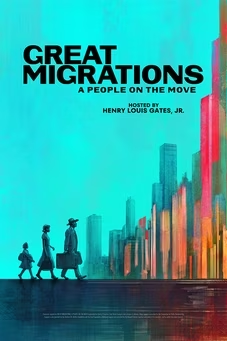
Great Migrations: A People on The Move
Great Migrations explores how a series of Black migrations have shaped America.

Support for PBS provided by:
Corporate support for BLACK AND JEWISH AMERICA: AN INTERWOVEN HISTORY was provided by Bank of America and Johnson & Johnson. Major support was provided by the Corporation for Public Broadcasting....