
ECSU Takes Flight & the Aggie-Eagle Classic
Season 38 Episode 3 | 26m 46sVideo has Closed Captions
A look at Elizabeth City State University’s aviation program and the Aggie-Eagle Classic.
In this HBCU Week special, learn about Elizabeth City State University’s aviation sciences program, the only four-year collegiate aviation education program in North Carolina. Also, join us as we take a look at the Aggie-Eagle Classic, a legendary college football rivalry that’s all about family.
Problems playing video? | Closed Captioning Feedback
Problems playing video? | Closed Captioning Feedback
Black Issues Forum is a local public television program presented by PBS NC
ECSU Takes Flight & the Aggie-Eagle Classic
Season 38 Episode 3 | 26m 46sVideo has Closed Captions
In this HBCU Week special, learn about Elizabeth City State University’s aviation sciences program, the only four-year collegiate aviation education program in North Carolina. Also, join us as we take a look at the Aggie-Eagle Classic, a legendary college football rivalry that’s all about family.
Problems playing video? | Closed Captioning Feedback
How to Watch Black Issues Forum
Black Issues Forum is available to stream on pbs.org and the free PBS App, available on iPhone, Apple TV, Android TV, Android smartphones, Amazon Fire TV, Amazon Fire Tablet, Roku, Samsung Smart TV, and Vizio.
Providing Support for PBS.org
Learn Moreabout PBS online sponsorship- Elizabeth City State University offers the only four-year aviation science and drone degree programs in North Carolina.
We visit the HBCU campus to learn all about taking flight.
And later on in the show, a look at why the historical Aggie Eagle Classic is more than just a rivalry, it's about family.
Join us in this HBCU Week special coming up next on "Black Issues Forum."
- [Announcer] "Black Issues Forum" is a production of PBS North Carolina, with support from the Z. Smith Reynolds Foundation.
Quality public television is made possible through the financial contributions of viewers like you, who invite you to join them in supporting PBS NC.
[upbeat music] ♪ - Welcome to "Black Issues Forum."
I'm Kenia Thompson.
Historically, Black colleges and universities were established to provide higher education opportunities for African American students when segregation and discrimination prevented them from attending predominantly white institutions.
Here in North Carolina, we are home to 10 HBCUs that proudly provide quality education to those who are Carolina-born and others who just come here for a taste of that Southern HBCU life.
One school in particular has faced some challenges over the years, but with determination of one passionate chancellor and the unique opportunity to offer students a competitive education, Elizabeth City State University has soared to heights beyond expectations.
We visited the campus and spoke with students, professors, and Chancellor Karrie Dixon about what makes the Vikings experience special.
Elizabeth City State University is home to over 2000 students, providing close connections with faculty and peers.
While the school offers many competitive programs, ECSU offers one that no other North Carolina school can compete with, aviation sciences.
From aviation management to drone systems, flight students are gearing up to take the growing airline industry by storm.
And some say it couldn't have happened without the guidance of Chancellor Karrie Dixon.
[uplifting music] Chancellor Dixon, thank you so much for joining us here for this conversation.
I want just say how beautiful the campus is.
- Thank you.
- Everyone's been so hospitable, and it's been a great experience to tour the aviation and the drone programs.
And so I just wanna talk a little bit about your start here as chancellor.
What made you choose ECSU?
And let's just talk about your leadership journey to this point.
- Definitely.
Well, first of all, thank you for being a part of our campus community today and getting to know us.
And my leadership journey started out unexpected.
So the university when I started as chancellor, was going through some very grave challenges, and it was not challenges that are unfamiliar with HBCUs, who have historically been underfunded across the country.
And so when we're looking at the finances of the institution as well as a 60% decline in enrollment when I started, it was really being referred to as an institution on life support.
And coupled with the fact that enrollment decline impacted the budget that the university had, we also were facing some severe audit findings, and then we were on warning for accreditation.
So we receive our accreditation from SACSCOC.
And some of those concerns, of course, caused them to put us on warning.
I knew coming in the door that we had to do something quickly, and we had to do it in a manner where there's no book or manual, I always say, to tell you how to transform an institution that was in the situation that ECSU was at first.
And so I ended up here because my former president of the University of North Carolina system, Margaret Spellings, asked me to come here and be a part of a task force to address some of the concerns that were happening here at ECSU.
And at the time, I was serving as vice president for Academic and Student Affairs at the UNC system office.
So it was just proper for someone at the system office to come here and kind of lead the process, which is what we would do if any university was facing some of the challenges that ECSU was.
And so when I started and just being here on campus, learning the community, learning the culture, I knew that there was a lot more that we could do.
But I also knew that we had to do whatever we could in a short period of time.
And so we were able to turn the university in a different direction, a more positive direction, in less than six months.
So that is really the start of what has now transpired into the campus that you see today.
- Yeah.
Six months, though.
That's huge.
Especially for where it was.
And so you started to allude to it, but what specifically do you think you did to contribute to that turnaround in six months?
And then what do you think community did to help support that turnaround too?
- So part of what I did to help support that turnaround was A, make some really tough decisions.
And very often as leaders, we have to make those tough decisions.
It's not personal, it's about business.
- Yeah.
And looking at the campus, assessing where we are, and figuring out where the gaps are and what we needed to do to restructure.
And so I had the help of some of the retired higher education leaders that I had relationships with to come in, help me assess department by department, division by division, what was happening across the campus, and where we needed to make some tough decisions to turn the university in a more positive direction.
And so in doing that, I reflect back to the experiences I have, the tools that I have in my toolbox, or as women we say, in our purse, that we would be able to use to make sure that we were doing the right things for the university, so that we could build a foundation for sustainability of its future.
- One of the distinct features that you guys here, programs that you have here on this campus, is the aviation program, right?
There is none like it in North Carolina.
And so talk about that competitive advantage that you guys have here, and how did you use that as that drawing tool for students to come to this campus.
- Yeah, so our aviation program is the only four-year degree program in North Carolina.
And I knew coming in the door, with the grave challenges that the university was facing, the first thing I asked my cabinet is, what is our niche?
And I didn't get a response back.
I knew the answer, but I wanted to hear if they actually knew, and if it was part of the culture here to understand the uniqueness of this program.
So I knew the best strategy to get the word out to control the narrative about ESCU and talk about our signature program through social media.
And so we really leveraged social media a lot to tell our story, to make everyone know here in North Carolina and beyond that ESCU has a strong, unique program and partnerships with the aviation industry, the airlines.
I wanted those partnerships very early on.
It took us a couple of years to get them.
But now we have partnerships with Delta Airlines, United, American, JetBlue.
And we're just really excited to have these partnerships now.
So when people started to learn about the jewel right here in northeastern North Carolina, I talk about the 28 additional academic programs we have.
We have a strong business program, a strong criminal justice, pharmaceutical science, biology.
And this year our incoming class, we have aviation science as our number one degree program for our freshman students.
And another big point of pride is that 52% of those freshmen are male.
- Yeah.
That is great.
And I think understanding where technology is going, where the advancements are heading, having these programs on this campus is competitive.
And so when you take a look at all of the programs, how are you ensuring that children or adults are prepared for what the future holds, right, so that they can be competitive in the work field?
- Oh, definitely.
Workforce development, workforce, we're looking at what the employers need, the demand, and trying to align our academic programs with those needs, especially in northeastern North Carolina.
And even though our students, of course, as alums, go off to do great things beyond North Carolina, we wanna make sure we're making the investment that we as a state can really reflect on and say, "Hey, we have some really great alumni that are coming out and contributing to the workforce."
- Even this eight-week program that you guys have going on in the summer, and my son's only 13, but I'm already thinking how can he, 'cause he's expressed interest in aviation, how can he come and experience this, because it's a once-in-a-lifetime kind of opportunity.
And to have that in our own backyards is amazing.
- Yeah, it was absolutely amazing.
The dean of our aviation program, Dr. Kuldeep Rawat, and I traveled to Washington DC, and we met with congressmen and women and talked about ESCU, talked about our flight program.
And that led to a conversation with United States Air Force.
And in that conversation, they actually sent the group here to look at our program, they were very impressed.
And the next thing we know, we were being included in the program that they have for the Air Force Cadets.
And so that 18, I mean, that eight-week program that you see during the summer, we're training their cadets on our aircraft.
When I started here at ESCU, we owned two airplanes.
We now own 14.
- [Kenia] Wow.
- And so to be able to say the growth in our fleet, the growth in our fleet of drones, the growth in our students, all those coupled together is really exciting for ESCU.
- And what has that done to the surrounding community?
I'm sure to see the school revive and become a huge staple, not just in this space but across the state, across the nation, that's encouraging for locals and residents as well.
- Yeah, it's very encouraging.
And I have to say, when I started here at ESCU, because of the challenges the university was facing, people began to lose hope.
And you could feel it, you could feel it on the campus, you could feel it in the community.
And I wanted to change that.
I wanted to change that perception, change that narrative.
So I went out to community groups, I talked about ESCU, I talked about how proud the community should be about Elizabeth City State University being a senior institution right here in the northeastern region, and how proud they should be that it's a constituent institution of the University of North Carolina system.
- Indeed.
Yeah, we've heard many, many good things, which is why we're here.
We just had to come see it for ourselves.
So when you look long-term, you think about years from now, five to 10 years, what's the plan?
What are some additions maybe that may be coming?
Or what would you like to see for the school and its students?
- So as I think long-term, first of all, I'm very proud of the progress we've made with enrollment growth.
I've been here five years, and every year we have grown.
Even during the pandemic, we grew 13%.
And so I want to see that continued growth.
I want the citizens of North Carolina to understand at ESCU they will receive a quality education at an affordable price.
I want that to go beyond North Carolina as we continue to recruit students.
I also wanna continue to work with the North Carolina legislature.
In the last budget session, we received or were allocated $140 million for capital projects.
The first time we have ever received that amount of money from the state of North Carolina.
And we've been in existence 132 years.
So to have $140 million for capital projects, it was a game changer for us.
So we have a new residence hall that's coming to our campus, a new dining hall, a skybridge across Wheatsville Road, an aviation school.
So we have some really good projects that are coming that are really gonna make the student experience a lot better, as well as help our faculty and staff to continue to grow and expand their programs.
And it's transformational leadership and transformational progress that helps us to do all that we can do to be the best that we can do at Elizabeth City State University.
- Transformational indeed.
So much done in five years.
I can't wait to see what happens in the next five.
I'm sure it's gonna be amazing.
And we'll be back to see it.
- [Karrie] Thank you.
- [Kenia] Thank you.
- I'm excited about it.
Come back.
- Yes, we will.
Thank you so much.
- [Karrie] Thank you.
[gentle music] - Students like Talmadge Turner are excited for what the program has to offer, and more importantly, he's eager to change what aviation looks like.
Hi, Talmadge, thank you so much for joining us today for this conversation.
I know that you're pretty busy here in the aviation department at ESCU.
I'd love to know, you come from Detroit, Michigan, you came all the way to North Carolina to come to this program.
What made you decide that this was the program for you?
- So I chose ESCU for the aviation program, of course.
But the main things I was looking for was an HBCU and the affordability we have here at Elizabeth City State University.
- Now, this school is one of the few schools that are part of the NC Promise, correct?
And so it makes it, like you said, fairly affordable for someone to come get this degree and to be able to really forge a career path that many other schools don't offer.
So tell me about the first time when you said, "This was the choice for me.
This is where I wanna go and where I wanna be."
- The choice for me was delayed.
You know how you have the college pick day in high school?
I didn't decide to come here until the orientation.
Orientation was...
It was small, it was intimate, it was what I was looking for.
You had the nice group of people I was with.
I was surrounded by Black people like myself, people that looked like me.
- When was that first passion sparked?
- That first spark was when my dad used to take me to the air shows in Ypsilanti, Michigan.
The Blue Angels were performing this time.
[wind whooshing] And it unlocked a whole new level of aviation, or a whole new level of possibilities for me.
I had that aviation spark for a while.
I'd watched "Red Tails" and I even got more consumed into the movie, into aviation.
And then it was towards my 10th grade year in high school, my sophomore year, where I was introduced to the Tuskegee Airmen National Historic Museum.
And their goal was to introduce aviation to those in the Black community and to those who didn't have the resources to pursue aviation that other people have.
So they provided the route and the means to do aviation.
- Yeah.
And seeing that representation of the Tuskegee Airmen, Black men who were in flight, and now perhaps we are not seeing as much representation in this space as we perhaps like.
Tell me about the importance of being an African American male student in this space and what do you see for yourself in the future in this industry.
- There's so many people of other ethnicities in aviation, but so little of my ethnicity of being Black.
And what I really want to see is a change of more people of my ethnicity in aviation.
I wanna see the availability, like Tuskegee Airmen Program allowed for me.
As a whole, Black men or Black people especially, are underrepresented in the aviation scene.
There aren't enough programs out here to introduce and to make aviation a possibility for those of people of color, and not even people of color, just people who don't have the resources to do aviation.
- [Kenia] Drone operation, also known as unmanned aircraft systems, has grown to be a high-demand industry.
Dean Kuldeep Rawat wants to ensure that students understand its importance and the power of having this knowledge.
- All right, students, so let's look at some special drones here in the lab today.
First, we'll look at the delivery drones.
For propellers, they're in dual mode here.
And what this drone can do is, actually, it can pick up around 15 pounds and deliver it up to five miles.
So if you want to drop a AED, you can drop a pizza, you can drop anything you want as long as it is within 12 pounds.
What we want you to do is go out and start your own business of operating drones.
Start a business that could provide drone service.
- [Kenia] While many say the use of technology and drone intelligence may pull humanity farther apart, Talmadge sees it a little differently.
[gentle music] - The way I think of it is there will always be a need for the human aspect in a pilot.
A computer can say, "This might be the best option.
This might take the least time.
This might use the least resources," but it's the human option, the human aspect of, "Will this be the best option for my passengers?
Will this get everyone on the ground safely?
Will this keep the people in the air safe as well as the people on the ground safe?"
And it's just a human aspect that I don't believe the computer has yet.
But other people may have different views on them.
- HBCU rivalries are nothing new, and those that participate in them take them very seriously.
The Aggie Eagle Classic football rivalry is one that has spanned over a century.
And while the battle on the field is real, the love off the field bonds them forever.
Take a look at a different perspective of the classic, one that begins with a love story.
- Henry came in 1949, I came in 1950.
African-Americans couldn't go to to hotels and that thing, so Beta Kappa had a party at the Magnolia House here in Greensboro.
And I looked over at the table and there was Henry playing cards with someone, having a great time drinking a Coke.
And I said, "Wouldn't it be nice to have come with somebody like that?"
[gentle music] - How's that?
Well, A&T and and North Carolina Central were and still are... What would you call it?
We are competitors.
[upbeat music] [indistinct chattering] - Until our research, we thought that the game, the first game played was in 1924, but it turns out the first game was played in 1922.
[upbeat music] - So the Aggie Eagle Classic has only been canceled or unscheduled four times in its history, in 1929, 1943, and 1944 due to World War II, and in the pandemic in 2020.
- It's not often that you can say that you have a rival that now numbers that are over 101 years and going strong.
[upbeat music] - You typically had small crowds coming out to the games and by small, maybe 1500, 2000 people.
And then it has evolved over the years, especially up the integration, where it went to a period where it was the largest single-day event for African Americans in the state of North Carolina.
- There were spaces for African Americans and the HBCU, along with the Black church, was one of those spaces.
- Actually, I was a high school student in the late sixties when I went to my very first Aggie Eagles Classic.
- I have been going to the game since the 1970s.
- We've been to all of them.
I mean, at least for 70 years - As you well know, it's not just about the classic.
There is culture, there is step show, there is so many other things that our institution can showcase.
- [Speaker] Tailgates are really big.
- [Speaker] Traditions, histories, relationships - [Speaker] Generate revenue.
- [Speaker] Oral and written and lived experiences.
- [Speaker] Fans, excitement.
- It was a great feeling for you to be able to come out of the tunnel in front of 40 and 50,000 people as a player.
And a lot of times on this level, a lot of student athletes don't have opportunity to experience that.
[upbeat music] [crowd cheering] - It also goes back to the battle of the bands.
[band playing] - Just seeing the crowd response and seeing the response of the students when we come off of the field is priceless.
- We just go out there and enjoy the game.
Enjoy the performance, enjoy the entire day, and just make it so everybody else can do the same.
- This is another football game, but it has significant value for our fan base and our football alums.
- [Speaker] The game used to be called the Turkey Classic and it used to be played on Thanksgiving Day.
So you have people coming together for Thanksgiving dinner who are affiliated with one school or the other, but they're family.
- There are many more people coming than came before, because I think there are more of us appreciating higher education than when we came.
[upbeat music] [crowd cheering] - I used that work here and he used that work over there.
[crowd cheering] - If you come to a classic, especially here, I have to say, you will see at least six blocks behind our neighbors with their tables out selling water, selling Kool-aid, selling snacks.
[upbeat music] - Wherever there was a historically Black college built, they created economic opportunities for those people who lived in that city and in that community.
[cheerleaders cheering] Be it political in industry, business, the law, medicine, you name it, education are having a huge impact.
- A sort of situation where you have iron sharpening iron.
- I was getting from people in Greensboro "What are you wearing?
What are you wearing?
You're an Aggie."
I was getting from people here at NCCU, "What are you wearing?
What are you wearing?
You better not have on blue and gold."
- We can compete and still love one another.
- It's something about just having something in common with somebody else that just brings everybody together.
[soft dramatic music] - I love to say to the people at North Carolina Central that everybody makes one mistake.
- We love you, but today I don't have any friends.
[soft dramatic music] [crowd cheering] - [Speaker] Every year, each institution wants to be tops.
[crowd cheering] [soft dramatic music] - It doesn't matter what sport it's in, you can lose anybody but not A&T.
- And past records didn't mean a thing.
Sometimes you were having a bad year, but if you could just win the Aggie Eagle Classic, then you'd be forgiven for anything.
[soft dramatic music] [crowd cheering] - At the end of the day, it's two HBCUs, two great programs, two great institutions that are battling on the football field.
- It's the passion we have for each other and the support we have for each of our institutions that matters.
- I enjoy a good game.
[crowd cheering] [soft dramatic music] - Whatever happens on that field, once it ends, we go back to being family.
- [Speaker] But it's all done with love and respect.
[soft dramatic music] - I'm just pleased to know that the tradition with the Aggie Eagle Classic is continuing, and I hope it continues forever.
- Whoa.
- How's that?
That's one for the ages.
[soft dramatic music] - Wait.
Your memory was better today than usual.
I'm pleased.
- Oh, I didn't know that.
- It was.
- Yay.
- You want another interview?
- Such a beautiful story.
HBCUs are vital institutions with a longstanding legacy of providing education, promoting diversity, and fostering leadership and excellence within society.
Their continued existence and success are important for advancing equity, diversity, and educational opportunities.
We hope you enjoyed this HBCU Week episode.
We'd like to invite you to engage with us on Instagram using the hashtag #BlackIssuesForum.
You can also find our full episodes on pbsnc.org/blackissuesforum and on the PBS video app.
Thank you for watching.
I'm Kenia Thompson.
I'll see you next time.
[soft upbeat music] ♪ - [Announcer] "Black Issues Forum" is a production of PBS North Carolina, with support from the Z. Smith Reynolds Foundation.
Quality public television is made possible through the financial contributions of viewers like you, who invite you to join them in supporting PBS NC.
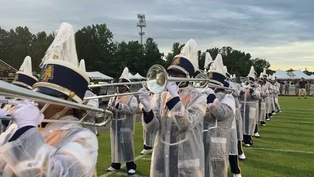
Preview | ECSU Takes Flight & the Aggie-Eagle Classic
Video has Closed Captions
Preview: S38 Ep3 | 30s | A look at Elizabeth City State University’s aviation program and the Aggie-Eagle Classic. (30s)
Providing Support for PBS.org
Learn Moreabout PBS online sponsorship
- News and Public Affairs

Top journalists deliver compelling original analysis of the hour's headlines.

- News and Public Affairs

FRONTLINE is investigative journalism that questions, explains and changes our world.











Support for PBS provided by:
Black Issues Forum is a local public television program presented by PBS NC