
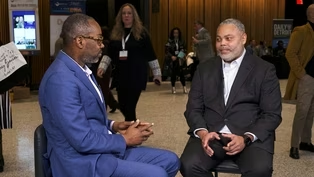
Discussing the outlook for small businesses with Mark S. Lee, president and CEO of The LEE Group
Clip: Season 54 Episode 9 | 11m 3sVideo has Closed Captions
Mark S. Lee also speaks to the unique economic challenges faced by African American entrepreneurs.
American Black Journal examines the outlook for small businesses in 2026. Host Stephen Henderson sits down with integrated marketing consultant Mark S. Lee, president and CEO of The LEE Group, to talk about how small business owners can plan for the rest of the year amid ongoing challenges such as inflation, tariffs and labor shortages. Lee stresses it isn't time to sit still.
Problems playing video? | Closed Captioning Feedback
Problems playing video? | Closed Captioning Feedback
American Black Journal is a local public television program presented by Detroit PBS
Discussing the outlook for small businesses with Mark S. Lee, president and CEO of The LEE Group
Clip: Season 54 Episode 9 | 11m 3sVideo has Closed Captions
American Black Journal examines the outlook for small businesses in 2026. Host Stephen Henderson sits down with integrated marketing consultant Mark S. Lee, president and CEO of The LEE Group, to talk about how small business owners can plan for the rest of the year amid ongoing challenges such as inflation, tariffs and labor shortages. Lee stresses it isn't time to sit still.
Problems playing video? | Closed Captioning Feedback
How to Watch American Black Journal
American Black Journal is available to stream on pbs.org and the free PBS App, available on iPhone, Apple TV, Android TV, Android smartphones, Amazon Fire TV, Amazon Fire Tablet, Roku, Samsung Smart TV, and Vizio.
Providing Support for PBS.org
Learn Moreabout PBS online sponsorship- Welcome to "American Black Journal."
I'm Stephen Henderson, your host.
We're three months into 2026, and small businesses are cautiously planning for the rest of the year.
Inflation, tariffs, labor shortage.
They are all still creating challenges for small business owners, but are there opportunities for growth?
Joining me now to talk about the outlook for small businesses in 2026 is Mark Lee, president and CEO of the Lee Group.
Mark, welcome back to "American Black Journal."
We do this - Good to see you.
- every year.
- Every year.
- I think this is the first time in a long time we've done it in person.
- I think you're right.
- We've been doing this on Zoom now.
- You're exactly right.
- So it's good to see you in person.
- Good to see you as well.
- All right, so let's start with where we are in 2026.
I think, you know, as a small business owner, a very small business owner, things are worse than I imagine that they would be at this point.
I think a lot of people, even if you were not politically aligned with the Trump administration, I think a lot of us felt like, well, maybe the economy will do well under this, and that'll be a silver lining.
I'm still looking for the silver, I guess.
(chuckles) - I think a lot of people are still looking for the silver lining.
- It's been pretty rough.
- Yeah, it's been pretty cloudy.
- Yeah.
- And I think that as you talk about, and by the way, any business is not necessarily a small business.
Every business is a major business.
- Right.
(chuckles) There we go.
- I set the record, including yours.
It's tough.
It's tough.
And I think right now I talk to a lot of businesses and what they're experiencing is just this uncertainty.
This uncertainty is very persistent right now.
People are still feeling the effects.
As you mentioned, your opening about tariffs, high costs, revenue's not increasing.
Revenue, quite frankly, is flat.
Collectively, we look at the trend lines, if you will.
Business confidence is relatively middle of the roads that high, not low in that mid-range range.
So I'm experiencing a lot of, I'm sensing a lot of uncertainty for these businesses.
And they're trying to figure out a, again, navigate these chartered waters.
I think with the President came in office, there was believe or not some optimism in that space.
But now that, you know, several months into his second year of his second term, the optimism has really kind of gone down.
- Yeah, we talk about this each year about how people ought to kind of approach these short term conditions with an eye toward the long term, right?
You don't want to make rash decisions that don't put you in the right position for when things get better.
So let's talk about what some of those things are like, how do you react to the negative numbers that we're all seeing now without overdoing it in a way that doesn't put you in a position to benefit.
- And that's the hard balance right there.
- Yeah.
- And so I think short term, what businesses need to do is to go back and retrench, look at your current plans, look at your current financials.
Make sure that you're on solid ground.
All right?
Look at your revenue projections.
Look at your diversification opportunities.
Can you diversify your income streams?
Don't just sit still.
Now, it's not the time just to sit still.
Work with partners.
Identify larger businesses and other smaller businesses that can become a partner of yours.
'cause right now, the challenge is, if you sit still in this today's economy, we can't predict the future.
We don't know what's gonna happen.
I can also tell you that there's a 30 to 40% chance, according to various economists across the country, that there could be a recession.
- An actual recession.
- Yeah.
An actual recession.
The good news is that's only 30 to 40%, right?
The bad news is that there's an opportunity can still happen.
(Stephen laughing) So you have to continue to navigate those challenges and make sure you go back and retrench and get your foundational principles as well as get your planning, your financials.
- Yeah, you know, the one part of the economy that is doing very well is the stock market.
I mean, investments are doing e extremely well.
Now, most Americans are not participants in the market, but a lot of businesses are, and certainly wealthier individuals are.
But, how do you make or take advantage, I guess, of that part of the economy while also trying to sort of pull up the rear in the sort of core part of your business?
- So let me also want to just say this, that 50% of the American public is not in the stock market, - Not the stock market at all.
- Not at all.
So they're not seeing that benefit of the stock market boom that you're seeing right now.
- Right.
- And I would venture to say that a majority of Black folks, African Americans, are not in the stock market.
- Are not at all.
Yeah.
- So what does that mean?
It means that, so therefore, those who are owning a business may not necessarily have those resources coming in from the stock market.
- Right.
- So the implication is you gottagain, tap into other resources.
So the huge challenge right now is we may not be benefiting from the stock market 'cause we're not playing in it, so to speak.
- Right.
- Whereas the larger white business owners are.
- Right.
- So they could tap into those resources, they might reallocate some of those resources into their business.
So Black business owners can't do that.
So the challenge again is you have to diversify that revenue stream, look at other opportunities to make sure that you can finance and fund your business moving forward.
- Yeah.
Every day I am getting a text message or an email from a bank or some other kind of lender trying to give my business money, trying to say, and I think they're looking at the same things we're looking at.
If revenue's down, costs are up, you might need cash.
But of course, that's a different kind of cash than revenue, right?
You gotta pay it back.
- You gotta pay it back.
- And it's adding to the bottom line.
What kind of council do you give small businesses about a restructure at this point that includes borrowing to get through what, you know, if it's a shorter term, kind of slow down maybe that, that is that bridge that you need.
You know, talk about that versus cost, spending discipline and the other things that you could do.
- That's a great question.
I counsel business owners by saying, look at your financials.
What is your business plan?
What's your long term objective?
So yes, those banks are coming after you right now to try to give you some type of funding, but you wanna be careful.
It's understand there are two types of funding opportunities.
There are quite a few, but two most famous ones, for lack of a better phrase.
One is taking a loan.
So a bank will give you a short term loan, a longer term loan.
The challenge with that is what you have to pay it back.
- Yeah.
- You gotta pay back the interest.
So therefore your cost will go up.
It affects your bottom line.
It affects your revenue and your overall profitability.
There's another opportunity though, a grant, we talked about that before.
- We've talked about that before.
- A grant, you do not have to pay back.
A grant is from an organization that simply provided you with revenue so that you can scale your business.
That you can't address the outstanding challenges.
The only catch is, I just say that respectfully, is that you still have to demonstrate how you're gonna spend that money, what the return is going to be, not necessarily the business return, but what is the grantor getting for the resources they're giving to you.
So to answer your question in a nutshell is look at your financial position.
Look at what your short term and your long term needs are.
Get your costs and make sure you make the decision based on the financial opportunities that you have for yourself and for your business.
- Yeah, you mentioned the differences between African American owned businesses and white businesses earlier in the conversation.
I wanna talk more about what we're seeing with the Black businesses right now with this economy.
How bad is it?
And what kind of things do you think we need to do differently?
Obviously, because we exist in a different space, right now, to deal with the bad economy is not another way to describe it, I think.
- You know, understand that the average Black business owner has less than $10,000 in the bank, and we let that sink in.
That's enough to get you through two weeks of operations.
- Right.
- You know, and a white business owner has significantly more resources.
So what can you do?
Now in an opportunity, leverage technology, leverage AI, right?
There's a lot of discussion about AI and people are nervous about it.
They're a little bit scared of it.
You can leverage AI for your business.
You can get cost efficiencies in terms of, if you integrate AI into your business model.
I have leveraged AI in my business model without spending additional resources.
It has helped me to take me places that've never gone before.
- Huh?
- But again, a lot of small businesses we're afraid of technology.
- I was gonna say, there's a lot of folks who I hear say, "Wow, I don't wanna mess with that AI.
It's not, you know, I don't trust it."
But I feel like the people who are not taking advantage of it are gonna get left behind.
- You gotta embrace it.
- That's a really important message right now.
- That's exactly right.
Right now, you have to figure out how to embrace technology.
Make sure, again, we talked before, embrace your partnerships.
If you have a board advisor, advisors, embrace them.
Now is the time not to be the expert on everything.
You're not.
- Right.
- Now is the, it is the time to leverage your resources that are out there, but leverage technology, leverage those funding opportunities.
Don't just look at the traditional funding opportunities.
Look at additional non-traditional opportunities are out there.
May say, "Mark, what are they?"
I would only say we have a limited amount of time.
- Yeah.
- Make sure you can Google, Just Google traditional or non-traditional funding opportunities for small businesses.
But you gotta begin to think outside the box right now.
- Yeah.
When we think about AI in particular, I feel like people need help just getting introduced to what it's capable of.
And as somebody who is trying to figure out that space too, it's incredible.
I mean, you're drinking from a fire hose.
Can you point people to some resources, people who are just afraid and not sure what to do?
How do they start?
- Start small.
Alright, go ahead and Google any of those AI, artificial intelligence programs out there and just begin to read about it, right?
Start to play around with it.
Remember, understand you might make mistakes, but you wanna start very small.
- Very small.
- Don't start huge.
Don't start large.
That's how I learned about it.
I started playing around with it.
I started typing in key prompts.
I said, oh, this is kind of beneficial.
I relied on other people.
I said, would you educate me?
So number one, start small.
- Yeah.
- Number two, educate yourself.
And number three, begin to implement it very slowly.
Don't come out full throttle because you may not, especially if you're not totally comfortable with that.
You wanna minimize or mitigate that risk.
- Yeah.
Mark, it's always great to see you.
Thanks for being here.
 New
NewWhy Eccalon founder and CEO André Gudger selected Detroit over other cities
Video has Closed Captions
Clip: S54 Ep9 | 5m 44s | American Black Journal talks with the CEO of a high-tech firm that’s expanding to Detroit. (5m 44s)
Providing Support for PBS.org
Learn Moreabout PBS online sponsorship
- News and Public Affairs

Top journalists deliver compelling original analysis of the hour's headlines.

- News and Public Affairs

FRONTLINE is investigative journalism that questions, explains and changes our world.











Support for PBS provided by:
American Black Journal is a local public television program presented by Detroit PBS