
Celebrating 50 Years of the NC Aquariums
Season 24 Episode 3 | 26m 46sVideo has Closed Captions
Celebrate 50 years of the North Carolina Aquariums with a special journey along the coast.
Celebrate 50 years of the North Carolina Aquariums with a special journey along the coast. Meet the people and animals at the heart of their mission, and discover how these beloved destinations inspire conservation and connect visitors with North Carolina’s coastal waters and wildlife.
Problems playing video? | Closed Captioning Feedback
Problems playing video? | Closed Captioning Feedback
North Carolina Weekend is a local public television program presented by PBS NC
Celebrating 50 Years of the NC Aquariums
Season 24 Episode 3 | 26m 46sVideo has Closed Captions
Celebrate 50 years of the North Carolina Aquariums with a special journey along the coast. Meet the people and animals at the heart of their mission, and discover how these beloved destinations inspire conservation and connect visitors with North Carolina’s coastal waters and wildlife.
Problems playing video? | Closed Captioning Feedback
Where to Watch North Carolina Weekend
North Carolina Weekend is available to stream on pbs.org and the PBS app.
Providing Support for PBS.org
Learn Moreabout PBS online sponsorship(upbeat music) - Welcome to North Carolina Weekend!
- Today we're celebrating 50 years of the North Carolina Aquariums with a look behind the scenes at how they inspire visitors and protect our coastal wildlife.
Coming up next.
- Funding for North Carolina Weekend is provided in part by Visit NC, dedicated to highlighting our state's natural scenic beauty, unique history, and diverse cultural attractions.
From the Blue Ridge and the Great Smoky Mountains across the Piedmont to 300 miles of Barrier Island beaches, you're invited to experience all the adventure and charm our state has to offer.
(upbeat music) ♪ - For 50 years, the North Carolina Aquariums have helped generations of visitors discover what lies beneath and beyond our state's coastal waters.
It all began in 1976 with three marine resource centers, places for research, education, and a closer look at North Carolina's aquatic life.
In 2011, Jennette's Pier in Nags Head joined the aquarium system, adding a distinctive fourth destination.
- They were conceived as opportunities to allow the residents of North Carolina to have access to the marine resources of our state.
Bottom line, people come to the aquariums to have a great family experience, to make memories, but it's much deeper than that.
So our role, our responsibility is to create those incredible experiences, but then also to make sure that we're hopefully creating a connection between those guests and the thousands of animals that are in our facilities and under our care.
- Today, we're going behind the scenes to see those connections firsthand and meet the dedicated staff whose passion brings the aquarium's mission to life.
We start here on Roanoke Island.
(upbeat music) ♪ For somebody who has never been to this aquarium, how would you describe it?
- So many people come here and they will say to us, "We've been to the Baltimore Aquarium "and it's beautiful and we love it, "but we like the intimacy of your aquarium."
- What do you think gives it that intimate design?
I mean, it does feel cozy.
- I think it's because it has a pathway.
You know, so many aquariums or other attractions you go into, you can go anywhere you want.
Here, you've got a route and you kind of follow that route through the aquarium and it's like you feel like you haven't missed anything.
We try to tell the story from inland marshland out to the ocean.
- Starting with the rivers that feed the Albemarle and Roanoke Sounds, the exhibits move through brackish water habitats and coastal wildlife before reaching the open ocean.
The experience also extends beyond the exhibits with a pollinator garden, a sound side pier, and behind the scenes tours that reveal what goes into caring for the animals here.
I headed above the Graveyard of the Atlantic habitat for a behind the scenes shark feeding.
- Got our feeding station.
So we've got our sand tigers right here and our sand bars over there and we do what's called target feeding.
So those colorful symbols, they can actually see color and they are trained to go to that specific target when it's time for feeding.
- These guys are ready for lunch.
- For sure, yes.
Ready?
One, two, three.
(cheering) - And just next door, visitors can see another side of the aquarium's work, caring for the injured and sick sea turtles at the STAR Center.
- The STAR Center is an acronym that stands for Sea Turtle Assistance and Rehabilitation.
It's a rare opportunity for the guests to come in and see the important rehabilitation work that our veterinarians and our husbandry team do to in essence triage and release turtles back to the wild.
- When a patient first arrives here, it's just like us going to the doctors to figure out what's wrong with us.
So they come in, we take baseline data and we treat them for whatever they might come in for.
- Why did I say 3.8?
- One of the patients the team cared for was a juvenile green sea turtle brought in at the beginning of June.
On the morning we visited, she was being prepared for release.
- All of our patients have to go through like an exit exam.
What we look for is diving and swimming properly.
We're looking at how well they've been eating and gaining weight.
We check their blood work to make sure that everything still looks good and that it's stable.
We essentially want to release them at their best as we see them coming in at their worst.
And then what we do, especially this time of year, we look at water temperature, we look at salinity to kind of make sure that water parameters are healthy for the turtle and that we're releasing them in an area that we know they will do well and thrive.
- With conditions just right, we headed behind the aquarium to watch this turtle return to the wild.
- Are you ready, friend?
(laughing) - It's like proud mom moments 'cause you are bringing them in, you're caring for them, and then you're releasing them at their best.
We're starting school season, so you're sending them off to school and hoping that they do well.
- The green sea turtle was just one of many patients to make it back into the wild.
Some become familiar to visitors who follow their recovery over many months.
- Star Center has had a lot of patients, but our most memorable and probably our largest sea turtle that we've had in goes by the name of Behemoth.
I think when we released him, he was somewhere between 330 to 350 pounds.
We gave him extra snacks to again boost his nutritional status and get his weight back up to a healthy weight.
We released him at Coquina Beach on the public access.
We had probably thousands of people come.
They had been following his story all year.
I think we very much underestimated the impact that he had on guests reading his story on social media and following his recovery.
That release is very memorable for staff as well as guests.
We still have guests talk about them visiting Star Center or going to the release and being able to see him in person.
Sea turtles are a pivotal ocean species.
They let us know when the oceans are healthy.
They let us know when there's something wrong with their environment.
They are integral to oceanic health.
The green sea turtles like we released today, help keep those seagrass beds at bay so that they don't take over.
When you can really interact with the public and they can see conservation at work in person, I think it really hits home more that people are doing good work and you're not just hearing about it in an article, but you're seeing that work in action.
And I think that that just really drives home every conservation message a little bit more.
- Conservation is also woven into the visitor experience with exhibits that help people of all ages connect with the wildlife around them.
- We developed an exhibit here that is right next to our STAR Center that is called Operation Sea Turtle Rescue.
So our goal with that one was, if they walk out of that exhibit knowing one threat to a sea turtle, we've done our job.
- When you think about the mission of the aquarium, what do you wanna see or hear back that people have taken away with them after a visit?
- Deborah, what I wanna hear is that, first of all, they had a great time, obviously, but more than that, I want to know that they walked away with a fun experience that left them with a goal, something that they're gonna change to help the future of marine life and the future of this planet.
(upbeat music) - Along North Carolina's Outer Banks, the Atlantic is more than a backdrop.
It's part of everyday life.
At Jennette's Pier in Nags Head, visitors can experience it firsthand as the ocean itself becomes the classroom.
Mike, what's the name of this aquarium and where are we located?
- Sure, well, you're sitting on the top porch at Jennette's Pier in Nags Head, North Carolina, right on the Atlantic Ocean.
We consider ourselves a marine education center, a platform for ocean research and observing, and of course, a public fishing pier.
Jennette's Pier dates back originally to 1939 and it was in private hands for about 60 years.
- The Aquarium Society purchased the property in 2002, but less than a year later, Hurricane Isabel nearly destroyed the original pier.
In the years that followed, plans took shape for the Jennette's Pier we see today.
- Fishing piers traditionally along the North Carolina Coast were social gathering spots.
So for the last eight decades, people have been coming to some version of Jennette's Pier, meeting with friends, making new friends, talking about things, all while enjoying the beautiful environment.
[waves crashing] - [Dustin] All right, everybody, welcome to family fishing.
- [Mike) Every weekday of the summer, we offer family fishing programs to teach people who have never experienced fishing on the oceanfront how it's done.
We have great instructors.
They make things easy for you.
We provide everything you need, the bait, the rods, the education.
- We can go head out there and get started.
Touch the pelican for good luck.
Flounder, keep it -- - It's always such a family-friendly atmosphere, and the kids just, no matter what we're doing, the kids have a great time.
So they offer so many great programs.
They offer summer camps that our kids do every year.
- Oh, and Calla's got a fish.
- The teachers here are wonderful, the educators.
I mean, there's just so many great things about Jennette's that makes it a part of our community.
- Good job!
I love it!
- Every summer, I usually do two or three camps of these, and it's really fun.
The counselors are really, really nice, and I'm good friends with them.
- Can you touch him?
- It's very exciting.
Fish are really cute in my opinion.
- They are pretty cute.
- Yeah.
- I'm getting something, I think.
I thought I felt it, I got it!
Look, I got a fish!
Dustin, help the girl!
(cheering) He's little, but I got him!
- All right, so we're gonna take him over.
- Oh my goodness.
- So I usually hold towards the belly because it's a little bit spiky up here, you see that?
And then these are circle hooks, so you just kind of rotate them out.
- Do I throw him back in, Dustin?
- Yes, ma'am.
- Okay, I'll be very gentle.
- Just drop him like... - Oh, he talked!
- And that's why they're called pig fish, they oink.
- He did oink!
- What do you like about fishing?
- The excitement you get when you catch a fish, and the relief you get when you drop the fish.
(upbeat music with chatter) - There you go.
- Dustin!
- All right, you can reel yours up, buddy.
I can see you don't have bait.
- There's no bait on this line.
- I lost my bait.
- I'm here.
- Dustin!
- I got another one, Dustin!
No, don't go away!
- I'm right here.
- Dustin!
- I got ya!
- Yes, sir.
Oh, got a double?
- They've got him running now!
Dustin is running!
These fish are biting!
- My girls both love him.
All of the kids love him, and all the other educators, but he's definitely such a bright light here at the aquarium.
- I think any time I get to see a kid catch their first fish, some of these kids don't have access to this, and just getting them to catch their first fish, it's always fun and exciting.
I've been fishing my whole life, and as a kid, that was a way I got to see like new little critters, stuff like that.
Still every day out here, you get to see new stuff.
- There's a shark!
- As part of the North Carolina Aquariums, we're first and foremost a conservation organization.
So you have access to this beautiful natural resource, and what we want to encourage is preserving that natural resource.
So we really focus on ethical angling.
Certain types of hooks, circle hooks used instead of J hooks, 'cause it doesn't injure the fish as much.
Getting it back into the water as quickly as possible, and only taking what you're gonna eat that night, so that those fish can produce more fish, and there's fish for our children and grandchildren going forward.
- Treat it well, treat it like you want to be treated, 'cause we are pulling them out of their environment, and to me, this is environmental education.
It's to understand what's out there.
- That's a really good lesson to learn.
It's not just about your recreation and your enjoyment, but really caring about the environment and wildlife here.
- That's exactly what we hope to instill in everyone that comes to Jennette's Pier.
(gentle music) - One of the biggest things we did recently was we upgraded all of our exterior lighting here at the pier to wildlife-friendly lighting.
What that means is it's amber color, so it doesn't negatively impact the natural behaviors of, for example, sea turtles, bats, birds, insects, and it's actually better for people as well, and it creates a beautiful ambiance.
Generations of families have returned to this place over the last 80 years.
I think that says a lot about it not just being a place to enjoy fishing, but it's a place where people make memories, make lifetime friendships, and come back.
- From the Outer Banks, our journey continues south... ...to North Carolina's Crystal Coast.
We're at the North Carolina Aquarium at Pine Knoll Shores, where there is plenty to discover, from the habitats of the Crystal Coast to some especially playful critters.
This is gonna be fun, come on.
(upbeat music) ♪ What will visitors experience when they come here to the Aquarium at Pine Knoll Shores?
- So we start our visitors off in the Mountain Gallery of the Aquarium here, and what happens is, as you're walking through the Aquarium, it's like you're walking across the whole state from the mountains to the sea.
And so in the Mountain Gallery, you see animals representative of animals you've found in the mountains.
And then in the Piedmont Gallery, which is our next gallery, you'll find animals, mostly aquatic animals that you would also see in the Piedmont areas of the state, including our North American River Otter habitat.
- Oh my goodness, they are so cute.
- Then you'll continue on through the coastal plain, and in the coastal plains, you'll see a lot, some more freshwater fish, some snakes, and then move into what we call our Tidal Waters Gallery, which is where all of our salt marsh and invertebrates are showcased in that gallery.
And then from there, we move into our Ocean Gallery.
And the Ocean Gallery, which is where we are right now, showcases and highlights a lot of the shipwrecks that you would find off the coast of North Carolina.
We dive every day in this habitat, most days.
We do have an amazing dive program with an amazing team of divers.
[upbeat music] - You don't just get to see the sharks here.
You might even get to watch people swimming right alongside them.
- In the Living Shipwreck, we're gonna have educational presentation dives.
That's where we utilize underwater full face mask communications on the diver, and they're gonna talk to an educator out front.
[person in tank speaking] - [Ethan] It's a good way to showcase sharks, you know, that have such a bad reputation of being very vicious animals, very aggressive predators, that they have a soft side as well.
And we get to see that as scuba divers on a regular basis out here off the coast.
But our visitors might not have the chance to see that.
- [Deb] That closer look at life underwater continues in the Future Waters Gallery, where visitors can watch the aquarium's conservation work firsthand.
In the Coral Lab, the team safeguards corals from Florida, preserving their genetic diversity as disease threatens reefs in the wild.
Nearby, baby fish are raised through aquaculture, reducing the need to collect animals from the ocean.
And for some of the animals we met earlier, daily care comes with a playful twist.
I joined keeper Kristen to help make food-filled enrichment for the river otters, giving them a little challenge at snack time.
- Cut it up.
- We've got a nice yellow bell pepper.
- Yep, bell pepper.
I try to give them a lot of crunchy vegetables, especially the carrots.
We want to cut the items so that they fit in the different enrichment items, but it's not too small that it's gonna fall right out.
You don't wanna make it too easy for 'em.
We wanna keep 'em busy.
- Okay.
- Yeah.
Yeah, like bigger pieces like this.
- Okay, that gets the ticket.
We got a lot of work to do here, Kristen.
We gotta fill this one up and this one up.
- After we cut up the veggies, Kristen dropped the snacks on the otter's habitat, and I watched to see if they could find their food.
The otters snack four times a day between their three meals of fish.
Can you get it?
(otters chattering) Here he goes.
He got it!
(Kristen clapping) He got it.
(Kristen laughing) He got a carrot.
- Aw.
- Yes.
He's looking for it, he's looking for it.
He got it, he got it!
(people chattering) How many otters are there?
- So we have three male river otters.
Petey and Rocky are actually brothers, and our third otter's Eno.
Petey has learned from Eno, which is really, really cool to see that Eno used to always do back flips.
And then one day I came in and I saw Petey doing the back flips.
So he's learned from Eno.
- Oh, that's so cute.
- He's like, "Oh, this is kind of fun.
Let me try this out."
- Oh my goodness.
Are you happy?
- What do you enjoy most about working with these little guys?
- They're so cute and playful, and they just, they make me smile.
Just so much fun to watch.
They're so playful, energetic, and they just have a great spirit about them.
(children chattering) A lot of the kids and families, they love seeing their playful nature, and they love seeing them playing with each other.
Petey and Rocky play like they're siblings, and people become connected with them.
(otters chattering) These guys, they were almost extinct in the western part of the state in the 1930s because of over-trapping and water pollution.
They have to have clean water in order to thrive, and we want that to, we want to always have river otters around.
We never want to see that decline again.
- At the southern end of the coast, the North Carolina Aquarium at Fort Fisher is preparing for its next chapter.
While the building undergoes a major expansion, the work of caring for its animals and connecting with the community continues.
(child chattering) I sat down with Fort Fisher director, Joanna Zazzali, to talk about the renovation and how the aquarium's work continues even while its doors are closed.
Joanna, how would you describe the aquarium at Fort Fisher?
- The aquarium has so many different programs, activities, animals, conservation stories to offer to the community.
We are nestled on 22 acres, beautiful land, salt marshes, just outside of Wilmington, right next to the Atlantic Ocean and the Cape Fear River.
- You're undergoing a major renovation.
Tell me about that.
- So we are increasing our square footage by roughly 25,000 square feet.
We are going to have a new sand tiger shark habitat that will be 400,000 gallons.
- The visitors are gonna love that.
- Yes, it's gonna bring our visitors nose to nose with the majestic sand tiger sharks, sand bar sharks, and hundreds of other species of animals.
- During this expansion, the work does not stop.
What's happening behind the scenes here?
- The animals are still here, and our staff still need to be here to take care of them, enrich them, care for them, work with them.
And it's going really well.
You know, our animals are getting used to not having the public here.
We're used to having about a half a million people come through the doors, but then all of a sudden, one day it stopped.
We've noticed since closure that our otters have been a lot more interested in people and things coming up to the windows that they've been missing out on their people watching.
So we had the great idea of getting cardboard cutouts to come dance around for them, and they'll come up to the window and interact with them, and we move them throughout the day.
We have the Friends cast, we have the Big Bang Theory, some presidents, and we have Jason Momoa as Aquaman.
- Right now, while this expansion is happening, people cannot visit Fort Fisher, but there is another place that they can stop through.
- That's correct.
We do have Discovery Bay, located at Independence Mall in Wilmington, and the team here created a kind of mini experience for the public, for the community.
We really wanted to remain engaged.
- Discovery Bay brings a little bit of the aquarium to the heart of Wilmington, with live animal and plant exhibits, hands-on activities, animal ambassador programs, and even a look at careers in science and conservation.
- At the main building, people are intentionally coming to the aquarium.
Here, people stumble upon us, and that has been a gift, in my opinion, because you get to see people so excited about the animals that they maybe never knew they would see in real life.
We have some students coming after school that typically sit out in the mall.
We are hoping to welcome them in with our brand new Career Corner exhibit.
- The exhibit introduces students to a range of careers in aquariums, science, and conservation.
- We all started somewhere, and we want to show maybe those folks in their teens and early 20s that might go to the mall, you can be a part of this, too.
- Staff are the backbone of our organization.
Without the people, we could not be successful.
When a family comes, and they have an experience at one of our habitats, when they talk to one of our staff in a blue shirt, that's a life-changing experience for them.
People remember that for the rest of their lives.
And really, that's the challenge to ourselves, is how do we create more opportunities for those public that want to learn more, that want to find out what is their role in supporting conservation of wildlife.
And that's where we see ourselves moving in the next 10, 20, 50 years.
- Well, that is it for tonight's show.
Exploring North Carolina's aquariums has been absolutely fabulous.
And whether it's your 50th visit or your very first, we hope we've shared something that you can't wait to experience for yourself.
And if you've missed anything in tonight's show, remember you can always watch us again online at pbsnc.org, and you can find all of our stories on our YouTube channel.
Have a great North Carolina weekend, everyone.
(upbeat music) ♪ - Funding for North Carolina Weekend is provided in part by VisitNC, dedicated to highlighting our state's natural scenic beauty, unique history, and diverse cultural attractions.
From the Blue Ridge and the Great Smoky Mountains across the Piedmont to 300 miles of Barrier Island beaches, you're invited to experience all the adventure and charm our state has to offer.
(upbeat music)
 New
NewVideo has Closed Captions
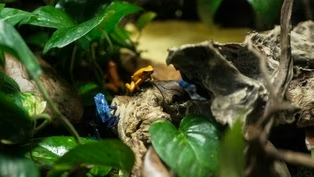
Clip: S24 Ep3 | 4m 32s | Go behind the scenes with the NC Aquarium at Fort Fisher as the facility undergoes renovations. (4m 32s)
 New
NewVideo has Closed Captions
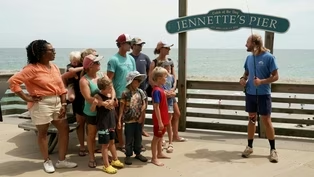
Clip: S24 Ep3 | 6m 16s | Visit Jennette’s Pier in Nags Head, and join Deb for a family fishing adventure on the Outer Banks. (6m 16s)
 New
NewNorth Carolina Aquarium at Pine Knoll Shores
Video has Closed Captions
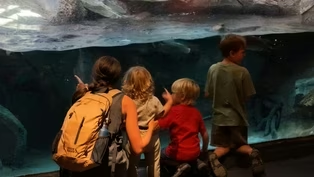
Clip: S24 Ep3 | 5m 51s | Explore the NC Aquarium at Pine Knoll Shores, and join Deb as she creates enrichment for its otters. (5m 51s)
 New
NewNorth Carolina Aquarium on Roanoke Island
Video has Closed Captions
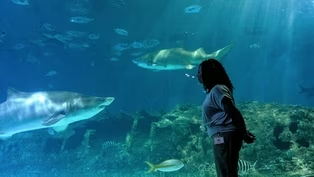
Clip: S24 Ep3 | 7m 32s | Explore the NC Aquarium on Roanoke Island and its work rescuing and rehabilitating sea turtles. (7m 32s)
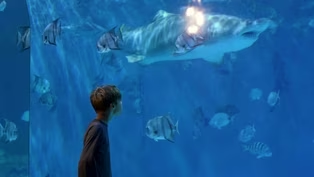
Preview | Celebrating 50 Years of the NC Aquariums
Video has Closed Captions
Preview: S24 Ep3 | 20s | Celebrate 50 years of the North Carolina Aquariums with a special journey along the coast. (20s)
Providing Support for PBS.org
Learn Moreabout PBS online sponsorship











Support for PBS provided by:
North Carolina Weekend is a local public television program presented by PBS NC