
Candidates for NC Court of Appeals Judge Seat 1: John Arrowood (D) & Michael Byrne (R)
Special | 11m 54sVideo has Closed Captions
Meet the Democratic and Republican candidates for the NC Court of Appeals Judge Seat 1.
Candidates John Arrowood (Democrat) and Michael Byrne (Republican) discuss their background and why they’re running for the NC Court of Appeals Judge Seat 1 with PBS NC’s David Hurst. The 2026 NC Judicial Candidates Forum is made possible by a partnership between PBS North Carolina and the North Carolina Bar Association.
Problems playing video? | Closed Captioning Feedback
Problems playing video? | Closed Captioning Feedback
State Lines is a local public television program presented by PBS NC
Candidates for NC Court of Appeals Judge Seat 1: John Arrowood (D) & Michael Byrne (R)
Special | 11m 54sVideo has Closed Captions
Candidates John Arrowood (Democrat) and Michael Byrne (Republican) discuss their background and why they’re running for the NC Court of Appeals Judge Seat 1 with PBS NC’s David Hurst. The 2026 NC Judicial Candidates Forum is made possible by a partnership between PBS North Carolina and the North Carolina Bar Association.
Problems playing video? | Closed Captioning Feedback
Where to Watch State Lines
State Lines is available to stream on pbs.org and the PBS app.
Providing Support for PBS.org
Learn Moreabout PBS online sponsorshipMore from This Collection
During major election cycles, PBS North Carolina's public affairs team sits down for in-depth conversations with candidates running for elected office in North Carolina. PBS North Carolina has invited major party candidates to a one-on-one interview with State Lines host and executive producer Kelly McCullen. Interviews are scheduled throughout the summer and early fall.
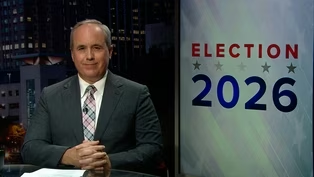
NC Judicial Candidates Forum: NC Court of Appeals Judge Seats 2 & 3
Video has Closed Captions
Meet candidates for the NC Court of Appeals Judge Seats 2 and 3. (26m 46s)
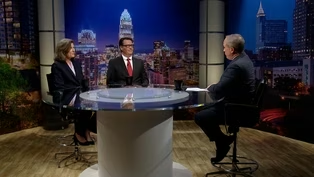
Candidates for NC Court of Appeals Judge Seat 3: Craig Collins (R) & Christine Marie Walczyk (D)
Video has Closed Captions
Meet the Republican and Democratic candidates for the NC Court of Appeals Judge Seat 3. (13m 7s)
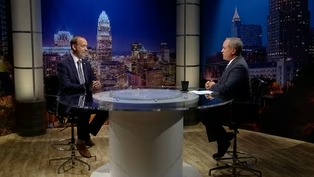
Candidate for NC Court of Appeals Judge Seat 2: Tobias Hampson (D)
Video has Closed Captions
Meet the Democratic candidate for the NC Court of Appeals Judge Seat 2. (12m 57s)
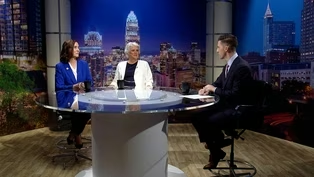
Candidates for NC Supreme Court Associate Justice Seat 1: Anita Earls (D) & Sarah Stevens (R)
Video has Closed Captions
Meet the Democratic and Republican candidates for the NC Supreme Court Associate Justice Seat 1. (12m 38s)
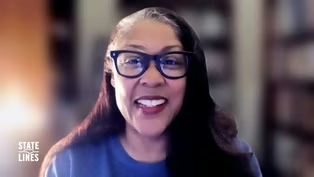
Kimberly Hardy, Democratic Candidate for NC’s 7th Congressional District
Video has Closed Captions
An interview with Kimberly Hardy, Democratic candidate for NC’s 7th Congressional District (2026). (14m 16s)
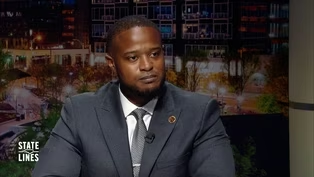
Cyril Jefferson, Democratic Candidate for NC’s 6th Congressional District
Video has Closed Captions
An interview with Cyril Jefferson, Democratic candidate for NC’s 6th Congressional District (2026). (13m 42s)
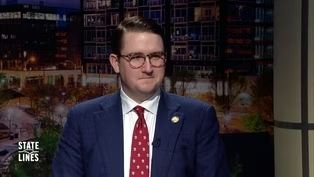
Addison McDowell, Republican Candidate for NC’s 6th Congressional District
Video has Closed Captions
An interview with Addison McDowell, Republican candidate for NC’s 6th Congressional District (2026). (14m 11s)
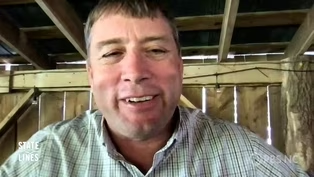
Jamie Ager, Democratic Candidate for NC’s 11th Congressional District
Video has Closed Captions
An interview with Jamie Ager, Democratic candidate for NC’s 11th Congressional District (2026). (14m)
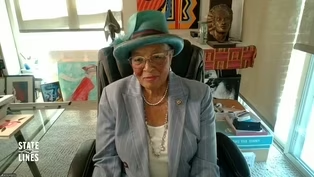
Alma Adams, Democratic Candidate for NC’s 12th Congressional District
Video has Closed Captions
An interview with Alma Adams, Democratic candidate for NC’s 12th Congressional District (2026). (15m 19s)
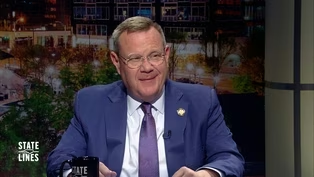
Tim Moore, Republican Candidate for NC’s 14th Congressional District
Video has Closed Captions
An interview with Tim Moore, Republican candidate for NC’s 14th Congressional District (2026). (14m 46s)
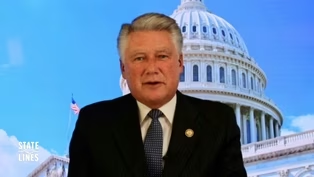
Mark Harris, Republican Candidate for NC’s 8th Congressional District
Video has Closed Captions
An interview with Mark Harris, Republican candidate for NC’s 8th Congressional District (2026). (15m 27s)
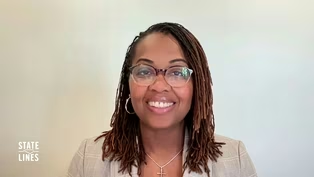
Lakesha Womack, Democratic Candidate for NC’s 14th Congressional District
Video has Closed Captions
An interview with Lakesha Womack, Democratic candidate for NC’s 14th Congressional District (2026). (14m 56s)
Providing Support for PBS.org
Learn Moreabout PBS online sponsorship- The 2026 Judicial Candidates Forum is made possible by a partnership between PBS North Carolina and the North Carolina Bar Association.
♪ - Joining us now are the candidates for North Carolina Court of Appeal seat one, Democratic candidate John Arrowood and Republican candidate Michael Byrne.
Thank you both for being here today.
We appreciate it.
- Thank you.
- Thank you for having me.
- Mr.
Byrne, you won the coin toss.
You decided to defer to the second question, so Mr.
Arrowood, we'll start with you.
What do you say you see as the role of the Court of Appeals?
- Well, having been the incumbent at the Court of Appeals for the past 10 years, what I see as the role of the court is we're an error-correcting court, and the issue is did the trial court err in doing X, Y, or Z in any particular case?
And our job is to see and to apply the law equally and without favor to see if, in fact, the trial court erred and to apply the precedence that we have.
- Mr.
Byrne, same question for you.
What do you see as the role of the court?
- Well, the Court of Appeals does two things.
They review rulings from administrative law judges like me, superior court judges, and district court judges to make sure that we got the law right, as Judge Arrowood used the phrase "error-correcting court," and I think that's fairly accurate.
They make sure that lower court judges don't commit legal error.
The second thing they do I think is equally important is that they review findings of fact to determine whether those facts are supported by the evidence.
That's something particularly important to me because in my job, I'm both fact finder and law finder, so it's equally important when a decision comes up that you can ascertain whether the facts the lower court judge finds are adequately supported by the evidence.
So they do those two things in my view.
- Mr.
Arrowood, what would you say are the two most important qualities for a judge on the Court of Appeals?
- Experience and integrity.
I just think that it's important that you have folks who have real-life experience.
Like I clerked at the court, was a staff attorney, the head of the staff for 25 years.
I was a commercial litigator in Charlotte.
I then was a superior court judge and have been at the Court of Appeals for about 10 years.
So I think experience is really what one needs to have in order to be able to fairly and without favor express the law and do what you need to do to make sure that equal justice is done.
And I think integrity is something that every judge should have and what every citizen should look at in determining whether the judges are fair and impartial.
- Same question to you, Mr.
Byrne, two most important qualities you would say?
- Well, in terms of experience, I think we have to look at a couple of things.
One is what the judge has done and what that judge would bring to the court as it's currently constituted.
In my case, I've been a state administrative law judge for six years.
One of the issues with the Court of Appeals, quite candidly, is getting opinions out.
There's an old saying, justice delayed is justice denied.
And as someone who represented state employees and police for years, waiting on decisions from various courts, that's something I have personal experience with.
As administrative law judge in six years, I've issued over 400 decisions.
All right, something equally important, getting the law right.
10 of those decisions were reviewed by the Court of Appeals.
All 10 were unanimously affirmed.
So I've never been reversed for legal error.
Basically, getting the law right is critical, getting the work out is critical.
And then finally, applying the law without fear or favor.
A judge who applies a partisan bent to a decision is a judge who, in my view, should not be on the bench.
In my job, I hear cases involving agencies that are controlled by Democrats and controlled by Republicans.
And the difference in the way I treat them is nothing, because there's not a Democratic or Republican law, there's just the law.
And the judge is required to apply that accurately, fairly, and without fear or favor.
- Mr.
Arrowwood, what would you say is it about your experience that is most valuable to the Court of Appeals?
- I think what's most valuable to the Court of Appeals is that I've been there for 10 years doing the job, and that I came there with experience, having been a law clerk there, having served on the staff, been a staff attorney there.
And so I know what the court was like, and I believe that I'm able to do the job fairly, equitably, and efficiently, because I would agree that it's important that we have fair decisions and that we have them quickly.
And there are 15 judges on our court.
Two-thirds of them haven't been there for a full term, and a full quarter of them haven't been there for five years.
And I believe that my experience, and you can read my opinions and determine what kind of a judge I am, and so I think that my experience at the court is totally worth keeping.
- What about you, Mr.
Byrne?
What is it about your experience that would be most valuable to the court?
- Well, first, my experience at the Court of Appeals goes back to the 1990s.
That's when I first started arguing cases there.
I was very fortunate to be able to argue personally more than 20 cases in the Court of Appeals and Supreme Court, was an amicus, a friend of the court, and many others, for groups like National Associates of Police Organizations, North Carolina Police Benevolent Association, North Carolina Fraternal Order of Police.
Just parenthetically, I'm the only judicial candidate in this race of either party who is endorsed by those three law enforcement organizations.
But in my case, it's not uncommon for people to have expertise on the appellate level.
In my case, I think I bring a unique diversity of perspective in that I have decades of experience in administrative law.
Administrative law affects every man, woman, and child in this state.
It's very complex.
When a river is polluted, that's administrative law.
When there is deciding who's gonna own or operate a new hospital, that's administrative law.
When making sure teachers and state employees are treated fairly, that's administrative law.
And I've worked on literally thousands.
When you add that I did 270-plus cases as a lawyer there, plus foreign decisions, you were nearly at 1,000 cases where I was applying and working and litigating a very complex but very critical area of law.
So I think that is something I bring to the court of appeals or would bring that is relatively unique and that is very much needed.
- Mr.
Arrowood, what I wanna ask you about what or who's inspired you, who are some of your judicial heroes?
-Well, the judge I clerked for is obviously someone who inspired me, which is Judge Gerald Arnold.
I believe that Ruth Bader Ginsburg was a fabulous Supreme Court justice.
I'm impressed and was impressed with Chief Justice Sarah Parker when she was at the North Carolina Supreme Court.
And not only was I impressed with her abilities to write and her ability to decide cases, but also her ability and her willingness to go out and talk to people and be wherever the folks were.
So all of those qualities are things that I believe are people who I admire and qualities that I try to emulate.
-What about you?
Who, living or past, inspires you?
Who are some of your judicial heroes?
-Well, there are two.
The first is Judge Julian Mann III.
He is an icon of the administrative law world.
He was in charge of our office for 32 years.
He hired me.
He transformed our office into one of the best administrative law panels in the country.
And I got my judicial philosophy from him.
He sat me down when I started, and he looked at me, and he said, "Michael, get the law right."
So he's responsible for that.
The other is, you know, people talk about U.S.
Supreme Court judges and justices.
I'm a North Carolina judge and a North Carolina lawyer.
And my hero is a gentleman named Samuel Ash.
Samuel Ash was on our North Carolina Supreme Court.
And in 1787, he decided a case called Baird v. Singleton.
Very quickly, in 1785, the General Assembly passed a law that denied the right of jury trial to people who had their property forfeited for being loyal to King George III during the Revolutionary War.
And somebody sued to recover their property, and Judge Ash wrote the first opinion in the United States, doing what we call judicial review, looking at a law and finding it unconstitutional.
Our Constitution now and then guarantees the right to jury trial.
And Judge Ash looked at that law and said, "This law denies the right to jury trial, and it simply cannot stand as it conflicts with the Constitution."
Now, what's cool about that is two things.
One, that had never been done before.
That was years before the Supreme Court of the United States did it for the first time in 1803 in Marbury v. Madison.
The second thing is the courage that took.
Can you think of a more unpopular group of people in 1787 than people who were loyal to King George?
But he didn't care.
He said, "Those constitutional rights apply to everyone, and they will be enforced," and I think that's a very courageous act, so he is my judicial hero.
- We've got about two minutes or so left, and this obviously isn't a debate, more of an opportunity for you to connect with potential voters.
So, Mr.
Arrowood, I want to give you about a minute.
I'm going to do the same with you, but a minute of sort of closing arguments, things you want to close with that you would like to tell the potential voters.
- Well, thank you for this opportunity, and I would appreciate the folks' vote on November the 3rd.
I believe that my experience, both real life and on the court as a Superior Court judge, as Court of Appeals judge, makes me uniquely qualified for this job, and I would appreciate all consideration, and folks can learn more about me at KeepJudgeArrowood.com.
- Mr.
Byrne, you've got about a minute or so left.
If you'd like to close us out, we'll give you the final word.
- Very good.
For 25 years, I represented ordinary working North Carolinian state employees and police to people who make our state work and who keep our families safe.
I don't represent rich people or big corporations.
I represent regular folks.
In my job as a judge, I've tried to reflect that in that everybody needs to be treated fairly.
Their case needs to be decided as rapidly as possible.
They need to be heard, and they need to be listened to.
I bring, again, a unique combination of over 30 years of appellate, trial, and judicial experience to this job, and I would be honored to receive the vote of our fellow citizens, and I'm grateful for the chance to talk to you and to them today.
- Well, thank you both for coming down here to the studio and chatting with us today.
We appreciate your time, and best of luck with the rest of the campaign.
Thank you both.
- Thank you.
- Thank you.
- The 2026 Judicial Candidates Forum is made possible by a partnership between PBS North Carolina and the North Carolina Bar Association.
♪
 New Episode
- News and Public Affairs

Top journalists deliver compelling original analysis of the hour's headlines.
 New Episode
- News and Public Affairs

Today's top journalists discuss Washington's current political events and public affairs.

 New Episode
 New Episode
 New Episode
 New Episode



 New Episode

Support for PBS provided by:
State Lines is a local public television program presented by PBS NC