
By Way of the Blue Ridge
Special | 26m 46sVideo has Closed Captions
Explore 10 unforgettable stops along the Blue Ridge Parkway in western North Carolina.
Discover 10 unforgettable experiences along the Blue Ridge Parkway. From motorcycle rides and mountain music to stargazing, forest therapy and breathtaking overlooks, explore the people, traditions and places that make western North Carolina unlike anywhere else.
Problems playing video? | Closed Captioning Feedback
Problems playing video? | Closed Captioning Feedback
Ten to Try is a local public television program presented by PBS NC
By Way of the Blue Ridge
Special | 26m 46sVideo has Closed Captions
Discover 10 unforgettable experiences along the Blue Ridge Parkway. From motorcycle rides and mountain music to stargazing, forest therapy and breathtaking overlooks, explore the people, traditions and places that make western North Carolina unlike anywhere else.
Problems playing video? | Closed Captioning Feedback
Where to Watch Ten to Try
Ten to Try is available to stream on pbs.org and the PBS app.
Related to This Special
[piano intro] - [Announcer] This program is made possible by generous support from Dogwood Health Trust, a private foundation based in Asheville, North Carolina focused on dramatically improving the health and well-being of all people and communities in the 18 counties in Qualla Boundary of western North Carolina.
And produced in association with Blue Ridge National Heritage Area, Incorporated.
[light music] - North Carolina is filled with culture, adventure, and boundless opportunity.
And when it comes to travel, there's something for everyone.
But where do you start?
[people cheering] - All right.
[expansive music] - Well, we have some suggestions.
From PBS North Carolina, this is "Ten to Try: By Way of the Blue Ridge."
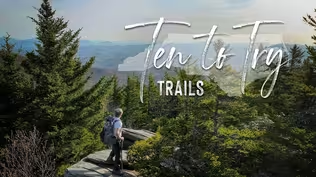
[light guitar music] The Blue Ridge Mountains are among the oldest on Earth, a landscape shaped over millions of years, where rolling peaks, deep forests, winding rivers, and mountain communities stretch across the heart of Appalachia.
Winding through this remarkable region is the Blue Ridge Parkway, a 469-mile ribbon of road connecting Virginia's Shenandoah National Park to North Carolina's Great Smoky Mountains National Park.
On this episode of "Ten to Try," join us as we explore 10 unique stops along the Blue Ridge Parkway, where every turn has something to say about the beauty of these mountains, the experiences they inspire, and the people who call them home.
[light guitar music fades out] [engine revving] [rhythmic guitar music] Started in 1935, the parkway was designed for a slower, more experiential kinda travel.
Where the road reveals itself one turn at a time.
[birds chirping] And for some travelers, the best way to experience it is on two wheels.
[engine revving] Near Little Switzerland, one stretch of mountain road has become legendary.
Known as The Diamondback, this twisting section of Highway 226A draws riders from across the country for one unforgettable ride.
[engines revving] - Blue Ridge Parkway's not just a state or a regional destination.
It is, in fact, a national destination.
[engines revving] Anybody that rides two wheels knows about the nearly 500-mile long ride along the spine of the Blue Ridge.
And if you only get here once in a lifetime, you've done it.
[engines revving] - [Narrator] In just 12 miles, riders tackle more than 190 curves.
[engine revving] Climbing into the Blue Ridge before connecting with the parkway itself.
- In an automobile, you ride through nature.
And you look at it out the windows in your capsule.
But if you're on two wheels, you're in nature.
You smell the smells.
You hear the birds.
[birds chirping] And if it's a particularly nice ride, I hear symphonies.
[engines revving] I hear music when I ride.
[engines revving] - [Narrator] While The Diamondback may challenge riders, the Blue Ridge has a way of giving something back.
- [Bob] When the group gets a rhythm going, it's really pleasant.
You're by yourself, but you are not.
You're in a group at the same time, doing the same thing as other folks who look over at you and with a silly grin, acknowledge that this is about as good as it gets.
[engines revving] How could you not encourage somebody to come and see one of the most extraordinary sights?
It's one of the places you must go.
[rhythmic guitar music fades out] [light music] [text scratching] - [Narrator] At the southern end of the parkway, a generation's old tradition carries on.
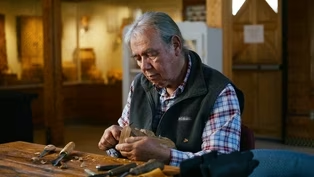
Inside Qualla Arts and Crafts Mutual, artists from the Eastern Band of Cherokee Indians continue practices that stretch back generations.
Here, every piece carries more than a craft.
It tells a story.
- Most of these artists have had families that have taught them this work as they grew up.
So they're continuing a family tradition, as well as preserving and perpetuating a traditional art form and life form that we have used for thousands of years.
[light music continues] I've been blessed in that I've been exposed to artists and people in the community that have nurtured me and gave me advice.
[light music continues] The best advice has been some criticism at times, but it was lessons well learned, coming from people that I respected and admired.
[light music continues] - [Narrator] It's an important cultural connection you can see in motion, touch, and feel, an opportunity to learn, and to take those lessons home.
[bag rustling] - Thank you.
- [Davy] In our pottery and in our wood carvings, we're representing these stories and our metaphors.
So they're relating to the legends that taught lessons to our children.
The artwork is a direct connection to the past, to thousands and thousands of years of culture.
[light music continues] There's only 16,000 Eastern Cherokee.
Only a fraction of those are artists.
So to buy a piece of Cherokee artwork is preserving a way of life.
[light music continues] We're still speaking our language.
We're eating traditional foods.
And so the culture is still strong, and we're endeavoring to persevere.
[light music continues] [light music fades out] [wind whooshing] [text scratching] [gentle music] [water sloshing] - [Narrator] As the summer heat subsides and the crisp fall air spills over the mountains, the Blue Ridge is one of the best places to watch the leaves.
[leaves rustling] And the seasons as they start to change.
[bugs chirping] Just beyond the parkway near Lake Lure, the forests transform, layer by layer, as elevation, temperature, and time work together.
- The Hickory Nut Gorge, which encompasses several little towns from Gerton all the way down through Lake Lure, it has a drastic drop in elevation, which means that our fall color is amazing.
Because it starts up close to 5,000 feet, down to the low 1,200s.
It might be peaking up in Gerton and it's still green down in Lake Lure.
[birds chirping] - [Narrator] With a variety of trails surrounding the lake and nearby Chimney Rock State Park, there's a perfect hike for anyone who wants to surround themselves in fall colors.
[gentle music continues] - [Emily] As soon as you step on that trail, you're disconnecting and reconnecting.
And regardless of if it's here or anywhere else, it's just important for all of us to remember that there's so much you can find in nature that really settles you.
[water rushing] The best place to see fall color is when you're standing on one of the outcroppings looking out.
And so you can look west and see the higher elevations that are maybe at peak, and then look east and see where it hasn't even started to turn yet.
[gentle music continues] [water rushing] When you're out there in the woods, you realize where you fit in.
I think it helps a lot of us find what we've been searching for, which is a little bit more quiet.
[gentle music continues] [birds chirping] People will say, "Oh, I've already hiked that trail.
I've already been to that peak."
It changes every day, so even if you're done it once before, try it again.
[birds chirping] I've worked here 20 years, but I never see the same thing twice.
[gentle music fades out] [light bluegrass music] [text scratching] - [Narrator] Photographs can serve as a reflection of a place in time that we're able to hold onto [camera clicking] long after we've left them.
At Julian Price Park, photographers capture more than a beautiful view.
They turn a moment into something timeless.
[birds chirping] - For me, I think what does make outdoor photography special is the idea of getting out in nature, getting some exercise, connecting with the natural world, and being able to practice some form of creativity.
Getting out before sunrise just allows you to experience the world in a way that a lotta people don't necessarily experience it.
It's a very solitary, meditative experience when you're out there alone with nature.
You get to hear the woods come to life, the mountains come to life.
[water sloshing] [birds chirping] You get to see it wake up with fog and clouds rolling out as the sun comes up.
[birds chirping] It's a chance to just connect one-on-one with nature.
[birds chirping] [camera clicking] I try to make it as immersive as possible, to really try and translate that emotion to other people.
People have told me, "Oh wow, like I actually feel like I'm there."
And that's the best feeling.
[light bluegrass music continues] [ground rustling] And especially where we're at in western North Carolina and at Price Lake, nearby, you have so many opportunities to capture photos.
[camera clicking] There are overlooks, there are waterfalls that are right off the parkway.
There are beautiful vistas that are less than a mile to get to, with views that you're never gonna see really anywhere else on the East Coast.
I think the misconception of nature photography is that you do need expensive, luxurious equipment.
If you have a phone, you have a pretty decent camera in your pocket.
Just go outside and practice.
[birds chirping] [light country music fades out] [gentle music] [text scratching] - [Narrator] The Blue Ridge Parkway can also connect us to places far beyond our reach.
[gentle music continues] At just below 6,000 feet, there's a spot where the night sky feels untouched.
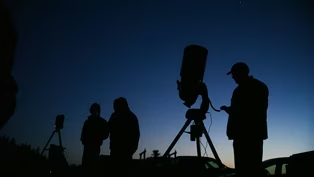
[gentle music continues] [gentle music continues] Waterrock Knob is the highest elevation visitor center on the parkway, making it a prime destination for stargazing.
[gentle music continues] - Places like this are few and far between.
You're looking for a place to get away from sources of city light, and this area, especially at Waterrock Knob, is ideal for that.
[crickets chirping] [gentle music continues] Just getting to a dark sky place opens up so many things that you can never see from many of the places that we live near.
Just with your naked eye, or even binoculars, you can have a fantastic evening just enjoying the experience and the beauty of the night sky.
[gentle music continues] [gentle music continues] - [Narrator] From up here, the distance between earth and sky feels a little shorter as you look back through space and time.
[crickets chirping] - [Tommy] We look at things that are a long ways off.
Sometimes they're 1,000 light-years, sometimes 31 million light-years away.
The scale is beyond our comprehension.
And you kind of get this perspective of how small we are, but we're also very important.
[crickets chirping] [gentle music continues] [gentle music ends] [crickets continue chirping] [bright fiddle music] [birds chirping] - [Narrator] From front porches to festival stages, these mountains have long been home to sounds shaped by migration, memory, and place.
Sounds that carry stories of work, of love, and of life in these hills.
[bright fiddle music fades out] [upbeat bluegrass music] - You learn music from people.
When you introduce a song or tune that you play, you often tell who you learned it from or maybe even where or a little anecdote about that song.
There's a lot of music that is specifically local to this place.
So it's really, I would say music of the people, by the people, for the people.
[upbeat bluegrass music fades out] [text scratching] [people clapping] [rhythmic bluegrass music] - [Narrator] Near the birthplace of the Blue Ridge Parkway at Cumberland Knob, you'll find the Alleghany Jubilee in Sparta, where you can become a part of that tradition.
[rhythmic bluegrass music continues] [feet tapping] [people cheering] - All right.
[gentle bluegrass music] - It's music that the musicians would play one way or another, whether anybody was listening or not.
It's really just the sound of the place.
You know, we hear these birds, we hear the air.
The breezes here and all those things kinda contribute to the way we think about sound and music.
[gentle bluegrass music continues] And so there's always a song somewhere.
[light guitar music] ♪ I worked for the ridge ♪ ♪ I've danced with the poor ♪ - [Narrator] With mentorships and programs devoted to training the next generation of Blue Ridge musicians, the tradition continues to grow, evolve, and endure.
- [Brandon] You have all these powerful forms coming together to create one thing.
There's African American music, Cherokee music, gospel music.
I think it's the fact that there were lots of types of people here in this place and brought these different traditions together.
♪ How long can one ♪ - [Brandon] Music is celebrated in so many ways throughout the Blue Ridge.
♪ I've been taught ♪ - I mean, how can you not be inspired to do something beautiful when you're in place like this?
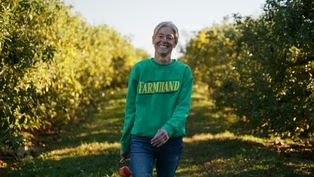
♪ How long can man endure ♪ [birds chirping] [light music] [text scratching] - [Narrator] Near Hendersonville, rows of apple trees stretch across the hillside, filled with fruit, waiting for the right moment to be plucked from the branch.
- So we're in Henderson County in western North Carolina.
Best place in the world, I believe.
A great place to farm, it really is.
[light music continues] [birds chirping] - [Narrator] North Carolina is one of the country's top apple-producing states.
Here, the harvest is more than a task.
It's a tradition.
[light music continues] - [Danielle] My grandfather started farming this land in the early 1960s.
Started out with my grandmother and her mother, with baskets in the trunk of the car.
In 1969, they started offering pick-your-own apples.
[tractor whirring] Families have been coming here for generations as well.
Grandparents with their children and their grandchildren who've been coming here for 30, 40, 50 years.
To be a part of folks' memories, that is just very gratifying for us.
[tractor whirring] [light music continues] - [Narrator] A day in the orchard offers a taste or North Carolina agriculture and tradition.
[light music continues] [birds chirping] - There's just something special about picking an apple off the tree.
An apple off the tree just tastes better than an apple out of the grocery store.
I'm just gonna be honest with you.
[light music continues] [birds chirping] Being farmers and being stewards of this land is just who we are as a family.
And that's what we're sharing with the people who visit our farm.
[light music fades out] [bright music] [water sloshing] [birds calling] [bees buzzing] - [Narrator] For those seeking a more curated, accessible experience just off the parkway, the North Carolina Arboretum presents an alternative way to immerse yourself in the natural world.
Here, landscapes are shaped with intention, with gardens designed to highlight both native species and global traditions.
- So we're here in springtime in the southern Appalachians, the Blue Ridge Mountains, and it's just popping.
The variety of trees is just huge.
So with that comes all the other plants, right?
The wildflowers, the shrubs, the grasses.
It's a very magical place.
[bright music continues] It's just beautiful.
[birds chirping] It's one of the draws of the Blue Ridge Parkway, right, the places you can go off of it.
And this is one of those gems.
It's like having your own garden or your own park that you can come and wander around.
If you wanna sit on a bench and just take in the trees and the sounds and chill, you can do that.
[birds chirping] - [Narrator] It's also home to an outstanding collection of native bonsai.
Rooted right here in the Appalachian landscape, these trees tell the same story as the mountains, just on a smaller scale.
- [David] The arboretum reflects Appalachian culture in that these are the natural trees and plants of this region.
And it was intentionally built in this way to highlight that.
[leaves rustling] And these connections with nature are moments of wonder.
[bright music continues] We settle, we become attentive and present.
Then we also realize that we are part of this garden.
The beauty of the garden reflects back the beauty of ourselves.
[bright music fades out] [birds chirping] [gentle music] [text scratching] [water sloshing] - [Narrator] Time in nature can help reduce stress, improve your mood, and reconnect us to something essential.
[water rushing] The ability to separate from the noise and get into the rhythm of the forest should be accessible to everyone.
According to research, just 17 minutes of daily exposure to nature can create a greater sense of connection to the world around you.
- Many times, when I guide people on a nature and forest therapy walk, we are in wonderful natural settings, but it's not conducive to all populations being able to walk on those trails or move on those trails.
What I'd like to do is just kinda go around, have everybody introduce themselves.
- [Narrator] Along the banks of the Tuckasegee River, the Jackson County Greenway Therapy Trail is the first all-accessible certified forest therapy trail in North Carolina.
[gentle music continues] It's known throughout the country not just for the scenery, but for the feeling people carry with them when they leave.
- This trail makes it possible for basically anybody to come and make a connection with nature.
A lot of people, when they hear of forest bathing, they think you need a swimsuit and a towel.
Actually, forest bathing is just an immersive experience in nature.
It's about slowing down, connecting.
It's about using your senses to notice what is around you.
I invite you to listen for the sounds of this place.
[water sloshing] [wind whooshing] [birds chirping] About five minutes or so after entering a natural space, your brain starts to slow down.
And instead of that to-do list, it starts to notice the patterns and the textures and the colors that surround you.
For me, I feel like I'm home here in the mountains.
And I think a lotta people wanna experience a place that feels like home.
[birds chirping] [gentle music fades out] [bike whirring] [light music] [text scratching] - [Narrator] In Ashe County, one of the oldest rivers in the world quietly cuts through the landscape.
[water sloshing] The New River offers a special connection to the region.
Whether you're sitting on the banks or wading out to cast a line.
- Coming to the Blue Ridge Parkway is amazing.
The Appalachian Mountains are a billion years old.
There's magic in the mountains.
It's interacting with an ancient world in a modern world.
[light music continues] [water rushing] [line whooshing] [birds chirping] - [Narrator] Thanks to cold, oxygen-rich mountain streams, North Carolina is one of the top trout fishing regions in the Southeast.
[water rushing] - The sound of the river, being unplugged, not checking phones.
Fly fishing forces you to pay attention to kinda what's going on there and now.
[birds chirping] Reading the water, figuring out what bugs are around, where trout might be hiding.
- [Sarah] I prefer to fly fish with others.
Having quality time and quiet time together is really special.
There's not a lotta hobbies you can do that.
It's the stories I have about my friends, the deep conversations I've had with my dad and my brother.
Catching a fish, I mean, that's just like the cherry on top, really.
- [Dave] It really just makes you forget everything else.
You could be out here for five hours and it feels like a half-hour.
- Western North Carolina's already a sanctuary, and fly fishing is like the refuge within the sanctuary.
[water rushing] When you get to know the ecosystem on such a deep level, it really deepens your love of the natural world around you.
[water sloshing] I'm like even getting like a little bit emotional talking about it.
[gentle music continues] It is a time to reflect, and it is a time to be grateful for what we have in North Carolina.
[gentle music fades out] [birds chirping] [light music] - [Narrator] Across the Blue Ridge Mountains, there are so many people, places, and moments waiting to be discovered.
On this trip, we've shared 10 experiences by way of the Blue Ridge Parkway, but the journey doesn't end here.
We hope you'll get out and find a few of your own.
Until next time, keep exploring.
[light music continues] [light music fades out] - [Announcer] This program is made possible by generous support from Dogwood Health Trust, a private foundation based in Asheville, North Carolina focused on dramatically improving the health and well-being of all people and communities in the 18 counties in Qualla Boundary of western North Carolina.
And produced in association with Blue Ridge National Heritage Area, Incorporated.
Video has Closed Captions
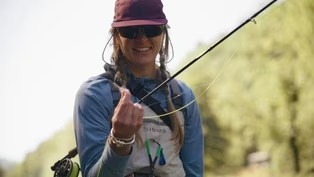
Follow local anglers into the rivers and streams of Ashe County, where fly-fishing is a tradition. (2m 29s)
Video has Closed Captions
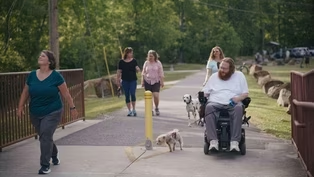
Slow down and reconnect with nature at the Jackson County Greenway in Sylva. (2m 33s)
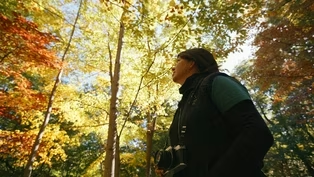
Leaf Peeping at Lake Lure, Rutherford County
Video has Closed Captions
Experience the brilliant fall colors surrounding Lake Lure with naturalist/educator Emily Walker. (2m 15s)
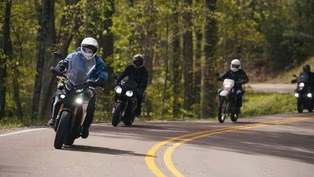
Motorcycling on the Diamondback, Little Switzerland
Video has Closed Captions
A motorcycle ride in Little Switzerland reveals the beauty and rhythm of the Blue Ridge Mountains. (2m 31s)
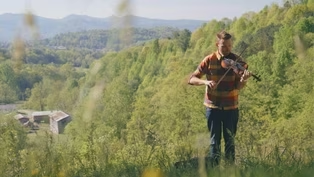
The Mountains Are Alive with Music
Video has Closed Captions
Explore the traditions of Appalachian music with the people keeping the sounds alive. (2m 36s)
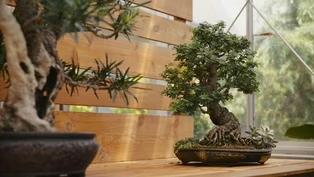
The North Carolina Arboretum, Asheville
Video has Closed Captions
Explore the North Carolina Arboretum in Asheville with local resident and photographer David Huff. (2m 19s)
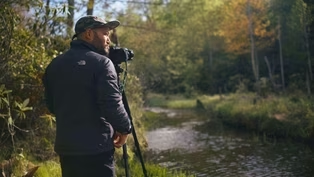
Outdoor Photography at Price Lake, Blowing Rock
Video has Closed Captions
Photographer Ricardo Tejeda finds inspiration in the beauty of Price Lake in Blowing Rock. (2m 26s)
Preview | By Way of the Blue Ridge
Video has Closed Captions
Preview 10 unforgettable stops along the Blue Ridge Parkway in western North Carolina. (30s)
Qualla Arts and Crafts Mutual, Cherokee
Video has Closed Captions
Artists preserve traditions of the Eastern Band of Cherokee Indians at Qualla Arts & Crafts Mutual. (2m 35s)
Stargazing at Waterrock Knob, Haywood & Jackson Counties
Video has Closed Captions
Witness incredible night skies from more than 5,800 feet above sea level at Waterrock Knob. (2m 25s)
Stepp’s Hillcrest Orchard, Hendersonville
Video has Closed Captions
Stepp’s Hillcrest Orchard welcomes visitors with crisp apples, scenic views and family traditions. (2m 10s)
Providing Support for PBS.org
Learn Moreabout PBS online sponsorship












Support for PBS provided by:
Ten to Try is a local public television program presented by PBS NC