
A River on the Brink
Season 2 Episode 6 | 22m 5sVideo has Closed Captions
A writer-photographer duo explores the Rio Grande and threats to its future.
A writer and photographer embark on an epic journey to explore the communities that depend on the Rio Grande and chronicle the threats to its future.
Problems playing video? | Closed Captioning Feedback
Problems playing video? | Closed Captioning Feedback
Production Support Provided By: H-E-B and Texas Parks & Wildlife Foundation
A River on the Brink
Season 2 Episode 6 | 22m 5sVideo has Closed Captions
A writer and photographer embark on an epic journey to explore the communities that depend on the Rio Grande and chronicle the threats to its future.
Problems playing video? | Closed Captioning Feedback
Where to Watch Texas Monthly Presents: The Story
Texas Monthly Presents: The Story is available to stream on pbs.org and the PBS app.
Providing Support for PBS.org
Learn Moreabout PBS online sponsorship- The Rio Grande is dying.
To understand the scale of that crisis, we made the decision to travel the entire length of the Rio Grande.
- [Charlie] They talk about the future wars will be over water.
It's getting close to being a reality.
- [Scott] We're kind of watching and waiting for the next flow of the river.
- [TJ] That's why a lot of this stuff is going away.
- [Luz] Water cannot be wasted.
It's like gold for us.
- [Jack] We're in a new unprecedented zone.
(inspiring music) (inspiring music continues) (keyboard clicking) - This is by far the biggest story I've ever reported, and it's not even close.
And it's because I've never felt like I've been on something that's more important than this.
(intriguing music) When somebody says the Rio Grande, what comes into my head is my family's connection to that river.
Hundreds of years ago, my ancestors crossed the Atlantic to ranch on this river.
It is kind of a hell of a thing to think that I might be the last generation to see the river flowing.
The photojournalist Jordan Vonderhaar and I had spent a lot of time on the border, and we could see just with our own eyes that there was a crisis.
It was just really obvious that something was badly wrong.
Since 2002, the flows have gotten down to 85% diminished.
Runs dry in huge portions.
It frequently fails to reach the Gulf.
All across the Rio Grande Basin, 15 million people depend on the river for their water, and they're at risk of losing that water imminently.
Jordan Vonderhaar and I had the idea for this story.
To understand the scale of that crisis, we made the decision to travel the entire length of the Rio Grande.
On a map, it looks like a blue line from point A to point B. Really quickly, we learned that rivers don't work that way.
It's a fantastically complex system of tributaries and feeder rivers that creates this river from its headwaters in Colorado, all the way down to the Gulf.
The trip just kept expanding because every stop we made, we kept getting more and more scared that so few people, even along the Rio Grande, understand the level of crisis that we are stumbling into.
(solemn music) When you report on immigration, you have an interesting relationship to the Rio Grande.
And the times that I was reporting on the water itself was when people found bodies in it.
And I think that that speaks to how a lot of Texans see the Rio Grande.
It's not a particularly romantic river.
When you think about it, you think of tragedy, danger, and hardship.
Having a partner, having a buddy there was really important, not just for safety, but on the storytelling level, he was able to turn my eyes to a perspective, to stories along the river that I wouldn't have seen if I hadn't traveled with him.
- Without the Rio Grande, we do not have the Texas that we imagine today.
It's the defining line of this state that has really shaped culture for a long time.
- My ancestors, the earliest ancestors to be Texan, or to arrive in Mexico, in Tejas y Coahuila, late 1700s.
And they came specifically to farm the river on both sides of Laredo.
And I think about that, like that's the scale of history, the way that people have depended on this river.
The millions of people who live in Texas and Mexico who depend on the water for their livelihood, this is an extremely agricultural dependent area.
So if that breaks down, people move.
But you could even get to the situation where it's not just the industry that's gone.
It's your drinking water.
And that's not an optional.
You don't look around and make the decision like, "Maybe I'll tough it out."
Like if there's no water, you have to leave.
(poignant music) I wanted to understand the future of the Rio Grande.
And so our first leg of this journey was high up into the headwaters in the mountains of Colorado to understand what is happening to the river before the first human being has even touched it.
What is going on?
What is the situation?
(wind whooshing) And the only way to do that actually was on foot.
This snow right here is becoming the Rio Grande.
This is its furthest origin point.
Up above it, (sighs) there's mountains and more snow.
This is where the river begins.
There is no Rio Grande without the snowpack.
And in a lot of ways, there's no Texas without the snowpack.
Cities like El Paso get less than 10 inches of rainfall a year.
And so there's no way you could support human life on any meaningful scale without the snowmelt that sends billions of gallons of water perennially from Colorado through New Mexico and get to El Paso.
This year was the worst in recorded history for the amount of snow that fell and collected in the San Juans.
That is part of a pattern that has continued for 26 years.
We are in a megadrought, the scale of which we haven't seen for 1,200 years.
The first really major reservoir along the Rio Grande is this reservoir called Elephant Butte, which is near Truth or Consequences, New Mexico.
It is one of the real stunning sights Jordan and I saw as we were following the headwaters down to El Paso, because when we looked at the reservoir, it was under 5% capacity.
(introspective music) Shouldn't be able to drive here.
Should be far, far underwater.
- [Jordan] We should be water underwater.
- When I look on the dashboard, it just showed us in the middle of the blue lake because it thought there'd be water there, but there wasn't.
This drought has lasted for over 20 years, and researchers have started to think about it as something different than a drought.
It's lasted so long.
It's been so intense that the hypothesis now is that this is what's called aridification.
That the climate in this part of the world has changed.
And it's not about waiting out the drought anymore.
It's about adjusting to the fact that this is our reality.
The rains we were used to are not coming back.
(gentle music) El Paso's water utility is unique in that they are the most pessimistic about the future of the river.
And so they've been investing a huge amount in cutting-edge technology to desalinate the groundwater and to recycle water at a level where you can take sewage, clean it, and send it back into the pipes of the drinking water.
This is one of the first places in the world to explore water recycling at that level.
- I look at this water and think, "This is pretty cool."
We're returning this water to the water cycle like rainfall or snowpack.
We're just (whistles) cleaning it and getting it back into our water cycle sooner.
Here in El Paso, we love the Rio Grande, but the Rio Grande, it's very unpredictable how much river water we get each year.
It is a managed flow river because Elephant Butte Reservoir is very low right now and the snowpack has been very dry.
Those combinations lead to having a limited river allocation.
We're kind of watching and waiting for the next flow of the river.
Right now, if you went out there, it's dry.
So we're in El Paso, Texas on the Rio Grande.
The river was shut off last August.
It's had about six months to completely dry out.
A full river season, you get water from March through October, 30 weeks of river water.
This year it may be two months of river water.
So we're expecting a very limited year.
- You know, if there's a bright spot on this whole story, it is El Paso.
This is a real unique desert city.
It's got a large population and gets less than 10 inches of rainfall a year.
And so to support a city of that size, the water utility has had to be at the cutting edge of water conservation and water reuse to make it possible to have people still live there.
(light music) For hundreds of miles between Southern El Paso and Presidio, Texas, the river runs dry for most of the year.
Some people call this the Forgotten Reach.
You can see the river in Laredo and Brownsville and you see water in the river.
Where's that coming from?
Almost all of it is coming from Mexico.
You have the Rio Conchos, this major tributary that runs through Chihuahua, flows north, and enters the Rio Grande around Presidio, Texas.
That is really the origin point of the lower Rio Grande for most of Texas.
But that's changing.
When you've come to the Conchos here, does it basically stay at this level or have you seen it fluctuate over the years?
- Oh, I've seen it, yeah, fluctuate.
I mean, you can see the waterline in the cliff where it's at.
It's been steadily decreasing.
The Rio Grande exists because of the Rio Conchos, not the other way around.
So this has always been the lifeblood, the source of the Rio Grande all the way to Brownsville and Matamoros.
They talk about the future wars will be over water, and you know, it sounds cliche a couple decades ago, but it's getting close to being a reality.
- Rivers are complicated things.
And unlike us, they don't really recognize borders.
And so when the border was established after the Mexican-American War, it immediately started a problem, which is that these are shared waters.
So how do you decide who gets what water?
In the 1940s, in the middle of World War II, diplomats met in D.C., and Mexico and America hammered out a treaty that decides how much water each country gets.
In its most basic sense, the treaty says that the United States will send a large amount of Colorado River water south to Mexico.
And in return, Mexico sends Rio Grande water north from its tributaries.
And so there's a sort of exchange.
And what's changed in the last 20 years when this megadrought hits is Mexico is keeping more and more of that water.
And they don't send the amount of water that they're due in the treaty north to Texas.
They default on this treaty.
Because in Mexico, the farming industry and the municipalities feel like they're at risk of losing that water imminently.
Este, nos han dicho, eso, de que pues Estados Unidos quiere el agua para los agricultores de Texas.
Pero pues dicen los agricultores de aquí "Bueno, ¿pues de dónde les mandamos agua si no tenemos ni para nosotros?"
(tense music) - The story you hear in Texas is that Chihuahua's just full of water and the Rio Conchos is full of water and they're being stingy with it.
And here it's the sense we feel like we're living on the razor's edge and any year we could run out of water.
As we reported, as we traveled all around the Rio Grande Basin, we realized that one story is at the center of everything we were seeing.
And that is what I call the battle of La Boquilla.
La Boquilla is the largest reservoir in Chihuahua.
It is how they can maintain their farming industry.
It's how they get their drinking water.
In 2020, Mexico was under huge pressure from the United States to make up its water debt.
And they opened up the gates of La Boquilla to send that water north.
And what happened next was an explosion.
That entire region of Chihuahua had an uprising.
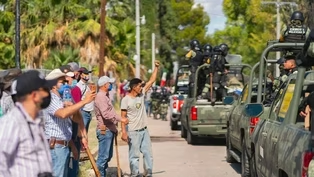
The farmers take over La Boquilla, take over the dam, and they're shutting the gates.
And the water that's flowing north towards Texas stops flowing north.
As one farmer said, "We liberated it."
- Era algo impresionante.
Pues no era algo que estábamos este, que teníamos nosotros planeado en nuestras vidas.
- Yeah.
¿Qué debemos hacer?
Qué debemos entender los Estados Unidos sobre la situación de agua aquí?
- Sí, pues mira, si no estuviéramos en unas condiciones de sequía severa como hemos estado viviendo en los últimos años, pues no estaríamos ni siquiera hablando del tema - O sea, realmente no podemos ir en contra de la naturaleza.
Pues no podemos mandar algo que no tenemos, ¿no?
- Yeah Y no es porque no existe la intención.
Es que no hay.
- This is the whole ballgame.
The municipalities in Mexico, they're not sending water north to Texas.
That has shifted that crisis downstream.
That means that huge swaths of farmland across Texas are not being planted because there's not enough water.
That has been nothing short of devastating.
It has been an apocalypse for Texas farmers, entire industries.
The sugarcane industry, for instance, does not exist in Texas anymore.
And so to understand in farmland how they're feeling this water crisis, I went to talk with the last family-owned citrus farm in the Rio Grande Valley.
- The juice.
The Texas citrus industry has been getting smaller and smaller throughout my career.
It's very sad to see.
There's been a lot of beautiful groves lost to growers that, you know, just decided to hang it up, you know?
Lack of water has a lot to do with that.
You have to have it.
It's not negotiable, and you have to have it when you need it.
Otherwise, you won't produce a crop.
We do get about 22 inches of rain a year, and that's enough to sustain a tree.
But if you want to produce a crop that makes food for the country and makes money for the grower, you have to have a significant volume of water in order to produce it.
That's why a lot of this stuff is going away.
- Farmers are MacGyvers.
Farmers are problem solvers.
Like all the problems that we don't want to solve, they just kind of have to figure it out.
One of the ways the Flowers' farm has been able to survive is they are on the cutting edge of water conservation.
They're using the best way they can to save as much water as possible.
But at the end of the day, it's not enough.
They are at their limit for how much water they can save and keep their business going.
- Water is a very precious resource.
Agricultural producers have to have it.
And if it doesn't rain, then there's always going to be a problem.
- You have these trend lines going in really dangerous directions where farming's increasing, and the amount of water in the Rio Grande is decreasing.
On both sides of the border, agriculture is using too much water.
Farmers are going to have to use less water.
There's not enough water for them.
And they really recognize that we're living in a real state of emergency.
But it wasn't until I actually walked out into the fields with farmers and telling me, "Oh, I've been doing this for five generations since my, you know, great-great-granddaddy came down here and started farming."
It is in those moments you realize the real human stakes.
What it means to give up this form of life on the Rio Grande, which, you know, is even how my family got there hundreds of years ago.
You realize it's not just numbers, it's not just economics, it's not a math equation.
There's something more important going on here.
Because without that water, without big change, they're living at the very end of farming in this part of Texas.
There's not enough water for the people who want it.
And we're getting towards a really scary day where there's not enough water for the people who need it for basic reasons.
(gentle music) I've always, you know, sort of wondered how many Texans know this, that thousands of Texans in this state are already living with water instability, water scarcity, just generally unreliable public infrastructure.
Luz Castillo hasn't had water for 30 years in Texas.
- It's been a long time.
Guess we just got used to it.
- The reason that Luz Castillo has to go without the basic service of running water isn't because there's not enough water in the Rio Grande.
The problem here is a Texan problem.
As we've become one of the richest states, one of the biggest economies in the world, thousands of people like Luz have gone without running water.
And the rest of the state has decided that we're fine with that.
That that's not a crisis.
That's not something we need to solve.
- A lot of people that moved here at La Presa, we were all promised that we were going to get all the services, electrical, water, drain.
But we learned the hard way that it wasn't true.
Hopefully we will be getting running water pretty soon.
And I hope this time our promise is kept because we've been waiting for so long.
So here we are.
- Luz, for decades, has hauled all of the water she uses for drinking, dishes, showering, even flushing her toilet.
She has to haul it with a truck back and forth from her house so she can have water.
- We are very fortunate that we finally have one of these pumps people with no running water can use.
Gonna go get ready to unload it to the other tank.
- In a lot of ways, she is living in the future because the reality she's living in today could be the reality for Texans in the next few years.
- Water cannot be wasted.
It's like gold for us.
It's very precious, so we have to save it and make very good use of it.
Once we start turning on the AC, once it's turned on, it starts dripping water from here.
And then this container, we place it under here.
That water, the dogs drink from it.
We use it to do laundry outside.
We use it to mop.
We use it for so many things.
So we make very good use of any water that we can get out front.
We don't just let it run.
- That is the scariest thing I saw in the colonias like La Presa.
The situation that Texas will tolerate its own citizens going without water.
As I've spent over a year reporting this story, I find it hard to conclude anything other than the fact that Day Zero is imminent in cities across the border.
We're in a new unprecedented zone.
There is not enough water for everyone who wants it and expects it, and indeed owns it.
And I just want to be clear that Texas isn't built on this presumption that we're going to run out of water.
Our legal system, our democratic system, our culture is not prepared for that day.
And I've seen evidence that we should be pessimistic about our government's ability to deal with this crisis when it happens.
And it's my hope that we can solve this problem.
We just have to be a little bit better than we are, just a little bit better than we are, to cooperate out of this crisis, to increase water recycling, to have farmers use less water.
Those are the decisions we have to make and we have to make now.
I think I'm going to choose to be hopeful that we can figure that out.
I want to be clear that we haven't, but I believe we can.
(serene music)
Video has Closed Captions
Preview: S2 Ep6 | 30s | A writer-photographer duo explores the Rio Grande and threats to its future. (30s)
Providing Support for PBS.org
Learn Moreabout PBS online sponsorship








Support for PBS provided by:
Production Support Provided By: H-E-B and Texas Parks & Wildlife Foundation