
Our First Civil War
7/16/2026 | 26m 46sVideo has Closed Captions
In North Carolina, the American Revolution looked more like a civil war.
The American Revolution was North Carolina’s first civil war, with families making difficult decisions on whether to support the patriots or the British crown. Through primary-source evidence, heart-wrenching journal entries and fieldwork with descendants of ancestors who fought on opposite sides, we discover the human cost behind one of history’s most celebrated victories.
Problems playing video? | Closed Captioning Feedback
Problems playing video? | Closed Captioning Feedback
Homegrown History is a local public television program presented by PBS NC
Sponsored in part by SECU Foundation, funded by the members of State Employees’ Credit Union.
Our First Civil War
7/16/2026 | 26m 46sVideo has Closed Captions
The American Revolution was North Carolina’s first civil war, with families making difficult decisions on whether to support the patriots or the British crown. Through primary-source evidence, heart-wrenching journal entries and fieldwork with descendants of ancestors who fought on opposite sides, we discover the human cost behind one of history’s most celebrated victories.
Problems playing video? | Closed Captioning Feedback
Where to Watch Homegrown History
Homegrown History is available to stream on pbs.org and the PBS app.
Related to This Episode
Providing Support for PBS.org
Learn Moreabout PBS online sponsorship- [Announcer] Funding for "Homegrown History" is provided in part by SECU Foundation, funded by the members of State Employees Credit Union and by the Corporation for Public Broadcasting, a private corporation funded by the American people.
[piano intro] - [Narrator] What if the stories of the American Revolution that you grew up with, those neat rows of red and blue, are not what it looked like in your neck of the woods?
In the Carolina backcountry, the war wasn't a distant thing fought by strangers.
It was personal, fought on familiar backroads between people who'd known each other for years and sometimes it was rooted in conflicts that went back further than the Revolution itself.
This is "Homegrown History."
Earlier this year, we heard about a story of two men, both named John, both living in the same stretch of country in North Carolina's Piedmont.
They were neighbors, but they fought on opposite sides.
So we dug into their stories and worked with a group of people who are still piecing them together.
- People suffered on both sides and both sides were at fault in some way.
It just is not as clean as people wanna make.
- [Narrator] From pension records and old deeds, from Facebook groups and family Bibles, and from the documents that ordinary people leave behind, just waiting to be discovered.
And the way their stories intertwine shows why many historians consider the American Revolution to be our country's first civil war.
To understand how neighbors ended up on opposite sides of the American Revolution, you gotta go back a decade to the heart of the North Carolina backcountry and a conflict most people outside this state have never heard of.
- This house here at Alamance Battleground is a great example of how folks here in backcountry North Carolina lived at the time of this battle.
- [Narrator] This is Lisa Cox, a historic interpreter at Alamance Battleground.
10 years before the Revolutionary War, backcountry settlers in this area organized in protests against corrupt Crown-appointed officials.
- Folks started moving here from the north.
They were farm families.
They were moving here for land.
It was affordable and it was available.
Life was going pretty well for 'em until they started having issues with their local officials.
I'm talking about some of the judges, lawyers, clerk of court's office, registered deeds office, the sheriffs.
They were just basically using their offices for their own personal gain.
- [Narrator] Take Colonel Edmund Fanning, who served as Orange County's Register of Deeds.
When he was convicted of charging settlers excessive fees, he was barely punished for it and later promoted.
So these farmers organized.
They called themselves the Regulators and they started with petitions.
- You know, we're not trying to overthrow the government.
We just want accountable and just government.
Keep in mind, these farmers were not against the King, they were not against Parliament, and they were not against the rule of law.
- [Narrator] One of those regulators was a doctor named John Pyle.
He'd come to North Carolina from Pennsylvania around 1766 with his wife and their eight children.
Almost immediately, he got himself in trouble.
We know this because in 1766, John Pyle wrote an apology letter to Colonel Edmund Fanning.
- "Colonel Fanning, whereas I have been active in publishing and spreading a certain piece of writing of a scandalous and defaming nature against thee, for the doing of which I am rely sorry.
Therefore, I have wrote to thee earnestly, begging thy forgiveness, intending if God doth enable me to behave better in the future.
Giving under my hand the 17th of March, 1766, John Pyle, in present of John Carter."
- [Producer] What strikes you about that?
- He's sorry he talked about him, didn't he?
- [Narrator] But Pyle wasn't sorry for long.
Two years later, in 1768, he signed a Regulator petition and was accused of taking part in a confrontation in Hillsborough where about 80 Regulators seized the sheriff, paraded him backwards through town on a confiscated horse, and fired shots into Edmund Fanning's house.
Two years after that, another Hillsborough riot erupted.
Regulators stormed a session of the Superior Court, dragged officials from the courthouse, and publicly beat them.
One of the men beaten that day was a clerk working for the colonial government named John Luttrell.
So here they are a decade before revolution.
John Pyle, the doctor on the side of the Regulators who wanted fair treatment from Crown officials.
And John Luttrell, one of those officials on the receiving end of Regulator rage.
The following year, the Regulators and the colonial militia met at the Battle of Alamance.
The Regulators were crushed.
As a reminder, the Regulators weren't against the Crown, they just wanted change, which helps explain what came next.
When the American Revolution broke out, the new royal governor had actually begun addressing Regulator grievances.
And Pyle, like most Regulators, stayed loyal to the Crown.
But Luttrell, the man who'd been beaten for serving the Crown, took a different path.
In 1776, he took a commission in the Continental Army.
And a few years later, on his own property, he'd build a fortified barracks that became the nerve center of Patriot operations across the Piedmont.
But very few people have ever heard of it.
We may never have connected Luttrell and Pyle if it weren't for a man named Thomas Mattocks and his 20-year long research obsession.
One day, while looking into his own family history, Thomas came across a pension record filed by his relative, Joseph Hackney.
Joseph served under John Luttrell in the Chatham County Militia during the American Revolution and something in this record caught Thomas's eye, a place called Luttrell's Barracks.
Thomas had never heard of such a thing in Chatham County, so he searched an online database of pension applications and got more than 50 hits from Revolutionary War veterans who reported on the barracks.
He decided to find out where they were.
First, he found the deed for John Luttrell's land, which said it was on the lower fork of the Terrell Creek.
Here.
- I started looking at state maps, hoping I could find some map that may possibly show the barracks and I actually did.
It was the 1833 Brazier-MacRae map.
It shows post offices and it says barracks and there's a structure there.
It appeared on several other maps.
That convinced me that Luttrell's Barracks was right there at the Silco Crossroad.
- [Narrator] Thomas also discovered that his relative Joseph Hackney had a personal history with the other character in our story, John Pyle.
In late 1776, Hackney reported arresting Pyle for fighting as a Loyalist in North Carolina's first Revolutionary War battle at Moore's Creek.
After his arrest, Pyle took an oath of loyalty to the state and was allowed to go home.
For the next several years, Pyle stayed out of local fighting, but that was about to change.
Soon, Pyle would raid Luttrell's Barracks.
To understand why, we visit a relative of John Pyle.
We're meeting Ron Osborne on a farm not too far from where John Pyle once farmed.
- This is called the poultry palace, and they're all ready to get out.
Okay, here they come.
- [Narrator] Ron's a genealogist and historic re-enactor, so he knows a thing or two about uniforms, which is good because they're about to play a big part in this story.
- [Ron] Tricorn hat, shoes with a buckle.
A lot of time you can put these on either foot, which not very comfortable at all.
- [Narrator] Four years after Pyle swore that loyalty oath, the war came home.
After the catastrophe at Camden, the British were marching into North Carolina and Loyalists across the Piedmont began organizing.
Pyle picked up where he'd left off.
In the early months of 1781, he raised a militia of several hundred men from the area.
He raided Luttrell's Barracks and sent word to Cornwallis, asking for a military escort to Hillsborough.
But things were about to go terribly wrong for John Pyle.
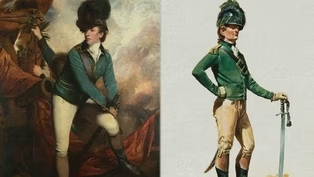
Pyle was marching this militia towards a rendezvous point, where he was supposed to meet Cornwallis' officers whose uniforms looked like this.
- Everything was going just as planned until the American cavalry got intelligence about this rendezvous.
- [Narrator] A highly skilled Patriot cavalry, led by Henry Light Horse Lee, was about to use that intelligence.
- Lee's legion decide to encounter John Pyle in a militia.
Now, what helped the matter from Lee's standpoint is both British cavalry and the American cavalry had uniforms that had green in them.
If you'd never seen one before and you heard that they were coming to rendezvous with you, you might mistake one for the other.
Lee took advantage of that.
John Pyle had his men lined up, heard that, oh, the British cavalry's approaching, you know, to greet us and they're going to escort us into Cornwallis' camp near Hillsborough.
Lee's legion got among all of Loyalists on either side of the road.
They drew their sabers and proceeded to hack them.
- [Narrator] One of the names given to this battle is Pyle's Hacking Match because it was pretty much a one-sided affair.
The Patriots decimated Pyle's Loyalists, which stifled local support of the British.
Pyle himself barely survived.
And according to local tradition, he crawled into a nearby pond and hid until his friends found him badly wounded.
A green jacket could belong to either side.
More than 90 men could die in 10 minutes over the confusion.
That was the nature of this war.
After this massacre, Pyle was broken, but the war wasn't done with him or with John Luttrell.
Their paths were about to cross one final time.
In March, just weeks after Pyle's defeat, the British and Continental Armies clashed at the battle of Guilford Courthouse.
It was technically a British victory, but it cost Cornwallis so many men that he pulled out of the interior.
The big armies left, but in the backcountry, the fighting didn't stop.
In the fall of 1781, the Loyalists pulled off a surprise attack on Hillsborough that no one saw coming.
They captured the Patriot governor of North Carolina and they left town with hundreds of political and military prisoners and headed towards Wilmington, the closest British military installation.
Word spread across the backcountry.
Patriot militia mustered from every direction and Colonel Luttrell and his men rode north from the barracks, heading to intercept the Loyalists and free the governor.
Pyle was back home, not far from where all of this was about to come to a head.
The day after the governor was captured, the Patriots set up an ambush near Lindley's Mill, where the road from Hillsborough crossed the Cane Creek.
Luttrell and his mounted militia were a part of the ambush.
The fighting lasted four hours, but Loyalists fought their way through and escaped with the governor still in their custody.
The Patriots lost and John Luttrell lay dead.
Five weeks later, the British surrendered at Yorktown.
But the former Crown clerk who'd given his life and his land to the Patriot cause didn't live to see it.
When the guns died down, some of the Quakers who were members of this meeting house came out of the woods.
Tradition says they cared for the wounded on both sides and buried the dead.
John Pyle also emerged from his home and onto the battlefield, not as a military commander, but as a doctor and a neighbor, tending the wounded on both sides.
Later, a Patriot commander gave Pyle a letter of recommendation, acknowledging his service that day.
His property was saved from confiscation and he was acquitted of all charges in the Chatham County Court.
And John Pyle lived out the rest of his days as an American citizen.
- When we study the American Revolution, we think it, you know, we think good guys versus bad British, but we don't tend to think about the people.
These were neighbors.
- I just don't think that they get enough credit.
People like John Luttrell rarely mentioned in history books, but I mean, he gave his life for this country.
- It's the same thing back then, it's the same thing today.
We are all in this together and yes, we can say, "Well, that's far off."
And then the next thing you know, you wake up and there's a battle out your front door.
- [Narrator] We don't know for certain where either man is buried and most folks we talk to have never heard of them.
In that way, they're alike, and both represent something essential about the Revolution as it was actually fought in the North Carolina backcountry.
Not by generals or statesmen, but a doctor and a clerk living down the road from each other pulled into a war that turned their own community inside out, pitting neighbor against neighbor.
That terrible reality took us 180 miles west to Rutherford County, where residents of a once divided community wrestled with a dilemma.
If you and your neighbor fought on different sides of a war and he lost, what should happen to him?
What about his family?
246 years ago, in the thick of the American Revolution, a group of Patriots dealt with that question right here in the North Carolina foothills.
They were fresh off the Battle of Kings Mountain, a Patriot victory that Thomas Jefferson said changed the course of the war.
In its aftermath, the Patriots held a trial under torchlight and decided to hang nine of their Loyalist prisoners from an oak tree.
Some were neighbors, some even family.
Why did they do it?
We weren't sure, so we dug deep into local history.
- As unpleasant as it is, it seems to have had its desired effect.
- [Narrator] Into the untold stories kept alive by the descendants of this once divided community.
- People from around here had friends and neighbors and even family that they had issues with.
It's been called the first civil war and I think it's pretty fitting.
- [Narrator] Our first stop is the Genealogical Society of Old Tryon.
- We have all kinds of great materials.
Marriage records, some land records, like on the land grants.
We also have family histories.
- [Narrator] Folks have been working with the Society to find out who their ancestors were since 1973.
Folks like Ricky Toms.
Ricky tells us that, years ago, he discovered that two of his ancestors from this area fought on opposite sides of the Revolutionary War.
- My grandfather [indistinct] Toms, Clara Stock.
- [Narrator] To understand why neighbors ended up on opposite sides, you have to understand what was at stake and how personal the war had become.
After years of stalemate in the north, the British bet everything on the south.
A string of major victories in Charleston, Camden, and Augusta gave them confidence.
A British officer named Major Patrick Ferguson was appointed to train and lead a core of Loyalist militia to secure the region.
One of the men who joined the British cause was Ricky's ancestor, Jonas Bedford.
For months, people in this county had been caught in the middle with both Patriot and Loyalist raids tearing through the area.
Jonas himself had lost 300 cattle to the Patriots.
They threatened to burn his home and take his life.
- They were both raiding and stealing and abusing women and children and everything else.
And once it got started, you know, it was a retribution against a retribution.
- [Narrator] Some men, like Jonas, fled the region, hoping if they were gone, the Patriots would leave their families alone.
For those who stayed, hope came in September 1780 when Ferguson set up a loyalist recruitment headquarters at a nearby settlement called Gilbert Town.
Hundreds joined up.
Ricky Toms thinks he knows why.
- The people that had something wanted to hang onto it, just like they do today, and they wanted to, you know, carry on, hand it down.
They didn't want to lose it.
And probably one of the bigger things was that they were fearful.
And these people, whether they had something or not, but especially those that were more fortunate, they didn't want to take a chance with an upstart... Country upstart bunch of Patriots that was hollering more representation, less taxes, all this stuff, because odds are they wasn't going to make it.
- [Narrator] Ferguson's mission was to secure the western flank for the British.
He warned the Patriots to stop raiding Loyalists and to lay down their arms or he would march on them.
But those threats backfired, provoking over a thousand men to come down from the mountains and foothills to fight.
This Patriot militia became known as the Overmountain Men.
They marched hundreds of miles to find them and clashed with Ferguson's forces at the Battle of Kings Mountain.
The Patriots prevailed.
Ferguson and over 200 Loyalist men were killed, but the biggest setback for the British was that over half of their soldiers were taken prisoner.
It was a decisive Patriot victory and a bloody battle fought almost entirely by colonists, not British-born soldiers.
Almost everyone on both sides was a southerner and, in many cases, a North Carolinian.
The reality was, at the Battle of Kings Mountain, you might run into someone you know on that hilltop and they might be fighting on the opposite side, which is what Ricky Toms said happened to his Patriot ancestor, Captain James Withrow.
- His brother-in-law was a Tory.
And the Tory got wounded during the battle and fell, must have been in pretty bad shape, and he called out to his brother-in-law for help.
And he let him know right quick, said, "Look to your friends for help.
I'm, you know, I'm not, not in that business.
I'm on the other side."
- [Narrator] So what happened after this famous victory?
The showdown of neighbors against neighbors and family against family?
- No one knows for sure where the graves are, but I cannot definitely say, but somewhere in this general area was probably the grave sites.
[solemn music] - [Narrator] We're heading into the woods with Chivous Bradley, a county historian whose ancestor was one of nine Loyalists executed here.
This is the Biggerstaff Plantation.
One week after the Battle of Kings Mountain, a column of weary Patriots transporting hundreds of Loyalist prisoners set up camp here.
They'd marched through horrible conditions.
It was raining, it was cold, food was scarce, men were deserting every night, and it was here where all that bad blood between the colonists reached a tipping point.
Patriot Colonel William Campbell convened a tribunal that accused high-ranking prisoners of robbing, burning houses, and murder.
Once the idea of a tribunal took hold, it snowballed.
The Patriots accused, judged, and sentenced approximately 36 prisoners to death.
One report says a man condemned his own cousin.
Revolutionary War pension records and diaries paint a vivid, bleak picture of what happened that night.
As darkness fell, torches were lit.
The families of the condemned were there, wives and children following the column, hoping their loved ones would be released.
The weather turned and in the gloom of that cold, miserable October night, the hangings began.
The nooses were slipped around the condemned men's necks and they were led to a large oak tree.
A Loyalist prisoner named Uzel Johnson described a tragic scene in his diary.
The daughters of one prisoner sought shelter from the rain after being convinced their dad would be released.
The women had hardly sat down when the news came that he'd been hung.
One report stated Colonel Ambrose Mills asked his own wife to tie a handkerchief over his eyes before his hanging.
Mrs.
Mills also appeared in Uzel Johnson's diary.
This is what he said.
"Mrs.
Mills, with a young child in her arms, sat out all night in the rain with her husband's corpse and not even a blanket to cover her from the inclement weather."
Nine men died that night, some of them just miles from their home.
The next morning, the column marched out, leaving the bodies swinging from the oak tree.
After they left, Martha Biggerstaff and a farmhand cut the bodies down.
Eight were buried in shallow graves on her property.
The ninth was carried by his sons on a plank to a nearby hill for burial.
Chivous can trace his lineage to Ambrose Mills, but he also can trace his lineage to a Loyalist soldier who was tried and spared that night.
- It just reminds me of how fragile relationships are and how that it was brother against brother and neighbor against neighbor in this battle.
- [Narrator] Today, the hanging tree is long gone.
The locals believe it once stood here.
- As we stand beside of this young white oak, there's the possibility that this tree came from an acorn off of the original hanging tree that was just a few feet away from this site, so it's very possible and just gives you something to think about.
The fact that this unpleasant thing happened in Rutherford County, but it was an important thing because while you say that the Battle of Kings Mountain was a turning point, the hanging of these nine Loyalists might have really been the turning point because it discouraged any other local citizens from becoming Loyalist soldiers anymore.
- [Narrator] In 2007, Chivous heard this property was for sale, so he worked with county leaders and private citizens to acquire it.
- [Chivous] I've seen so much development going on, I felt like the public ought to have an opportunity to see this history and it not be destroyed.
- [Narrator] So what happened to this once divided community after the war ended?
That question brought us here to Brittain Presbyterian, the church older than the nation itself.
Our tour guide is Leonard Hutchins, who's been a member here for his whole life.
- After the Revolutionary War, we changed the spelling so it would be separate from England, Britain, and we put the extra T. Just so we would be distinguished that we were no longer part of England or the British.
We were United States.
- [Narrator] Over a dozen Patriot soldiers are buried here, including one who died of his wounds on the march home from Kings Mountain.
The Overmountain Men stopped here to bury him just two days before the hangings at Biggerstaff.
And it's here where we find a headstone for Ricky Toms' Patriot ancestor, James Withrow, the man who oral tradition says refused to help his injured brother-in-law at the Battle of Kings Mountain.
The fate of Ricky's Loyalist ancestor, Jonas Bedford, holds clues to what happened to the folks who were on the losing side after the war.
Many Loyalists lost everything.
Jonas Bedford was one of them.
Jonas escaped after the Battle of Kings Mountain and continued fighting for the British.
After the war, he sailed to England to seek financial restitution for his losses.
His wife, Mercy, stayed behind with their kids and was left nearly destitute.
Five years after Jonas left to fight with Ferguson, Mercy finally got help.
In 1785, the state passed an act for the relief of Mercy Bedford, granting her and the children Jonas's land, the power to sell what remained of his estate, and collect on his debts.
Others left the state entirely, starting over in places where nobody knew which side they'd been on.
And today, many descendants of the Loyalists and Patriots who experienced the violence and change of the Revolution are still here, rooted in the same place, connected to the stories and sacrifices of their ancestors.
- I'm just as proud of... And this is Jonas Bedford, the Tory, and that's James Withrow, the Patriot.
I'm just as proud of one as I am another.
I've got some of both of them in me and they help make me what I am.
I'm not bragging for no, but I mean, I think that's true of everybody.
Everybody can learn and feel close to their ancestors and learn what they went through and appreciate them and appreciate the past and appreciate the present and hopefully pass it down and appreciate the future.
- [Narrator] Do you have a North Carolina history story we should be aware of?
Follow the link below or scan the QR code on your screen to share your story with us.
- [Announcer] Funding for "Homegrown History" is provided in part by SECU Foundation, funded by the members of State Employees Credit Union and by the Corporation for Public Broadcasting, a private corporation funded by the American people.
[piano outro]
Video has Closed Captions
In North Carolina, the American Revolution looked more like a civil war. (20s)
Providing Support for PBS.org
Learn Moreabout PBS online sponsorship










Support for PBS provided by:
Homegrown History is a local public television program presented by PBS NC
Sponsored in part by SECU Foundation, funded by the members of State Employees’ Credit Union.