
Echoes of the Forest & Haywood Ice Fest
5/14/2026 | 26m 46sVideo has Closed Captions
Hurricane Helene-downed trees are reborn as art, and a master carver prepares for Haywood Ice Fest.
Follow two western North Carolina artisans as they carve natural elements. Trees that were downed during Hurricane Helene are reborn as benches, life-size sculpture and functional works of art for the community. Ice sculptor Patrick O’Brien crafts dazzling work for the Haywood Ice Fest.
Problems playing video? | Closed Captioning Feedback
Problems playing video? | Closed Captioning Feedback
Best of Our State is a local public television program presented by PBS NC
Stories of the resilience and recovery of western North Carolina communities impacted by Hurricane Helene are made possible by Dogwood Health Trust.
Echoes of the Forest & Haywood Ice Fest
5/14/2026 | 26m 46sVideo has Closed Captions
Follow two western North Carolina artisans as they carve natural elements. Trees that were downed during Hurricane Helene are reborn as benches, life-size sculpture and functional works of art for the community. Ice sculptor Patrick O’Brien crafts dazzling work for the Haywood Ice Fest.
Problems playing video? | Closed Captioning Feedback
How to Watch Best of Our State
Best of Our State is available to stream on pbs.org and the free PBS App, available on iPhone, Apple TV, Android TV, Android smartphones, Amazon Fire TV, Amazon Fire Tablet, Roku, Samsung Smart TV, LG TV, and Vizio.
Providing Support for PBS.org
Learn Moreabout PBS online sponsorship- [Announcer] This program is made possible in part by generous support from Dogwood Health Trust, a private foundation based in Asheville, North Carolina, focused on dramatically improving the health and wellbeing of all people and communities in the 18 counties and the Qualla Boundary of Western North Carolina.
[gentle music] - Coming up on "Best of our State," after Hurricane Helene, Western North Carolina artists are turning fallen trees into works of healing and hope.
Then we head to the mountains in Haywood County, where winter brings more than a chill to the air.
It brings art to life.
We dip into the treasured stories for a look at all the beauty and character of North Carolina.
Hello, I'm Elizabeth Hudson, editor-in-chief of "Our State Magazine" and your host.
After Hurricane Helene, the forests of Western North Carolina look different.
Through the eyes of artists though, the forest is speaking again in the forms carved from what fell, offering people a place to pause, remember, and start again.
[gentle music] - [Mike] I carve a lot of different wood, but it feels completely different to carve these logs, knowing where they came from.
- [Reporter] The aftermath of Hurricane Helene still inflicting maximum pain on communities in North Carolina.
- [Reporter] One emergency official calls it biblical devastation.
- [Reporter] Some towns have made steady progress in their recovery.
In others, the scars are still visible.
- The sense that I get when I'm doing these sculptures is that I'm bringing happiness and life from a tragedy.
There is a lot of emotion tied up in it, and every single piece I'm doing has a lot of me in it.
Blood, sweat, tears.
If you look at my hands, there's blood in them sculptures too, but [laughs].
[hammer smacks] - There are many levels to this experience of making art with this wood.
Helene was a very impactful time for me and my family.
To turn disaster and tragedy into beauty, to create something that is evocative of the resilience of this Asheville community is very meaningful to me.
- When I tell people about Echoes, just right away they start telling their story about what happened.
It's like a therapy for people.
They just start opening up.
- Buncombe County commissioned this piece to serve as a lasting reminder that we are stronger than any obstacle we face.
- The resilience of the community is one of the reasons why I am just so proud to live in Asheville, and I think that's what sparked me to start Echoes of the Forest.
So this is the tree where it all began, and this is what my husband now calls the troublemaker.
[gentle music] Echoes of the Forest started after Hurricane Helene.
My husband and I were out for a walk and we saw this tree that was mangled and twisted.
I thought it looked like a teapot.
He thought it looked like a rooster.
And got my mind going and thinking, huh, wouldn't it be cool if we could actually create a trail of pieces of art made out of downed trees?
- When Echoes approached me, Liisa said that she wanted to do this project using the salvage wood from the hurricane.
It's like, I'm in.
You're taking something that's otherwise gonna rot or be discarded or burned in a fireplace, and you're making a piece of artwork that's gonna bring smiles to people's faces, you know, or making a memory out of it.
- I watched so many trucks driving around town, collecting trees and debris that fell during the storm, and I just couldn't help but think that a lot of these people have no idea the value of what they have behind their truck.
And so, to have Echoes of the Forest come along and give me the opportunity to create something beautiful with this beautiful log, there's so much beauty and character in it.
I was excited to be able to use it and for it to have all these layers of story behind it.
- We lost almost 40% of our forests up here.
So there's remnants of our forest and the projects that we're doing, these Echoes, hopefully will reflect, but also fill that loss.
[hammer pounds] - My name's Kwadwo Som-Pimpong, and I am a furniture maker in beautiful rural Clyde, North Carolina in the mountains.
My design philosophy has transformed over the years that I've been doing furniture making.
Initially, and I was really influenced by the mid-century modern, Scandinavian, straight lines, simplicity, all of that.
Over the years, I realized that something was missing in my work, and that was my culture.
My family is from Ghana, West Africa, which is a very important part of my upbringing and my life.
That eventually translated into sculptural work, work that incorporates the liveliness, the warmth of the Ghanaian artistry, along with that modern cleanness.
I found out about Echoes of the Forest through a woodworking friend of mine that decided to connect with the founder Liisa.
And eventually I was tapped to make an Echo as well.
This is a white oak log that fell during Hurricane Helene, and it's going to become a bench.
My wife was pregnant with our son and due at any moment when Helene hit.
No cell service, no electricity, no running water, [laughs] and I have pictures of my wife waddling with pieces of wood down to a place we'd found to set up a fire and cook.
Being able to work on a project that ties to our Helene experience feels really special.
So I'm trying to decide right now how much spacing between the seats.
And with something artistic like this, it just, it's a lot of feelings.
If it looks balanced, then I know I'm good to go.
This bench is inspired by a very unique and ancient tradition in Ghana, which is the carving of Ashanti stools.
And the stool has the significance of embodying the spirit of the tribe, the culture, the nation.
Connecting the African American experience to Ghana is very significant because Ghana was the first African nation to gain independence from a European colonizer.
And that process inspired a lot of the civil rights movement that happened here in the United States.
Now, this bench is going right outside of the YMI, which has great significance in African American culture here in Asheville.
There are just many connections there that are very significant.
I look forward to being able to tell my son about how I made a piece that is connected to his birth story.
His name is Dzidzo, which is my wife's language, Ewe in Ghana, and it means joy of the Lord.
And he's the most joyful baby that you will ever meet.
It's amazing for me to reflect on how I get to turn a horrible situation into a joyful experience, which is creating beauty out of the disaster.
[gentle music] [fire crackles] - Where are you from?
- Well, they call me Mountain Mike Ayers.
I live in Maggie Valley, North Carolina, chainsaw carver in the Smoky Mountains.
[saw whirs] [gentle music] As a chainsaw sculptor, I take a really rough tool and make elaborate art with it.
Rustic refined is what I call it most of the time.
15 years ago, my uncle and I had some land and we were building hunting cabins and he says, "I want a bear for my front porch.
Can you carve one?"
I said, "All right, well, I'll try."
So the first bear I carved, carved a five foot bear with no reference and went to go put it on his porch and the neighbor came over and said, "Hey, man, I love that bear.
Can I buy it?"
So I said, "I can make a living doing this."
The project I'm currently working on is called "Soccer Cub."
Cane Creek Park was the yard where they stored all the debris from the county, and if you'd seen the mountain of trash that was there, it's like 50 foot high, like 500 feet long pile of debris.
And they've cleaned all that up and they've put this soccer field park there, so this piece of artwork is gonna be for the grand reopening of this park.
So, I mean, the emotions I'm gonna describe with that, it's just, that's amazing.
So here we have "Soccer Cub."
I've already done the blockout work and the shaping.
So now I'm gonna take, and I'm gonna use the smaller detail saws and we're gonna do the furring texture to make it look like the ruffled coat of a bear.
And then I'm gonna come back and I'm gonna torch off that little bit of fuzz and then sand it, and that's the final steps before it gets sealed and painted.
After the storm, I went through a a dark period where I was like, I don't know what I'm gonna do.
I was looking at different pathways, am I gonna have to move?
And then it was like a sign.
All of a sudden, Echoes was here, and I was like, this is what I want to do with my life.
I want to do art that has a meaning.
And to me, that's the biggest value of it.
And I hope that people see that in each sculpture.
They're like, "This guy's putting a lot of heart into this."
[audience applauds] Hi, guys.
Welcome, welcome.
Thank you guys for coming out.
Liisa approached me about doing projects with Echoes, and at that time I had been affected by the storm too, with a lot of damage and it still gets me emotional with all the stuff that people have gone through in the community.
I'm proud to be a part of this project.
I'm proud to be able to bring light and joy with art.
This storm has brought us all together and shows how amazing our community is and how wonderful the people in the mountains here are.
And I hope you guys keep following the journey of Echoes of the Forest, support us.
They're helping lots of local artists and we're gonna try to bring joy to all the community that we can.
And with that, I want to unveil this project.
I hope you guys like this.
Thank you for coming out.
[audience applauds] - Every time we do an Echo unveiling, we invite the public and the community to come.
- [All] Three, two, one!
[audience applauds] - [Liisa] With the Echoes project specifically, it's all about healing, and a lot of the pieces that are being done are meant to be reflective.
- [Kwadwo] It's very important for people to remember that we need to care for one another, we need to love each other.
And doing public art is a way of really tapping into that humanity and helping us to remember what makes us human.
- I just wanna see the faces, like I like to stand back and see people's expression and see the artwork.
Every time they do an unveiling, just to see everybody's love and the excitement it brings, that's amazing.
And I hope we can keep doing this forever.
I don't know how much salvage timber we'll have from the storm forever, but we'll make it work.
[calm music] - On a frigid weekend in January, Haywood County becomes a place where nature, art, and a little winter magic meet.
We followed a master ice sculptor from his mountain workshop to the sparkling scene of the Haywood Ice Fest in Waynesville, where bundled visitors marveled at ice creations that captured the spirit of the Smokies.
- Ice allows for a temporary art piece that can be expressive and awesome.
It sounds exactly like glass shattering.
[ice crunches] When I get to carve something that came outta my head and seeing it come to fruition, there's an absolute freedom with it.
- Carving ice is this absolutely incredible art form, and so they are the key focal point of the festival.
- There was kids sledding down 'em, we had games, tic-tac toe, there was a corn hole.
- It kind of is a full circle thing where we have this beautiful landscape and we're taking this raw material, you know, water, and turning it into this beautiful sculpture.
And then it's also cool 'cause it just goes away and you get to remember it.
It goes back to nature.
Yep.
[gentle music] My name is Patrick O'Brien.
I own Ice Mill Ice Sculptures and Cocktail Ice, located in Asheville, North Carolina.
Ice Mill does mainly ice sculptures, but we also do fruit, vegetable carving, as well as some pumpkins, bread once in a while, and a little bit of cheese.
First time I did fruit carving, it did come pretty naturally to me.
It was fun.
I enjoyed it.
And my buddy remarked on it, he goes, "You're a fruit ninja!"
I was like, "Yes, I am."
I am the only Irish ninja that many of my friends know.
We realized as a business that fruit carving wasn't gonna support our family.
We saw an opportunity in ice to be able to transition and pick up a new skillset.
Ice sculptures are just sculptures made out of ice.
They're temporary artwork that bring amazing wow factor to events.
I'm thoroughly blessed.
I've been able to do some of the most amazing things and been in crazy places doing what I love to do for different companies, different people.
It's just, it's been a blast.
[laughs] I sell fruit, cut up fruit, and frozen water for a living.
Go figure.
- Hey, Patrick.
- Hey, Corrina.
How are you?
- I'm great, how are you?
- I'm wonderful.
Getting ready for Ice Festival.
- [Corrina] We are super psyched.
- Yes.
The Haywood Ice Fest is North Carolina's largest ice festival.
- Haywood County connects really well with ice because we are what's known as a headwater county, which means 100% of our water originates from within our county.
So we take that water, we turn it into art, and it seems like a really great way to highlight our communities.
How are you doing with all your ice carving in our, I think we have more than 50 sculptures this year if we count the slides and all the big ones as well?
- Yeah, they're going really well.
So this is what we got for Maggie.
This is the order that they're going out on the street.
You know, when we do events, you know, they're on such a large scale, you know, 100, 150, you know, or more blocks of ice.
- I'm getting a block of ice out of the machine.
This is the foundation, this is the, it's the building block.
- [Patrick] It's all hands on deck.
We are trying to do it as coordinated as possible.
- This is one block of one, two, three, three blocks today.
- Producing the ice, carving all the sculptures, getting 'em packaged and ready to go.
Yeah, let's just straighten this up a little bit so that you got a little tight there.
The logo looks good.
You know, Scotsman will get really good representation for their Irish coffee.
It's awesome.
Vince is my production manager.
He is really my right hand man.
He is a lot further ahead of many people that have only been carving about a year and a half, and he's really done very, very well.
I'm very proud of him.
So a lot of our sculptures start off as either something that the client wants to see or something that we suggest.
So we'll go online and find, you know, just inspiration from a picture that I like.
Of course, we have tons and tons of bears around this area, so we gotta have bears represented at the Ice Fest.
We get a concept of what size it's gonna be, the general idea of the sculpture, and then we'll either use a paper template or we'll put it on our CNC machine and make reference lines that will give us the basic drawing, the basic outline of the sculpture.
And then that's when it's, you know, the artistic part of it comes into, you know, making it go from a flat template to an actual three dimensional sculpture.
You know, we can figure out where everything needs to be with the machine, but the shape, the life of the sculpture is done by hand, you know.
And that's the part that is really fun and takes a lot of, dare I say, skill.
So I'm pushing his face back a little bit.
You know, his nose will come out towards you, so I'm gonna push his cheeks back, his eye sockets back a little bit further, and so his nose is more pronounced.
This business is also my passion.
Yeah, I mean, the more you do it, the better you get, and you can do something different with each one.
I got into it because I love to carve and I still do and I still enjoy that.
More control by hand.
You can actually take off more by hand than you ever would with the tools, but the tools give a really nice finish and you can do more detail, I think, with the power tools.
And it kind of brings me back to what I love and gives me the mental break that I need a lot of time.
You know, my favorite thing to tell people, everybody asks, "What's your favorite thing to carve?"
I say, "It's the next one."
I don't care if it's a bear, if it's a swan, whatever, the next thing is always the most entertaining for me.
I get to do what I love and that truly helps me not stress out too much about a lot of things in this world.
Everything is North Carolina about this guy.
Mountain waters of Asheville, North Carolina, making the ice, and of course Pisgah National Forest.
Yeah, this guy screams North Carolina.
Even when I'm having the worst day ever at work, still a pretty good day.
The truck is here.
We are happy.
Now it's load up time.
Right now, we're in really good shape for the festival.
Right here.
Oops.
Sorry.
Today went great.
The production that came out was great.
So over the next three or four days, we will fully pack a 53 foot semi-truck with ice.
Yeah, we've got quite a bit left to do.
[calm music] I'm gonna go straight down.
Watch your toes.
We're getting everything unloaded for the Haywood Ice Festival.
[grunts] There we go.
Everybody's, you know, working together and making it happen.
Just getting a lot of ice off the truck.
It's awesome.
Ice Festival just works in Maggie Valley because it's such a cool area.
It's synonymous with snow and skiing, and then we bring in the ice element.
- We're building a slide.
Sit on a sled and then slide all the way down.
- This is a ice throne for people to sit on and take pictures of.
We're gonna put sculptures all the way down Main Street, different things in front of businesses that have sponsored the sculpture.
- How's it going?
In general.
- It's going great.
We got all the pieces pre-made, which makes it substantially easier.
- Today's gonna be a lot of fun here in Waynesville for the ice block party.
We've got over 25 businesses that have commissioned their own special ice sculpture.
- One thing we really love about being part of this event is getting creative and choosing what type of ice sculpture we're gonna have represent our business.
And when you look around, every business has something unique.
We are beyond impressed.
The amount of work and the amount of detail that they put into it, it's really fun to see, 'cause it's a surprise to us too.
- This year, we did our Mountain Strong, which Mast General Store started after Hurricane Helene last year.
- So we definitely can't wait to see those sculptures up and down Main Street.
- [Speaker] Whatcha working on now?
- I'm working on a big old tree frog sitting on a branch.
- I can't wait to see what the live demo guys do.
Live carving versus production carving is a different animal.
- I am on the clock, so I am just making sure that things are as good as I can get 'em.
- When we're production carving, there is more of you and the ice and you're trying to make the best piece possible or creating the end result.
With live demo, I mean, there's an interaction part of it.
You know, we can talk with people.
- Tell me, people.
How's it going?
- Good.
Good.
Awesome.
- [Group] Welcome to the Ice Fest!
- Some of my favorite moments of the Ice Festivals are watching any age just look in amazement at the ice sculptures.
- Oh, I love it's interactive.
That's so cool.
- What I love most about the Ice Fest is that it really embraces our small town charm, art, creativity.
- Oh my goodness.
- Alright.
Just hold it straight and put this up in their plug.
I love watching the people's reaction.
That's, you know, the biggest enjoyment I get out of it is when people come out and just to enjoy a wonderful day, to have valuable time with their family, playing ice cornhole, riding the ice slides.
"Did you see the Lego man?
Did you see this one?
Did you see the Sasquatch?"
- It just adds to the ambiance, all the snow flying all over the place.
- Yeah, everybody's just oohs and ahs and it's wonderful.
It's snowing, it's wonderful.
The ice loves it.
Everybody's having a great time.
It's great to have a winter ice festival when it's cold.
And that's probably one of the biggest goals we have with this, to make memories.
I am ecstatic.
I think that for what we were up against this week, our team has done a fabulous job.
Wonderful turnout.
People seem to have a really great time.
Can't wait for next year.
- [Speaker] It's an amazing end to a ton of hard work.
- We know it's not gonna last forever.
You know, that sculpture that is long gone and in the river, it's a temporary thing.
You have to experience it and you get that sense of wonder.
You know, you can take that experience on with you.
[gentle music] - When I was six years old, my grandmother and I walked downtown to watch an artist paint a mural in Asheboro.
It was 1976, a bicentennial year, a year of commemoration.
Holding hands, she'd swing our arms, her sterling silver charm bracelet tinkling against our wrists.
I remember everything about that bracelet, how it draped across her hand.
A dozen polished charms dangled off it, each engraved with the name of someone she loved.
Mine was there.
"Elizabeth Ann" written in delicate script.
I liked tracing the charms with my fingers, not yet understanding the permanence of those names etched in silver, proof that we were here, that we existed, that we were loved.
I thought about it recently, walking through Greensboro's Tanger Family Bicentennial Garden, created in that same commemorative year.
Behind the azaleas stands a towering 300 year old American beech covered in carvings.
I sat at its base, tracing the smooth bark and reading the names.
Tracy and Jay, Mark and Trish, Megan and Russell.
Hearts and initials everywhere.
I see these messages all over our state, carved into trees on Asheville trails, scratched into sand on Emerald Isle, painted on the back of boats in Oriental.
Each one, a memorial, proof that someone was here, someone existed, someone was loved.
The bracelet belongs to me now.
It's too small for my wrist, but when I hold it, the charms still clink together and I remember.
[gentle music] [gentle music continues] - [Narrator] More information about "Our State Magazine" is available at ourstate.com or 1-800-948-1409.
- [Announcer] This program is made possible in part by generous support from Dogwood Health Trust, a private foundation based in Asheville, North Carolina, focused on dramatically improving the health and wellbeing of all people and communities in the 18 counties and the Qualla Boundary of Western North Carolina.
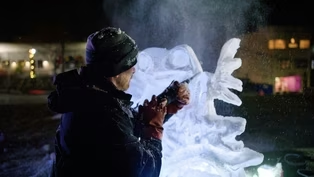
Preview | Echoes of the Forest & Haywood Ice Fest
Video has Closed Captions
Hurricane Helene-downed trees are reborn as art, and a master carver prepares for Haywood Ice Fest. (20s)
Providing Support for PBS.org
Learn Moreabout PBS online sponsorship












Support for PBS provided by:
Best of Our State is a local public television program presented by PBS NC
Stories of the resilience and recovery of western North Carolina communities impacted by Hurricane Helene are made possible by Dogwood Health Trust.